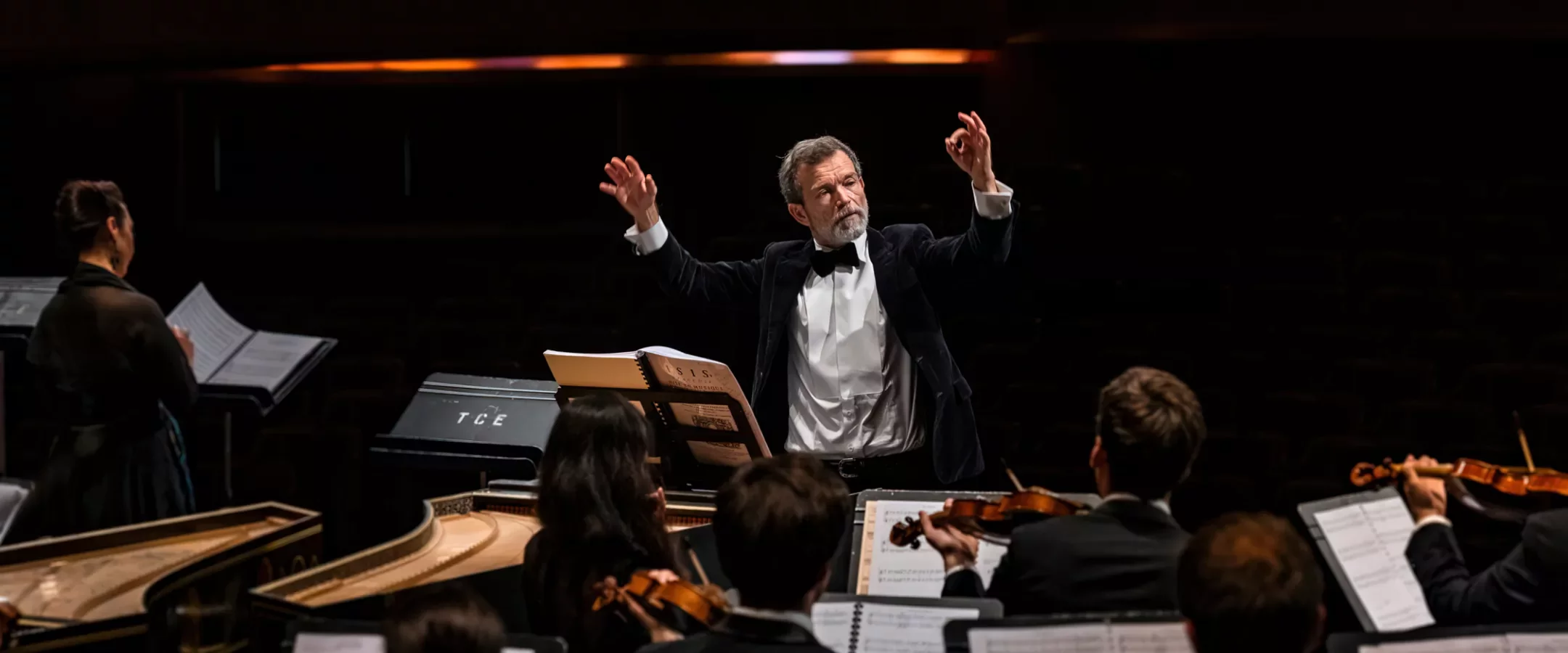
Les Talens Lyriques, Choeur de Chambre de Namur & Christophe Rousset
thésée
A very warm welcome to Klarafestival!
Flanders Festival Brussels, Klara and our partners are delighted to greet you once again. “I believe audiences aren’t just listening. They are actively contributing”, festival artist Barbara Hannigan remarked in an interview. Concerts are an interaction between the audience, artists and anyone who is contributing to those magic moments in front of or behind the scenes. Together we ‘become’ music.
As a conductor and soprano, Hannigan is a global reference point. With her, classical music becomes a contemporary and unique experience. This is an inspiration to Klarafestival as the largest broadcast festival in Belgium. Her versatile talent is sure to enrapture you, as is that of the many Belgian and international artists who connect past and present with musical stories.
Klarafestival opens in style with Hannigan as conductor of the London Symphony Orchestra. After that, you will hear and see her with young musicians from her mentorship project Equilibrium Young Artists. In no fewer than 25 concerts, we present top talent including Les Talens Lyriques, the City of Birmingham Symphony Orchestra with Mirga Gražinytė-Tyla and Vilde Frang, and the St. Louis Symphony Orchestra with Víkingur Ólafsson. Klarafestival also treasures creation. The film concert Reich/Richter as a symbiosis of Gerhard Richter’s paintings and the music of Steve Reich; the creation Counterforces by composer Frederik Croene to text by poet Dominique de Groen; and the music theatre production Prey by Kris Verdonck with a composition by Annelies Van Parys will surprise you!
This and all other concerts are possible thanks to the collaboration with our cultural partners: Bozar, Flagey, Kaaitheater, Théâtre Varia, Muntpunt, Concertgebouw Brugge and DE SINGEL. Thanks to our private partners KPMG, Proximus, Brewery Omer Vander Ghinste, Belfius, Interparking and the players of Belgium’s National Lottery. We are grateful for the support of the Flemish Community and the Brussels Capital Region. And finally, thanks to Klara and VRT: there would be no broadcast festival without their valued collaboration.
Joost Fonteyne
Intendant Klarafestival
Les Talens Lyriques
Chœur de Chambre de Namur
Christophe Rousset, direction
Mathias Vidal, Thésée
Karine Deshayes, Médée
Deborah Cachet, Æglé
Marie Lys, Cleone & une bergère
Bénédicte Tauran, Minerve & La grande prêtresse de Minerve
Thaïs Raï-Westphal, Dorine, une bergère & une divinité
Robert Getchell, un berger & une divinité
Fabien Hyon, un combattant & une divinité
Philippe Estèphe, Egée
Guilhem Worms, Arcas
coproduction by Klarafestival and Bozar
copresentation by De Munt / La Monnaie
broadcast by Klara (live)
presentation by Clara De Decker
Les Talens Lyriques and Christophe Rousset warmly thank Ms Aline Foriel-Destezet for her support of this project.
Jean-Baptiste Lully (1632-1687)
Thésée, tragédie lyrique en cinq actes avec prologue sur un livret de Philippe Quinault (1675)
Acte I
Acte II
Break
Acte III
Acte IV
Acte V
end scheduled at 19:30
In the shadow of Thésée
Medea, from myth to #metoo
“As protagonist, performer, and composer, she would henceforth stand her ground,” I once wrote in a Baroque course. Indeed, the flourishing of music printing, instrument making, and teaching opened new avenues for women to enter public musical life. But they also moved to the foreground in the score. Particularly when it came to the operatic repertoire, composers seized on stories surrounding femmes fatales, powerful matrons, untamed shrews, and other feminine stereotypes to showcase their inventiveness in prancing overtures, voluptuous dances, and bellowing arias. A more deserving subject than Medea could hardly be imagined in that respect. She therefore became the most famous enchantress of the stage in 17th century Europe. However, anyone looking at the source repertories could just read about it. For Medea was often a shadow protagonist, while her male counterpart was the headliner. In 1674, for instance, Médée was staged as a spider in a web of intrigue by Jean-Baptiste Lully and Philippe Quinault – the Lennon and McCartney of French baroque opera. But the title role was for Thésée: the Athenian superhero who added a new chapter to Medea’s compendium of unhappy loves.
From myth to muse
In Greek mythology, Medea was an enchantress who helped Jason, leader of the Argonauts, steal the Golden Fleece from his father Aeëtes. Euripides’ tragedy (431 BC) Medea jumps to a later point, when Jason and Medea flee to Corinth together. There, their folie à deux ends when Jason chooses another woman over her. Medea takes her revenge on him by not only killing her rival and her rival’s father, but also by killing her two sons.
The woman who initially still exuded strength, pride, and self-reliance gets swallowed up in a spiral of disillusionment, jealousy; and revenge: a horror scenario you hardly dare to watch but never get tired of. Medea’s magic power gives her an aura of divinity and untouchability, but she is not entirely detached from the earthly: the driving force behind her actions is raw, unrestrained, all-consuming love. It is precisely this multidimensionality that has made Medea one of the most widely discussed and most often portrayed characters of antiquity.
Theatre becomes tragedy
Jean-Baptiste Lully (1632-1687) translated the Medea narrative into one of the greatest triumphs of his career. As surintendant de la musique for Louis XIV, Lully determined the musical agenda at the French court from the mid-17th century, initially with dance spectacles, then comédie-ballets, and eventually full-blooded operas.
Before that, he and librettist Philippe Quinault (1635-1688) realised a synthesis of classical French tragedy, ballets de cour, and pastorale and Italian operas. The result: the ‘tragédie en musique’ or ‘tragédie lyrique’: a grand, overwhelming, heroic opera. In 1673, the pair of writers staged Cadmus et Hermione: the first of 11 tragédies and the start of a monopoly on a style that would remain incontournable until the middle of the next century.
Recipe for success
Thésée, Lully and Quinault’s third feat, had its premiere on 11 January 1675 at Château de Saint-Germain-en-Laye and would remain in the Opéra’s repertoire for almost a century. It is a typical example of a tragédie en musique: the amorous adventures of mythical characters unfold in five acts, with a minimum of narrative jammers. The exception is the allegorical prologue, in which the gods Mars and Venus – as per tradition – extol the virtues of the Sun King.
The actual plot revolves around Médée (Medea) fleeing her grim past and ending up at the court of King Egée (Aegeus). Theseus wants to marry his pupil, Princess Eglé (Aegle), even though she is in love with Thésée (Theseus), the heroic army captain who freed Athens from the rebels. But Médée also covets Thésée. Using her magical powers, she tries to sway Eglé’s love in her favour – in vain. She then convinces the king that Thésée is a threat to the throne and insists on poisoning him. Everything seems to be going according to plan until the king recognises Thésée’s sword as that of his prodigal son. The assassination plan is dropped and the king grants Thésée the hand of Eglé. An enraged Médée causes disastrous destruction but deus ex machina Minerve (Minerva) restores order. Cléone and Arcas – the respective confidants of Médée and the king – complete the revelry with an ode to love.
At the heart of the opera are recitatives (récits) carefully forged around the French word accent and arias (airs) that are rather short and soberly accompanied. The choir acts as a full pawn in the drama and the generously staffed orchestra (with remarkable percussion parts) is also deployed with its full flow of colours and effects during dramatically intense episodes – like the scenes with Theseus in the first act – and divertissements that provide merveilles throughout the opera.
One (wo)man show
The ‘moved mover’ of all actions, relationships, and transformations is Médée. Libretto and score are therefore entirely at the service of its dramatic clout: Quinault provides Médée with the sophisticated poetry needed to create character depth, while Lully offers currency in the form of catchy arias and extended monologues.
And yet… It is Thésée who ultimately had his name immortalised in the golden duo’s oeuvre list. Operas were now named after their most prominent (male) hero. This was still the case decades later in various adaptations of Quinault’s text, including for Handel’s Teseo (1712) and the Thésées by Jean-Joseph Cassanéa de Mondonville and François-Joseph Gossec.
Their remakes did not make it into the history books. Even Lully’s masterpiece disappeared from view for centuries until it began a renaissance on the stage in the new millennium. Médée/Medea appears to have gained even more layers there in the #metoo era. Indeed, as a woman wriggling out of a victim role and taking control of her own destiny, she accomplishes the ultimate metamorphosis: from hysterical hell-raiser to woman warrior.
Sofie Taes
Mathias Vidal, tenor
Tenor Mathias Vidal studied musicology at the University of Nice and voice at the Paris Conservatory. Praised for his skills in the Baroque repertoire, he has performed in Les Indes galantes (Paris, Munich) and sang the title role in Pygmalion (Houston, Dallas). He has also performed various roles in the French light music repertoire, as well as Italian bel canto roles such as Ernesto/Don Pasquale. In the 20th century and contemporary repertoire, he sang the title role in Zemlinsky's Der Zwerg (Lille and Rennes).
Karine Deshayes, soprano
In 2016, Karine Deshayes was chosen as ‘Lyric Artist of the Year’ at the Victoires de la musique classique for the second time. This mezzo-soprano, acclaimed on the greatest opera stages throughout the world, shines in the Baroque repertoire as well as in operas by Mozart and Rossini and in French melodies. In 2023, she sings La Contessa/Le nozze di Figaro at the Théâtre du Capitole in Toulouse, Adalgisa/Norma at the Staatsoper in Hamburg and Valentine/Les Huguenots at the Opéra de Marseille.
Deborah Cachet, soprano
Deborah Cachet is a Belgian soprano and winner of the 2019 Jardin des Voix. She studied at the LUCA School of Arts, the Conservatory of Amsterdam and perfected her skills with Rosemary Joshua. She has performed with ensembles such as Les Arts Florissants and Le Poème Harmonique and on stages such as the Theater an der Wien in Vienna, the Wigmore Hall in London and the Théâtre des Champs-Élysées in Paris. Her extensive discography includes Lully's recent Acis et Galatée with Les Talens Lyriques conducted by Christophe Rousset (Aparté) and her first solo album with Sophie Vanden Eynde, La Chambre bleue (Passacaille).
Marie Lys, soprano
Swiss soprano Maria Lys studied at the Haute École de Musique de Lausanne and the Royal College of Music in London. She won the International Competition for Baroque Opera Pietro Antonio Cesti in 2018 and the Concours international de Belcanto Vincenzo Bellini in 2017. She has already performed such important roles as Galatée/Acis et Galatée at the Opéra de Massy and Yniold/Pelléas et Mélisande at the Grand Théâtre de Genève. She recently sang Vivaldi's Irene/Il Tamerlano at the Teatro del Giglio in Lucca.
Bénédicte Tauran, soprano
French soprano Bénédicte Tauran studied at the Limoges Conservatory and at the Schola Cantorum Basiliensis. Her young career has already taken her to the Theater an der Wien, the Théâtre des Champs-Élysées and the Freiburger Oper with roles such as Vénus/Psyché, Servilia/La clemenza di Tito and Serpina/La serva padrona. She can also be heard regularly on stage under conductors such as Marek Janowski and Christophe Rousset.
Thaïs Raï-Westphal, soprano
French soprano Thaïs Raï got hold of the opera bug when she sang her first role as an adolescent in Britten's The Beggar's Opera at Montpellier Opera. Meanwhile, she perfected her skills at the Paris Conservatoire. In her early career, she was already allowed to sing in fine productions at the Théâtre des Champs-Élysées, the Église de la Madeleine and the Philharmonie de Paris. She also dedicates herself wholeheartedly to several outreach projects by Les Talens Lyriques.
Robert Getchell, tenor
Robert Getchel studied at the Centre de musique baroque de Versailles and the Conservatory of Amsterdam. A sought-after soloist with Les Talens Lyriques, Le Concert des Nations and the Akademie für Alte Musik Berlin, he has performed such roles as La Furie/Isis, Astophe/Roland, Chamberlin/The Fairy Queen and Ferrando/Così fan tutte. In 2023, he will sing in Bach's St Matthew Passion with Concerto d'Amsterdam and collaborate in projects with Gli Angeli and Les Musiciens de Saint-Julien.
Fabien Hyon, tenor
Fabien Hyon studied at the CNSMDP and the Chapelle Musicale Reine Élisabeth with José Van Dam and Sophie Koch. He is laureate of the Concours international de Gordes and first prize winner of the Grand Prix de Mélodie française of the Concours international de chant de Toulouse. He has already sung at the Théâtre des Champs-Élysées, the Théâtre du Châtelet and the Opéra Royal de Versailles. In 2023, he can be heard with Le Concert Spirituel in Médée by Charpentier and in La Jérusalem délivrée by Régent Philippe d'Orléans with Cappella Mediterranea.
Philippe Estèphe, baritone
The young baritone Philippe Estèphe is currently studying with Lionel Sarrazin. Since his debut at the Opéra Bastide, he has already had the opportunity to perform as Taddeo/L'italiana in Algeri at the opera of Saint-Étienne, and as Aeneas/Dido and Aeneas, Belcore/L'elisir d'amore and Papageno/The Magic Flute with the Opéra Éclaté company. He has also been a guest at major French opera houses in Rennes, Marseille, Paris and Rouen. This season, he sings Aronte and Ubalde/Armide at the Théâtre National de l'Opéra Comique and Mercutio/Roméo et Juliette at the Rouen Opera.
Guilhem Worms, baritone
The French baritone Guilhem Worms studied at the CNSM in Paris and the PESM Bourgogne. He has already performed at the opera houses of Paris, Marseille, Nice, Tours and Bordeaux in roles such as Basilio/Il barbiere di Siviglia, Lord Rochefort/Anna Bolena and Zuniga/Carmen. In 2023, he will perform Le Marquis d'Obigny/La traviata at the Théâtre du Capitole de Toulouse and Mathisen/Le prophète at the Festival d'Aix-en-Provence.
Les Talens Lyriques
Les Talens Lyriques performs a broad vocal and instrumental repertoire from the Baroque to the Romantic era. Their musicological approach combines lesser-known repertoire with some top works. Besides opera, Les Talens Lyriques also explores other musical genres such as the madrigal, the symphony or the motet. The ensemble performs in various instrumentations all over the world.
Les Talens Lyriques is supported by the Ministry of Culture-Drac Île-de-France, the City of Paris and the Cercle des Mécènes. The ensemble thanks its main patrons: the Annenberg Foundation / GRoW - Gregory and Regina Annenberg Weingarten, Ms Aline Foriel-Destezet, and the Société Générale Foundation C'est vous l'avenir. The Ensemble is regularly supported by the Centre National de la Musique for its national and international reputation and its recordings.
Chœur de Chambre de Namur
Since its founding in 1987, the Choeur de Chambre de Namur has defended the musical heritage of its own region (Lassus, Arcadelt, Rogier, Du Mont, etc.), without however losing sight of the great choral repertoire. The choir is a much sought-after guest at Europe's most renowned festivals and has already released numerous recordings. In recent years, the choir has been exploring major works by Händel as well as the world of operetta. Since 2010, its artistic direction has been in the hands of Leonardo García Alarcón.
The Chœur de Chambre de Namur is supported by the Wallonia-Brussels Federation (music and dance department), the National Lottery and the City of Namur. With the support of the Tax Shelter of the Federal Government of Belgium, Inver Tax Shelter and Wallonie Bruxelles International.
Christophe Rousset, conductor
Christophe Rousset studied harpsichord at the Schola Cantorum in Paris and then at the Royal Conservatory of The Hague. In 1991, he founded the prestigious Baroque ensemble Les Talens Lyriques. With this ensemble, he performs in concert and opera houses such as the Concertgebouw Amsterdam, the Théâtre des Champs-Élysées and the Philharmonie in Paris and Wigmore Hall in London. At the same time, he leads an active career as a harpsichordist and chamber musician. His recordings of Couperin, Rameau, D'Anglebert and Scarlatti are references within the Baroque repertoire.
16:30-16:50
Klarafestival LOUNGE
Introduction by Lalina Goddard (EN)
Bozar, Salon Ovale
Introduction by Elsa de Lacerda (FR)
not available
Les Talens Lyriques
dessus de violon I
Gilone Gaubert
Charlotte Grattard
Jean-Marc Haddad
dessus de violon II
Josépha Jégard
Giorgia Simbula
Bérengère Maillard
haute-contre de violon
Pierre-Eric Nimylowycz
Alexandra Delcroix Vulcan
taille de violon
Sarah Brayer-Leschiera
Maya Enokida
quinte de violon
Pierre Vallet
Lucia Peralta
basse de violon
Emmanuel Jacques
Claire Gratton
Julien Hainsworth
Nils De Dinechin
Pablo Garrido
traverso
Jocelyn Daubigney
Stefanie Troffaes
hautbois & flûte à bec
Vincent Blanchard
Jon Olaberria
basson
Josep Casadella
trompette
Jean-François Madeuf
Jean-Daniel Souchon
timbales & percussion
Marie-Ange Petit
continuo
Emmanuel Jacques, basse de violon
André Henrich, luth & guitare
Isabelle Saint-Yves, viole de gambe
Korneel Bernolet, clavecin & orgue
Christophe Rousset, clavecin
Chœur de Chambre de Namur
dessus I
Julie Calbete, Camille Hubert, Amélie Renglet
dessus II
Weil-Lian Huang, Barbara Menier, Zoé Pireaux
haute-contre
Dominique Bonnetain, Marc Scaramozzino, Marcio Soares Holanda, Renaud Tripathi
taille
Maxence Billiemaz, Thibaut Lenaerts, Vincent Mahiat, Samuel Namotte
basse-taille
Pieter Coene, Simon Dubois, Philippe Favette, Sergio Ladu, Jean-Marie Marchal
main partners
Klara, KPMG, Nationale Loterij-meer dan spelen
festival & event partners
Belfius, Brouwerij Omer Vander Ghinste, Interparking, Proximus
public funding
BHG, Nationale Bank van België, Vlaamse Gemeenschap, Vlaamse Gemeenschapscommissie
cultural partners
AB, Bozar, Concertgebouw Brugge, DESINGEL, Flagey, Kaaitheater, Muntpunt, Passa Porta, Théatre Varia
official festival suppliers
Café Costume, Café Victor, Casada, Daniel Ost, Fruit at Work, Greenmobility, Levi Party Rental, Piano’s Maene, Ray & Jules, Thon Hotels
media partners
BRUZZ, BX1, Canvas, Clearchannel, Davidsfonds, De Standaard, Eén, La Libre, La Première, La Trois, MIVB, Musiq3, Radio 1, Ring TV, visit brussels