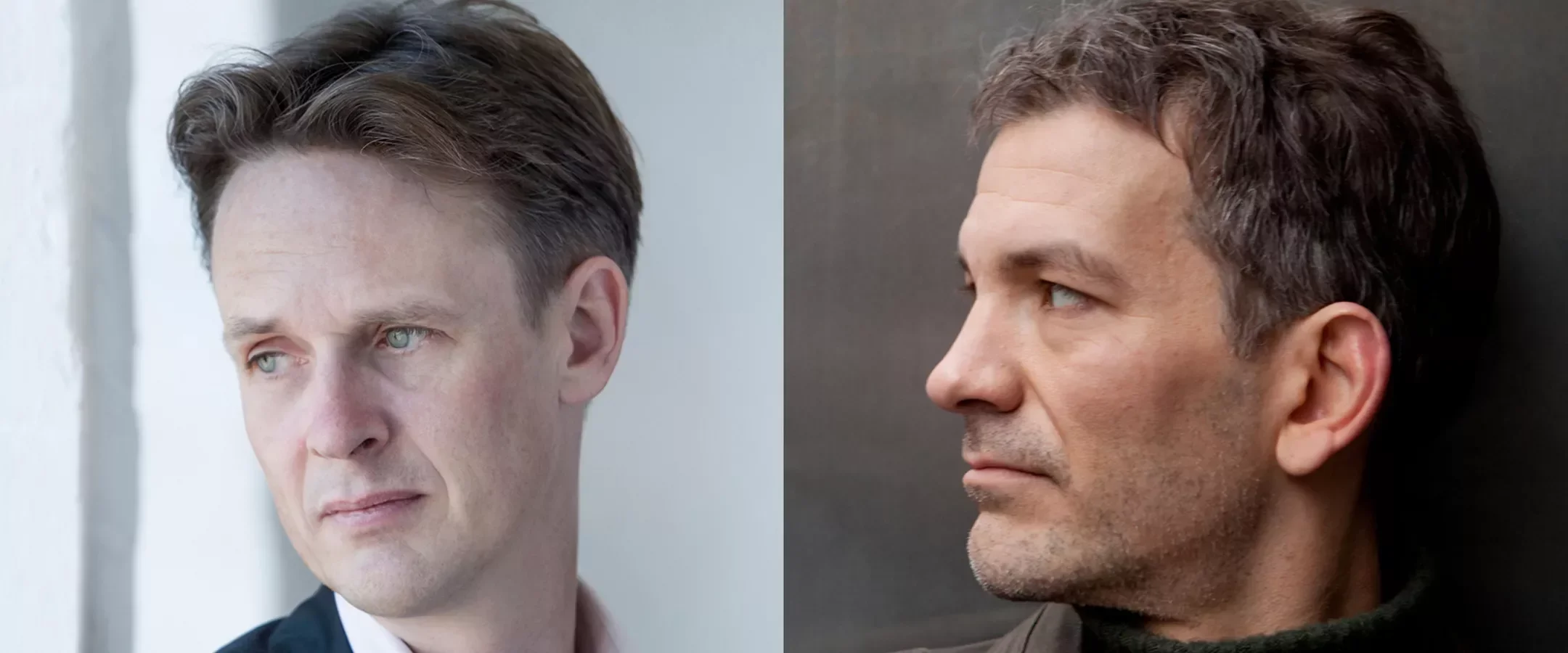
Brad Mehldau & Ian Bostridge
the folly of desire
A very warm welcome to Klarafestival!
Flanders Festival Brussels, Klara and our partners are delighted to greet you once again. “I believe audiences aren’t just listening. They are actively contributing”, festival artist Barbara Hannigan remarked in an interview. Concerts are an interaction between the audience, artists and anyone who is contributing to those magic moments in front of or behind the scenes. Together we ‘become’ music.
As a conductor and soprano, Hannigan is a global reference point. With her, classical music becomes a contemporary and unique experience. This is an inspiration to Klarafestival as the largest broadcast festival in Belgium. Her versatile talent is sure to enrapture you, as is that of the many Belgian and international artists who connect past and present with musical stories.
Klarafestival opens in style with Hannigan as conductor of and soloist with the London Symphony Orchestra. After that, you will hear and see her with young musicians from her mentorship project Equilibrium Young Artists. In no fewer than 25 concerts, we present top talent including Les Talens Lyriques, the City of Birmingham Symphony Orchestra with Mirga Gražinytė-Tyla and Vilde Frang, and the St. Louis Symphony Orchestra with Víkingur Ólafsson. Klarafestival also treasures creation. The film concert Reich/Richter as a symbiosis of Gerhard Richter’s paintings and the music of Steve Reich; the creation Counterforces by composer Frederik Croene to text by poet Dominique de Groen; and the music theatre production Prey by Kris Verdonck with a composition by Annelies Van Parys will surprise you!
This and all other concerts are possible thanks to the collaboration with our cultural partners: Bozar, Flagey, Kaaitheater, Théâtre Varia, Muntpunt, Concertgebouw Brugge and DE SINGEL. Thanks to our private partners KPMG, Proximus, Brewery Omer Vander Ghinste, Belfius, Interparking and the players of Belgium’s National Lottery. We are grateful for the support of the Flemish Community and the Brussels Capital Region. And finally, thanks to Klara and VRT: there would be no broadcast festival without their valued collaboration.
Joost Fonteyne
Intendant Klarafestival
Brad Mehldau, piano
Ian Bostridge, tenor
co-production Klarafestival, Bozar
broadcast on Klara (live)
presentation by Greet Samyn
flowers provided by Daniel Ost
—
Brad Mehldau (°1970)
The Folly of Desire (2019)
- The Sick Rose (William Blake)
- Leda and the Swan (William Butler Yeats)
- Sonnet 147 (William Shakespeare)
- Sonnet 75 (William Shakespeare)
- Über die Verführung von Engeln (Bertolt Brecht)
- Ganymed (Johann Wolfgang von Goethe)
- Ganymede (W.H. Auden)
- the boys i mean are not refined (e.e. cummings)
- Excerpt from Sailing to Byzantium (William Butler Yeats)
- Night II, from “The Four Zoas”, The Wail of Enion (William Blake)
- Lullaby (W.H. Auden)
Robert Schumann (1810-1856)
Dichterliebe, op. 48 (1840)
- Im wunderschönen Monat Mai
- Aus meinen Tränen spriessen
- Die Rose, die Lilie, die Taube, die Sonne
- Wenn ich in deine Augen seh'
- Ich will meine Seele tauchen
- Im Rhein, im heiligen Strome
- Ich grolle nicht, und wenn das Herz auch bricht
- Und wüßten's die Blumen, die kleinen
- Das ist ein Flöten und Geigen
- Hör' ich das Liedchen klingen
- Ein Jüngling liebt ein Mädchen
- Am leuchtenden Sommermorgen
- Ich hab' im Traum geweinet
- Allnächtlich im Traume seh' ich dich
- Aus alten Märchen winkt es
- Die alten, bösen Lieder
Brad Mehldau: A Musical Portrait
In Playing Changes, jazz critic Nate Chinen’s New York Times book on contemporary jazz, he dedicates an entire chapter to Brad Mehldau. It was given the title From This Moment On, in reference to Cole Porter’s famous jazz standard which featured on Mehldau’s 1995 debut on the Warner Bros label. It affirms both how strongly the pianist is rooted in the Great American Songbook and jazz tradition, and his firm intention to bend these traditions to his own will by contemporary means. In fact, his influence is so far-reaching that we could consider there to be a “before Mehldau” and an “after Mehldau” in jazz history.
In the early 1990s, the jazz world was still dominated and shaped by the Young Lions - promising young musicians producing a neoclassical form of jazz in the slipstream of trumpeter Wynton Marsalis’ overwhelming critical acclaim and commercial success. One such wunderkind was alto saxophonist Christopher Hollyday, who was just seven months older than Mehldau but was responsible for both the pianist’s first recording session in 1990 and his first European tour in 1991. Joshua Redman was a musician of greater fame at the time (and would eventually prove to be one of greater longevity as well) and in 1993 decided to form a quartet with Mehldau, bassist Christian McBride and drummer Brian Blade. After moving to New York City, Mehldau soon became a popular sideman, performing with guitarist Peter Bernstein, alto saxophonist Jesse Davis and Miles Davis’ legendary drummer Jimmy Cobb. But it was Mehldau's contribution to Redman’s MoodSwing (Warner Bros.) that first truly caught the attention of the jazz world.
He, too, was signed by Warner Bros. His first release on the label was Introducing Brad Mehldau, an album that clearly established the path Mehldau had mapped out for himself and for the trio that would become the main focus of his creativity over the next few decades. As Chinen notes, the album opens with a penetrating staccato that sounds like someone impatiently knocking at the door to the future. It introduces an unusual variation on Rodgers and Hammerstein’s “It Might As Well Be Spring”, a jazz standard already in the repertoires of legendary singers like Sarah Vaughan, Frank Sinatra and Ella Fitzgerald, and made famous by instrumentalists like pianist Bill Evans and trumpeter Clifford Brown as well. The regular 4/4 pulse – so de rigueur in jazz - was transformed into a penetrating and rhythmically unstable 7/8. Mehldau kept one foot in the jazz piano tradition with a way of playing that was deeply embedded in post-bop, but at the same time developed a new, idiosyncratic dialect of advanced rhythmic adaptations and a seemingly effortless two-handed piano technique. A finely-balanced consensus with bassist Larry Grenadier and drummer Jorge Rossy (who was later replaced by Jeff Ballard) resulted in a kind of collective consciousness that was more free than and notably different to the trios headed by famous predecessors like Bill Evans or Keith Jarrett.
In many ways, Mehldau’s story is not the story of a single musician: it is the crucial challenge that since his rise to fame has confronted every thinking, self-examining jazz musician wanting to pay tribute to the language, history, tradition, repertoire and origin of music while also carving out a space for themselves.
Mehldau was acutely aware of the artist's relationship with the past, with the musicians who preceded him and the traditions they helped to shape, as borne out by the many - and by jazz standards very elaborate - sleeve notes he has written for his albums. For Live At the Village Vanguard: The Art of the Trio Volume 2 (1997), he reflected on the originality of the artist and his indebtedness to style and tradition.
Mehldau enjoys quoting German philosophers, Michel Foucault, Sigmund Freud and Anthony Burgess in his liner notes. He has written lengthy meditations on Igor Stravinsky and the emotional nullity of music, about Sehnsucht and Unheimlichkeit, about German Romanticism. His great love for the music of Brahms and Schumann always shines through. It is indicative of what Nate Chinen identifies as the earnestness of the contemporary jazz scene: jazz is now played by thinking musicians, who strive to find the meaning behind the notes, behind the form, behind the triumvirate of melody, harmony and rhythm. This makes Mehldau’s repertoire all the more remarkable, as he finds inspiration in pop and rock music that is often far removed from the jazz tradition. He is just as likely to turn to The Beatles (as he does on the brand-new album Your Mother Should Know: Brad Mehldau Plays The Beatles, Nonesuch Records 2023) or Radiohead, Rollins or Coltrane, Brahms or Schumann. Mehldau’s improvisations appear like variations on variations on variations, which may be far removed from their original form but are always deeply personal. This example will set a legion of young jazz musicians on a path to finding their own fresh sources of inspiration.
The Trio’s last album, Seymour Reads The Constitution!, was recorded in 2018 before COVID-19 swept the globe. But since the start of the new millennium, Mehldau’s output has taken on increasingly hybrid forms as he operates on multiple musical fronts at the same time. On the album Largo (2001), he used extensive instrumentation to create a sonorous landscape interwoven with electronic effects in a production by Jon Brion who also joined Mehldau on the latter’s 2016 release Highway Rider and has worked with the likes of Kanye West, Fiona Apple, Rufus Wainwright, David Byrne and Elliott Smith. Additional personnel were called in for Highway Rider, including a string ensemble in a narrative jazz suite that is equally indebted to pop and classical music. Mehldau has also increased his profile as a composer, becoming the first jazz artist to be appointed to Carnegie Hall’s Richard and Barbara Debs Composer's Chair in 2010-2011.
In addition to all this, there have also been regular solo recitals where pop music, jazz, classical music and self-composed pieces are viewed through the lens of his eminently personal kaleidoscope. For a retrospective summary, there is 2015’s box set 10 Years Solo Live, a collection of recordings covering a decade of recitals all over Europe, including in Brussels.
His cross-genre and cross-border collaborations with musicians from wildly different backgrounds are also worth seeking out. In 2006, for example, Mehldau wrote Love Sublime, a song cycle of poetry by Rainer Maria Rilke, Louise Bogan and Fleurine set to music for the classical soprano Renée Fleming. This was followed up in 2010 with Love Songs, a Carnegie Hall commission setting poems by Sara Teasdale, Philip Larkin and e. e. cummings to music for the Swedish mezzo soprano Anne Sofie von Otter.
Other idiosyncratic collaborations include Taming the Dragon from 2014, a synergistic synths-and-drums combination with star drummer Mark Guiliana, and the beautiful album Mehldau created with mandolin player Chris Thile in 2017.
Brad Mehldau’s Trilogy at Klarafestival
During his residence at Klarafestival, Brad Mehldau will morph into multiple different forms. On 23 March he will share the stage with tenor Ian Bostridge, 24 March will see the Belgian première of his Piano Concerto with the Belgian National Orchestra and finally, on 25 March, there will be an intimate solo recital.
A few years ago, after a performance in Schloss Elmau in Germany, Mehldau met tenor Ian Bostridge backstage. Their shared love of Robert Schumann formed the basis of a friendship which in turn led to this collaboration. Schumann’s famous song cycle Dichterliebe was the inspiration for Mehldau's The Folly of Desire, a new cycle written specifically for Bostridge in which the composer turns to the poetry of Shakespeare, W.H. Auden, e. e. cummings, Yeats, Goethe and Blake to explore themes like love, primal desire, lust and rape, in what Mehldau himself describes as “an inquiry into the limits of post-#MeToo Romantic irony”.
Mehldau’s Piano Concerto has already been performed at some of the world’s most prestigious concert venues, including the Philharmonie de Paris and the Barbican in London. The work takes the listener on a 35-minute journey into an opulent sonic universe. The audience at London’s Barbican Centre showed their appreciation with a minutes-long standing ovation.
Mehldau will conclude his residence with a solo performance that allows the pianist to demonstrate once again that his chapter in the great book of music is a story of many twists and turns, as well as moments of indescribable beauty.
Frederik Goossens
Ian Bostridge
British tenor Ian Bostridge made his operatic debut in 1994 as Lysander (A Midsummer Night's Dream, Britten) at the Edinburgh Festival. Since then he has had successes as Aschenbach/ Death in Venice, Tom Rakewell/ The Rake's Progress and Jupiter/ Semele in such major houses as the Opéra national de Paris, the Bayerische and the Wiener Staatsoper. As a Lieder singer, Ian Bostridge has been invited to the most prestigious international stages and to the festivals of Salzburg, Munich, Vienna, Aldeburgh, Edinburgh and St. Petersburg.
Brad Mehldau
Brad Mehldau is a unique voice in the piano because of his surprising improvisational skills and technical mastery. Moreover, he knows how to mold jazz, classical and pop into a unity like no other. He has collaborated with such diverse musicians as Pat Metheny, Renée Fleming, and Joshua Redman, and made brilliant arrangements of songs by Paul Simon, Cole Porter, and The Beatles. He performs his own work all over the world, both solo, in trio (with bassist Larry Grenadier and drummer Jorge Rossy) and with orchestra.
Brad Mehldau
The Folly of Desire (2019)
THE SICK ROSE
William Blake
O Rose thou art sick.
The invisible worm,
That flies in the night
In the howling storm:
Has found out thy bed
Of crimson joy:
And his dark secret love
Does thy life destroy.
LEDA AND THE SWAN
William Butler Yeats
A sudden blow: the great wings beating still
Above the staggering girl, her thighs caressed
By the dark webs, her nape caught in his bill,
He holds her helpless breast upon his breast.
How can those terrified vague fingers push
The feathered glory from her loosening thighs?
And how can body, laid in that white rush,
But feel the strange heart beating where it lies?
A shudder in the loins engenders there
The broken wall, the burning roof and tower
And Agamemnon dead.
Being so caught up,
So mastered by the brute blood of the air,
Did she put on his knowledge with his power
Before the indifferent beak could let her drop?
SONNET 147
William Shakespeare
My love is as a fever, longing still
For that which longer nurseth the disease,
Feeding on that which doth preserve the ill,
The uncertain sickly appetite to please.
My reason, the physician to my love,
Angry that his prescriptions are not kept
Hath left me, and I desperate now approve,
Desire is death, which physic did except.
Past cure I am, now reason is past care,
And frantic-mad with evermore unrest,
My thoughts and my discourse as madmen’s are,
At random from the truth vainly express’d.
For I have sworn thee fair and thought thee bright,
Who art as black as hell, as dark as night.
SONNET 75
William Shakespeare
So are you to my thoughts as food to life,
Or as sweet-season’d showers are to the ground;
And for the peace of you I hold such strife,
As ‘twixt a miser and his wealth is found.
Now proud as an enjoyer and anon
Doubting the filching age will steal his treasure,
Now counting best to be with you alone,
Then better’d that the world may see my pleasure,
Sometime all full with feasting on your sight,
And by and by clean starved for a look,
Possessing or pursuing no delight
Save what is had or must from you be took.
Thus do I pine and surfeit day by day,
Or gluttoning on all, or all away.
ÜBER DIE VERFÜHRUNG VON ENGELN
Bertold Brecht
Engel verführt man gar nicht oder schnell.
Verzieh ihn einfach in den Hauseingang
Steck ihm die Zunge in den Mund und lang
Ihm untern Rock, bis er sich naß macht, stell
Ihm das Gesicht zur Wand, heb ihm den Rock
Und fick ihn. Stöhnt er irgendwie beklommen
Dann halt ihn fest und laß ihn zweimal kommen
Sonst hat er dir am Ende einen Schock.
Ermahn ihn, dass er gut den Hintern schwenkt
Heiß ihn dir ruhig an die Hoden fassen
Sag ihm, er darf sich furchtlos fallen lassen
Dieweil er zwischen Erd und Himmel hängt –
Doch schau ihm nicht beim Ficken ins Gesicht
Und seine Flügel, Mensch, zerdrück sie nicht.
GANYMED
Johann Wolfgang von Goethe
Wie im Morgenglanze
Du rings mich anglühst
Frühling, Geliebter!
Mit tausendfacher Liebeswonne
Sich an mein Herz drängt
Deiner ewigen Wärme
Heilig Gefühl,
Unendliche Schöne!
Daß ich dich fassen möchte’
In diesen Arm!
Ach, an deinem Busen
Lieg’ ich, schmachte,
Und deine Blumen, dein Gras
Drängen sich an mein Herz.
Du kühlst den brennenden
Durst meines Busens,
Lieblicher Morgenwind!
Ruft drein die Nacthigall
Liebend nach mir aus dem Nebeltal.
Ich komm’, ich komme!
Wohin? Ach, wohin?
Hinauf! Hinauf strebt’s.
Es schweben die Wolken
Abwärts, die Wolken
Neigen sich der sehnenden Liebe.
Mir! Mir!
In eurem Schosse
Aufwärts!
Umfangend umfangen!
Aufwärts an deinen Busen,
Alliebender Vater!
GANYMEDE
W.H. Auden
He looked in all His wisdom from the throne
Down on that humble boy who kept the sheep,
And sent a dove; the dove returned alone:
Youth liked the music, but soon fell asleep.
But He had planned such future for the youth:
Surely, His duty now was to compel.
For later he would come to love the truth,
And own his gratitude. His eagle fell.
It did not work. His conversation bored
The boy who yawned and whistled and made faces,
And wriggled free from fatherly embraces;
But with the eagle he was always willing
To go where it suggested, and adored
And learnt from it so many ways of killing
THE BOYS I MEAN ARE NOT REFINED
e.e. cummings
the boys i mean are not refined
they go with girls who buck and bite
they do not give a fuck for luck
they hump them thirteen times a night
one hangs a hat upon her tit
one carves a cross on her behind
they do not give a shit for wit
the boys i mean are not refined
they come with girls who bite and buck
who cannot read and cannot write
who laugh like they would fall apart
and masturbate with dynamite
the boys i mean are not refined
they cannot chat of that and this
they do not give a fart for art
they kill like you would take a piss
they speak whatever’s on their mind
they do whatever’s in their pants
the boys i mean are not refined
they shake the mountains when they dance
EXCERPT FROM SAILING TO BYZANTIUM
William Butler Yeats
III
O sages standing in God’s holy fire
As in the gold mosaic of a wall,
Come from the holy fire, perne in a gyre,
And be the singing masters of my soul.
Consume my heart away; sick with desire
It knows not what it is; and gather me
Into the artifice of eternity.
NIGHT II, FROM “THE FOUR ZOAS”
(THE WAIL OF ENION)
William Blake
I am made to sow the thistle for wheat; the nettle for a nourishing dainty
I have planted a false oath in the earth, it has brought forth a Poison Tree
I have chosen the serpent for a counsellor and the dog
For a schoolmaster to my children
I have blotted out from light and living the dove and nightingale
And I have caused the earthworm to beg from door to door
I have taught the thief a secret path into the house of the just
I have taught pale Artifice to spread his nets upon the morning
My heavens are brass, my earth is iron, my moon a clod of clay
My sun a pestilence burning at noon, and a vapour of death in night.
What is the price of Experience? Do men buy it for a song
Or Wisdom for a dance in the street? No – it is bought with the price
Of all that a man hath – his house, his wife, his children.
Wisdom is sold in the desolate market where none come to buy
And in the wither’d field where the farmer ploughs for bread in vain
LULLABY W.H. Auden
Lay your sleeping head, my love,
Human on my faithless arm:
Time and fevers burn away
Individual beauty from
Thoughtful children, and the grave
Proves the child ephemeral:
But in my arms till break of day
Let the living creature lie,
Mortal, guilty, but to me
The entirely beautiful.
Soul and body have no bounds:
To lovers as they lie upon
Her tolerant enchanted slope
In their ordinary swoon,
Grave the vision Venus sends
Of supernatural sympathy,
Universal love and hope
While an abstract insight wakes
Among the glaciers and the rocks
The hermit’s carnal ecstasy
Certainty, fidelity
On the stroke of midnight pass
Like vibrations of a bell
And fashionable madmen raise
Their pedantic boring cry:
Every farthing of the cost.
All the dreaded cards foretell.
Shall be paid, but from this night
Not a whisper, not a thought.
Not a kiss nor look be lost.
Beauty, midnight, vision dies:
Let the winds of dawn that blow
Softly round your dreaming head
Such a day of welcome show
Eye and knocking heart may bless,
Find our mortal world enough;
Noons of dryness find you fed
By the involuntary powers,
Nights of insult let you pass
Watched by every human love.
Robert Schumann
Dichterliebe (Heinrich Heine*)
1.
Im wunderschönen Monat Mai,
Als alle Knospen sprangen,
Da ist in meinem Herzen
Die Liebe aufgegangen.
Im wunderschönen Monat Mai,
Als alle Vögel sangen,
Da hab' ich ihr gestanden
Mein Sehnen und Verlangen.
[EN]
1.
In the wonderful month of May,
When all the buds were bursting open,
My love burst forth from my heart.
In the wonderful month of May,
When all the birds were singing,
I confessed to her my longing.
2.
Aus meinen Tränen sprießen
Viel blühende Blumen hervor,
Und meine Seufzer werden
Ein Nachtigallenchor.
Und wenn du mich lieb hast, Kindchen,
Schenk' ich dir die Blumen all',
Und vor deinem Fenster soll klingen
Das Lied der Nachtigall.
[EN]
2.
From my tears burst
Many full-blown flowers,
And my sighs become
A nightingale chorus
And if you love me, dear child,
I will send you all flowers;
And before your window should sound
The song of the nightingale.
3.
Die Rose, die Lilie, die Taube, die Sonne,
Die liebt' ich einst alle in Liebeswonne.
Ich lieb' sie nicht mehr, ich liebe alleine
Die Kleine, die Feine, die Reine, die Eine;
Sie selber, aller Liebe Wonne,
Ist Rose und Lilie und Taube und Sonne.
Ich liebe alleine
Die Kleine, die Feine, die Reine, die Eine.
[EN]
3.
The rose, the lily, the dove, the sun-
I once loved them all with ecstatic love.
I love them no more, I love only
the little one, the dainty one, the pure one, the One.
She alone, the well-spring of all love,
is rose and lily and dove and sun.
4.
Wenn ich in deine Augen seh',
So schwindet all' mein Leid und Weh;
Doch wenn ich küsse deinen Mund,
So werd' ich ganz und gar gesund.
Wenn ich mich lehn' an deine Brust,
Kommt's über mich wie Himmelslust;
Doch wenn du sprichst: ich liebe dich!
So muß ich weinen bitterlich.
[EN]
4.
If I look into your eyes
all my sorrow and pain disappear;
but If I kiss your mouth,
then I become wholly well.
If I lie upon your breast
a heavenly happiness comes over me;
but If you say: I love you!
then I must weep bitterly.
5.
Ich will meine Seele tauchen
In den Kelch der Lilie hinein;
Die Lilie soll klingend hauchen
Ein Lied von der Liebsten mein.
Das Lied soll schauern und beben
Wie der Kuß von ihrem Mund,
Den sie mir einst gegeben
In wunderbar süßer Stund'.
[EN]
5.
I will dip my soul
in the chalice of the lily;
the lily shall breathe
a song about my beloved.
The song shall quiver and palpitate
like the kiss of her mouth
that once she gave me
in a wonderfully sweet moment!
6.
Im Rhein, im heiligen Strome,
Da spiegelt sich in den Well'n
Mit seinem großen Dome,
Das große, heilige Köln.
Im Dom da steht ein Bildnis,
Auf goldenem Leder gemalt;
In meines Lebens Wildnis
Hat's freundlich hineingestrahlt.
Es schweben Blumen und Eng'lein
Um unsre liebe Frau;
Die Augen, die Lippen, die Wänglein,
Die gleichen der Liebsten genau.
[EN]
6.
The Rhine, the holy river,
reflects in its waves,
with its great cathedral,
the great holy city of Cologne.
In the cathedral there hangs a painting
painted on gilded leather;
in the confusion of my life
it has shone kindly down upon me.
Flowers and cherubs float
about Our dear Lady.
Her eyes, her lips, her cheeks
are exactly like those of my love.
7.
Ich grolle nicht, und wenn das Herz auch bricht,
Ewig verlor'nes Lieb! Ich grolle nicht.
Wie du auch strahlst in Diamantenpracht,
Es fällt kein Strahl in deines Herzens Nacht.
Das weiß ich längst.
Ich grolle nicht, und wenn das Herz auch bricht.
Ich sah dich ja im Traume,
Und sah die Nacht in deines Herzens Raume,
Und sah die Schlang', die dir am Herzen frißt,
Ich sah, mein Lieb, wie sehr du elend bist.
Ich grolle nicht.
[EN]
7.
I bear no grudge, although my heart is breaking,
Love lost to me forever, I bear no grudge.
You are radiant with diamonds in your splendor,
there falls no light in the darkness of your heart.
I knew this long ago. I saw you, yes, in a dream,
And saw the night that's come within your heart's chamber,
And saw the serpent that is gnawing at your heart,
I saw, my love, how wretched (miserable) you (really) are.
8.
Und wüßten's die Blumen, die kleinen,
Wie tief verwundet mein Herz,
Sie würden mit mir weinen,
Zu heilen meinen Schmerz.
Und wüßten's die Nachtigallen,
Wie ich so traurig und krank,
Sie ließen fröhlich erschallen
Erquickenden Gesang.
Und wüßten sie mein Wehe,
Die goldenen Sternelein,
Sie kämen aus ihrer Höhe,
Und sprächen Trost mir ein.
Sie alle können's nicht wissen,
Nur Eine kennt meinen Schmerz;
Sie hat ja selbst zerrissen,
Zerrissen mir das Herz.
[EN]
8.
And if they knew it, the blooms, the little ones,
how deeply wounded my heart is,
they would weep with me
to heal my pain.
And if they knew it, the nightingales,
how I am so sad and sick,
they would loose the merry sound
of refreshing song.
And if they knew my pain,
the golden little stars,
they would descend from their heights
and would comfort me.
All of them cannot know it,
only one knows my pain,
she herself has indeed torn,
torn up my heart.
9.
Das ist ein Flöten und Geigen,
Trompeten schmettern darein;
Da tanzt wohl den Hochzeitsreigen
Die Herzallerliebste mein.
Das ist ein Klingen und Dröhnen,
Ein Pauken und ein Schalmei'n;
Dazwischen schluchzen und stöhnen
Die lieblichen Engelein.
[EN]
9.
There is fluting and fiddling,
And trumpets sounding sharp;
There may dance the wedding party of
The dearest of my heart.
There's a pealing and a rumble,
Of timpani and pipes;
And between, the sobs and moaning
Of the good angels can be heard.
10.
Hör' ich das Liedchen klingen,
Das einst die Liebste sang,
So will mir die Brust zerspringen
Von wildem Schmerzendrang.
Es treibt mich ein dunkles Sehnen
Hinauf zur Waldeshöh',
Dort löst sich auf in Tränen
Mein übergroßes Weh'.
[EN]
10.
Do I hear the small song sounding,
That once my sweetheart sang?
How my chest wants to shatter
With the Wild urge of pain.
It drives me, this dark pining
Up to the forest height,
There to dissolve into tears
My overwhelming plight.
11.
Ein Jüngling liebt ein Mädchen,
Die hat einen andern erwählt;
Der andre liebt eine andre,
Und hat sich mit dieser vermählt.
Das Mädchen nimmt aus Ärger
Den ersten besten Mann,
Der ihr in den Weg gelaufen;
Der Jüngling ist übel dran.
Es ist eine alte Geschichte,
Doch bleibt sie immer neu;
Und wem sie just passieret,
Dem bricht das Herz entzwei.
[EN]
11.
A young man loves a maiden
Who chose a different way;
This other loves another,
And marries him today.
The girl marries out of trouble
The first, best, man who ran her way;
The youth soon finds he changes
in the wake of hurt and pain.
It's an old story
But somehow always new;
And who she just happens to pass
Their heart breaks in two.
12.
Am leuchtenden Sommermorgen
Geh' ich im Garten herum.
Es flüstern und sprechen die Blumen,
Ich aber wandle stumm.
Es flüstern und sprechen die Blumen,
Und schaun mitleidig mich an:
Sei unsrer Schwester nicht böse,
Du trauriger blasser Mann.
[EN]
12.
In the shining summer morning
I walk through the garden
The flowers whisper and speak,
I only wander in silence
The flowers whisper and speak,
And look upon me in pity:
Don't be angry with our sister,
You sad, pale man.
13.
Ich hab' im Traum geweinet,
Mir träumte, du lägest im Grab.
Ich wachte auf, und die Träne
Floß noch von der Wange herab.
Ich hab' im Traum geweinet,
Mir träumt', du verließest mich.
Ich wachte auf, und ich weinte
Noch lange bitterlich.
Ich hab' im Traum geweinet,
Mir träumte, du wär'st mir noch gut.
Ich wachte auf, und noch immer
Strömt meine Tränenflut.
[EN]
13.
I've wept in my dream,
I dreamed you lying in the grave.
I woke up, and the tear
Ran still down from my face.
I've wept in my dream,
I dreamed, you left me.
I woke up and I cried
For a long age bitterly.
I've wept in my dream,
I dreamed you would be fine...
I woke up, and still....
Stream these tears of mine.
14.
Allnächtlich im Traume seh' ich dich,
Und sehe dich freundlich grüßen,
Und laut aufweinend stürz ich mich
Zu deinen süßen Füßen.
Du siehest mich an wehmütiglich
Und schüttelst das blonde Köpfchen;
Aus deinen Augen schleichen sich
Die Perlentränentröpfchen.
Du sagst mir heimlich ein leises Wort
Und gibst mir den Strauß von Cypressen.
Ich wache auf, und der Strauß ist fort,
Und's Wort hab' ich vergessen.
[EN]
14.
Allnächtlich im Traume seh' ich dich
Und sehe dich freundlich grüßen,
Und laut aufweinend stürz' ich mich
Zu deinen süßen Füßen.
Du siehst mich an wehmütiglich
Und schüttelst das blonde Köpfchen;
Aus deinen Augen schleichen sich
Die Perlentränentröpfchen.
Du sagst mir heimlich ein leises Wort
Und gibst mir den Strauß von Zypressen.
Ich wache auf, und der Strauß ist fort,
Und das Wort hab' ich vergessen.
15.
Aus alten Märchen winkt es
Hervor mit weißer Hand,
Da singt es und da klingt es
Von einem Zauberland;
Wo bunte Blumen Blühen
Im gold'nen Abendlicht,
Und lieblich duftend glühen,
Mit bräutlichem Gesicht;
[Und grüne Bäume singen
Uralte Melodei'n,
Die Lüfte heimlich klingen,
Und Vögel schmettern drein;
Und Nebelbilder steigen
Wohl aus der Erd' hervor,
Und tanzen luft'gen Reigen
Im wunderlichen Chor;
Und blaue Funken brennen
An jedem Blatt und Reis,
Und rote Lichter rennen
Im irren, wirren Kreis;
Und laute Quellen brechen
Aus wildem Marmorstein.
Und seltsam in den Bächen
Strahlt fort der Widerschein.]
Ach, könnt' ich dorthin kommen,
Und dort mein Herz erfreu'n,
Und aller Qual entnommen,
Und frei und selig sein!
Ach! jenes Land der Wonne,
Das seh' ich oft im Traum,
Doch kommt die Morgensonne,
Zerfließt's wie eitel Schaum.
[EN]
15.
From old fairy tales beckons
To me a white hand,
Where there is a singing and sounding
Of a magical land,
Where multicolored flowers bloom
In golden twilight,
And glow lovely and fragrant
With their bridal visage,
And where green trees sing
Primeval melodies;
Where breezes sound secretly,
And birds warble,
And mist-figures rise
From the earth
And dance airy round-dances
In an odd chorus,
And blue sparks burn
On every leaf and twig,
And red lights run
In a mad, chaotic circle,
And loud springs break
Out of wild marble stone,
And in the streams--oddly--
Shine forth the reflections.
Ah! If I could enter there
And indulge my heart
And give up my agony
And be free and holy!
Ah! This is the land of bliss
That I see so often in a dream,
But when the morning sun comes,
It melts like mere froth.
16.
Die alten bösen Lieder,
Die Träume bös' und arg,
Die laßt uns jetzt begraben,
Holt einen großen Sarg.
Hinein leg' ich gar manches,
Doch sag' ich noch nicht, was;
Der Sarg muß sein noch größer
Wie's Heidelberger Faß.
Und holt einen Totenbahre
Und Bretter fest und dick;
Auch muß sie sein noch länger,
Als wie zu Mainz die Brück'.
Und holt mir auch zwölf Riesen,
Die müssen noch stärker sein
Als wie der starke Christoph
Im Dom zu Köln am Rhein.
Die sollen den Sarg forttragen,
Und senken ins Meer hinab;
Denn solchem großen Sarge
Gebührt ein großes Grab.
Wißt ihr, warum der Sarg wohl
So groß und schwer mag sein?
Ich senkt auch meine Liebe
Und meinen Schmerz hinein.
[EN]
16.
The hateful songs of times past,
The hateful, brutal dreams,
Let's now have them buried
Fetch up a great coffin.
I've a lot to put in it -
Just what, I won't say yet;
The coffin must be even bigger
Than the Great Cask of Heidelberg.
And fetch a bier
Boards that are strong and thick;
They too must be longer
Than the river bridge at Mainz.
And fetch me, too, twelve giants;
Who must be stronger
Than St. Christopher, the great statue
At the Cathedral of Cologne on the Rhine.
It's they that must haul the coffin
And sink it in the sea;
For a great coffin like that
Deserves a great grave.
Do you know why the coffin really
Has to be so huge and heavy?
Because I sank all my love in it,
And all of my great grief.
*thanks to E. De Soomer
main partners
Klara, KPMG, Nationale Loterij-meer dan spelen
festival & event partners
Belfius, Brouwerij Omer Vander Ghinste, Interparking, Proximus
public funding
BHG, Nationale Bank van België, Vlaamse Gemeenschap, Vlaamse Gemeenschapscommissie
cultural partners
AB, Bozar, Concertgebouw Brugge, DESINGEL, Flagey, Kaaitheater, Muntpunt, Passa Porta, Théatre Varia
official festival suppliers
Café Costume, Café Victor, Casada, Daniel Ost, Fruit at Work, Greenmobility, Levi Party Rental, Piano’s Maene, Ray & Jules, Thon Hotels
media partners
BRUZZ, BX1, Canvas, Clearchannel, Davidsfonds, De Standaard, Eén, La Libre, La Première, La Trois, MIVB, Musiq3, Radio 1, Ring TV, visit brussels