Orchestre Philharmonique du Luxembourg, Martin Rajna & Jan Lisiecki
Ein Heldenleben
Where Is Home?
Coming home in music
A man steps onto the stage, cello in hand. He looks out into the concert hall, spreads his arms and says, ‘Welcome. Tonight, you are not listeners, but participants. Our meeting is an exchange.’ Then he begins to sing and play, and everything becomes clear. He absorbs the audience’s energy like a human antenna and returns it tenfold. The concert hall shifts into an intimate living room. Everyone who witnessed it walks away transformed.
This is essentially how a concert by Abel Selaocoe unfolds. Together with this charismatic cellist, singer and composer, we warmly welcome you to the 21st Klarafestival. As a festival artist, Selaocoe will play three concerts spanning the full spectrum of his musical world. From traditional music from his native South Africa to baroque, jazz, contemporary classical and improvisation: he melds all these influences into a unique body of work, centred on identity and cultural exchange.
The theme of this year's festival is taken from the debut album of Selaocoe’s own Bantu Ensemble: Where Is Home? It is an open question with endless answers – especially in the super-diverse city of Brussels, home to 180 nationalities and 100 languages. Our capital is a crossroads, a refuge, a temporary or permanent home for countless individuals, each carrying their own story. Every day, we feel privileged that our festival can take root in such fertile soil.
Klarafestival 2026 is an ode to the city we call home. During Muziekberg/Mont des Musiques, Brussels musicians will take over the Kunstberg (Mont des Arts) for a day, from the Musical Instruments Museum to Bozar, from the Ravenstein Gallery to the Royal Museums of Fine Arts. And both Radio Lomax and the choir Les Invisibles (La Voix des Femmes Sans Papiers) will perform Brussels songs with diverse roots.
Our mission is to show as wide an audience as possible that classical music is alive and kicking. Even the most familiar works take on fresh life in the hands of the adventurous musicians we surround ourselves with. Prepare to be captivated by Bach's St John Passion as conducted by Maxim Emelyanychev. Marvel at Beethoven and Strauss with the Orchestre Philharmonique du Luxembourg. Rediscover Chopin and Scriabin in a performance by Alexandre Kantorow. Or encounter keyboard phenomenon Anthony Romaniuk: like Abel Selaocoe, he intertwines his own compositions with the established repertoire, from Bach to Björk.
This festival programme features many more musical kindred spirits. Annelies Van Parys completed the 8th symphony of her former teacher Luc Brewaeys. Pianists Kris Defoort and Stephane Ginsburgh pay tribute to their friend Philippe Boesmans, who would have turned 90 in 2026. Abel Selaocoe, in turn, improvises with like-minded souls, both old and new, and performs a brand-new cello concerto by American composer Jessie Montgomery.
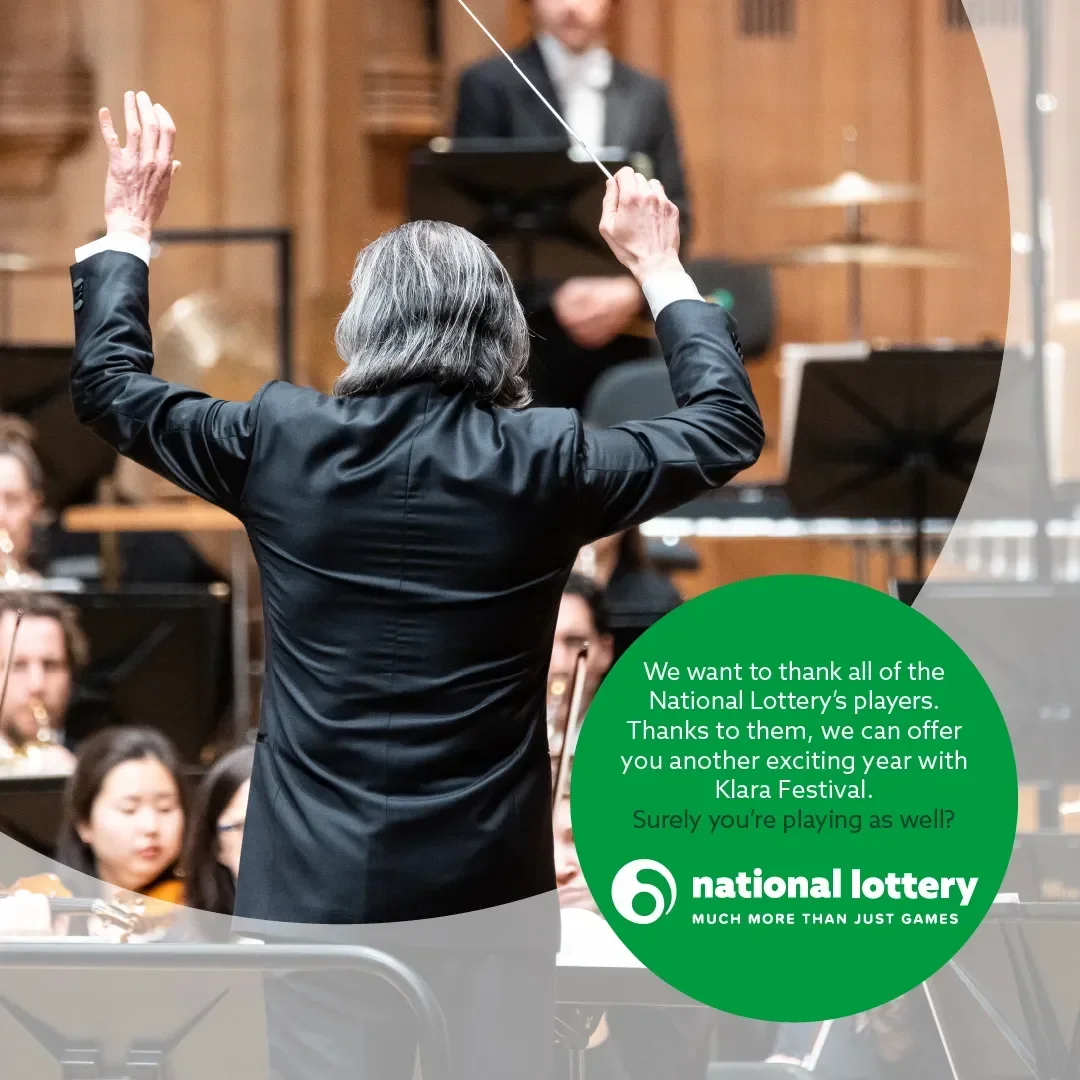
None of this would be possible without the support of our partners in Brussels and beyond. Bozar, Flagey, De Munt, Ancienne Belgique, Brussels Philharmonic, Belgian National Orchestra, Passa Porta, BNA-BBOT and the Luc Brewaeys Foundation all contribute to Klarafestival’s unique DNA. Our indispensable private partners include KPMG Belgium, Proximus, Brugse Zot, Gimv/WorxInvest and Interparking. We are grateful for the support of the Flemish Community, the Flemish Community Commission, the Brussels-Capital Region and the National Lottery. Our collaboration with VRT and Klara, meanwhile, is the secret to our success as a broadcasting festival. Above all, we thank our enthusiastic audience who follow us both in the concert hall and at home on the radio and VRT MAX.
For Abel Selaocoe, ‘home’ is much more than a building or a place. 'It can be a spiritual space. It can be people. (...) It can be something you find along your travels.’ For seven years, Klarafestival has been ‘home’ for festival director Joost Fonteyne. His sense of adventure and social connection is more evident than ever in this festival programme. In April 2026, he will continue his journey and pass the torch to Jan Van den Borre. Many thanks, Joost, for the wonderful years!
The Klarafestival Team
Joost Fonteyne, intendant
Jan Raes, chairman
Chantal Pattyn, network manager Klara
Orchestre Philharmonique du Luxembourg
Martin Rajna – musical direction
Jan Lisiecki – piano
Coproduction: Bozar, Klarafestival
In the context of The European Gala
Ludwig van Beethoven (1770-1827)
Piano Concerto No. 4 in G Major, Op. 58
- Allegro Moderato
- Andante con moto
- Rondo. Vivace
interval
Richard Strauss (1864-1949)
Ein Heldenleben, Op. 40
- Der Held
- Des Helden Widersacher
- Des Helden Gefährtin
- Des Helden Walstatt
- Des Helden Friedenswerke
- Des Helden Weltflucht und Vollendung
A shy piano concerto?
The concert Beethoven gave in December 1808 must have been one of the most curious moments in Western music history. In an ice-cold Theater an der Wien, Beethoven served his audience with a four-hour programme that included the premières of his fifth and sixth symphonies, along with parts from his Mass in C Major and the Choral Fantasy as a finale. That evening also represented a milestone in Beethoven’s career as a pianist: it was the last time he performed as a soloist, in the public première of his Piano Concerto No. 4. Incidentally, he didn’t even want to play it, but his student Ferdinand Ries wasn’t prepared to put in the hours of practice it required and his replacement, Friedrich Stein, withdrew at the last minute.
A lack of rehearsal and Beethoven’s increasing deafness prevented the Fourth Piano Concerto from making the impression it might have made. The opening bars of this concerto don’t cause any particular surprise among contemporary listeners, but in 1808 they were groundbreaking: Beethoven had done away with the usual orchestral introduction that announces the soloist, making way for a short, intimate piano solo. Maybe the audience at the Theater an der Wien did hear the similarities between the opening motifs in this piano concerto and the Symphony No. 5 (short-short-short-long). But where the fifth symphony is characterised by struggle and power, the first movement of this concerto evokes an elegant, somewhat timid presence: Beethoven avoids virtuoso excesses and rarely raises his voice in this friendly opening section.
In the short Andante con moto, the strings seem to take a strict tone with the soloist in an emphatic theme played in unison (the wind instruments and timpani do not feature in the second movement). The solo instrument responds gently and lyrically, as if to calm the orchestra. It succeeds, and they come to rest together in the mysterious and somewhat uncanny middle section, where Beethoven makes eager use of the latest piano mechanism that allowed him to strike only one or two strings with the hammer (instead of all three) and thus obtain an intimate sound. That makes the contrast with the finale all the greater: after a restrained start to the third movement, Beethoven finally releases his grip on the orchestra’s reins. We hear a carefree, energetic dance theme that, as befits a rondo, returns at regular intervals.
Richard Strauss, the Hero
‘Because Beethoven’s Eroica is so unpopular with our conductors and thus rarely performed, I am responding to great demand by composing a grand, symphonic poem entitled Ein Heldenleben.’ With this ironic reference to Beethoven’s Symphony No. 3, Richard Strauss announced his new work in a letter dating from July 1898. Beethoven played a considerable role in Strauss’ career: the latter made recordings of himself conducting the fifth and seventh symphonies, and he quotes the second movement of the Eroica in his Metamorphosen.
Strauss divided Ein Heldenleben into six movements to be played without breaks. He even gave these movements titles, although he later withdrew them. Nonetheless, they still provide a handy aid for listening to a tone poem in which the music always refers to something beyond itself, in this case the different phases and relationships in the life of an unnamed hero. Strauss also uses a leitmotif technique inspired by Wagner to link characters to musical themes, giving the listener even more reason to interpret Ein Heldenleben as a musical story.
The first movement, ‘The Hero’, introduces the main character with a virile theme in the low strings and horns, which Strauss believed were the instruments best suited to express heroism, as we see from the eight horns in this piece. The composer leaves us in the dark as to the hero’s identity. The listeners had to decide for themselves who he was, Strauss believed, but it is generally assumed that the score has autobiographical leanings. That was enough to cause quite a controversy, especially in the second movement, ‘The Hero's Adversaries’. Strauss’ critics heard themselves in the mocking flutes, whining oboes and threatening tubas, assuming that the hero’s theme was the musical representation of the composer himself. That is only partly true, Strauss explained in a letter to his father, but the link has stubbornly endured to this day.
If Strauss is the hero, the title of the third movement, ‘The Hero's Companion’, probably refers to his wife, the opera singer Pauline de Ahna. A seductive violin solo that sometimes seems to be giggling coquettishly attracts the hero’s attention: his own theme only appears in fragments, trying to appear more masculine in the presence of the young lady. The almost overwrought romance that is so typical of Strauss is roughly pushed aside for the tumultuous fourth movement, ‘The Hero at Battle’. An agitated variation on the hero’s theme, the Companion’s leitmotif and severe little motifs for his adversaries from the second movement become embroiled in a fierce fight, spurred on by unyielding drums and belligerent trumpets. When the heat of the battle dissipates, the hero’s theme returns with supreme self-confidence: a countermelody for the eight horns in unison makes it clear that the protagonist is victorious.
For Strauss fans, the fifth movement, ‘The Hero's Works of Peace’, is a feast of familiar references. In this section, the scarcely 34-year-old composer pays tribute to his own earlier compositions by quoting themes from works including Don Juan, Don Quixote, Tod und Verklärung and Also sprach Zarathustra. The final movement is also surprising for a 34-year-old composer: the hero withdraws from public life. Themes from the previous movements make one last appearance but, ultimately, the horn and violin are the instruments whose tender dialogue will herald Ein Heldenleben’s imposing finale.
What to listen out for
1. After the opening bars of the Piano Concerto No. 4, the strings respond in the ‘wrong’ key. After a few detours, they return to G Major.
2. In both the first and the third movement of Beethoven’s fourth piano concerto, the orchestra leaves plenty of space for a piano solo, known as a cadenza.
3. In Ein Heldenleben, the trumpets announce the fourth movement from behind the stage to create the illusion of distance. A similar technique can be heard in Mahler’s Symphony No. 1 and Berlioz’ Symphonie Fantastique.
Stijn Paredis
Translation: Helen White
Orchestre Philharmonique du Luxembourg
The Orchestre Philharmonique du Luxembourg was founded in 1933 as part of Radio Télévision Luxembourg. It has been Luxembourg's national orchestra since 1996 and is permanently based at the Philharmonie Luxembourg since 2005. The orchestra also collaborates with the Grand Théâtre de Luxembourg and the Centre des Arts Pluriels Ettelbruck and represents Luxembourg in concert halls throughout Europe. Past conductors have included Leopold Hager, Emmanuel Krivine and Gustavo Gimeno, while Martin Rajna will be chief conductor from the 2026-27 season onwards. Between 2017 and 2021, it released nine albums on the Pentatone label; since 2021, it has been collaborating with Harmonia Mundi France.
Martin Rajna
Hungarian conductor Martin Rajna studied at the Franz Liszt Academy of Music in Budapest with Ádám Medveczky and András Ligeti and at the Hochschule für Musik Franz Liszt in Weimar. In 2023, he was appointed chief conductor of the Hungarian State Opera, where he conducted productions of Maria Stuarda, Der fliegende Holländer, Macbeth and Die Fledermaus, and more. He has also conducted the Hungarian Radio Symphony Orchestra and the Hungarian National Philharmonic in his home country and has been assistant conductor to Ádám Fischer during the annual Budapest Wagner Days since 2023. From the 2026-27 season, Rajna will become chief conductor of the Orchestre Philharmonique du Luxembourg.
Jan Lisiecki
Canadian pianist Jan Lisiecki gave his first concerts with an orchestra at the age of nine and has since developed into a musician known for impeccable technique and thoughtful interpretations. As a soloist, he has worked with conductors such as Claudio Abbado, Antonio Pappano, Yannick Nézet-Séguin and Daniel Harding, and with orchestras such as the Boston Symphony Orchestra, the Cleveland Orchestra, Filarmonica della Scala and the Orchestre de Paris. His recordings for Deutsche Grammophon have been awarded a JUNO Award, an ECHO Klassik and a Diapason d'Or. His discography includes live recordings of all Beethoven's piano concertos, a collection of Beethoven songs with Matthias Goerne and a double album featuring Chopin's complete nocturnes
Structural partners
Klara, KPMG
Event partners
Brouwerij Halve Maan, Gimv | Worxinvest, Interparking, Proximus
Cultural partners
Ancienne Belgique, Belgian National Orchestra, Bozar, Brussels Philharmonic, De Munt | La Monnaie, Flagey, Muntpunt, Museum of Musical Instruments, Passa Porta
Public funding
Nationale Bank, Nationale Loterij meer dan spelen, Stad Brussel, Visit Brussels, Vlaamse Gemeenschap
Media partners
BRUZZ, De Standaard, La Première, La Trois, Le Soir, Musiq3, Radio 1, Ring TV, VRT Eén, VRT Canvas, VRT Max
Festival suppliers
Daniel Ost, Drukkerij VD, Maison Dandoy