Belcea Quartet
schubert - connesson - beethoven
A very warm welcome to Klarafestival!
Flanders Festival Brussels, Klara and our partners are delighted to greet you once again. “I believe audiences aren’t just listening. They are actively contributing”, festival artist Barbara Hannigan remarked in an interview. Concerts are an interaction between the audience, artists and anyone who is contributing to those magic moments in front of or behind the scenes. Together we ‘become’ music.
As a conductor and soprano, Hannigan is a global reference point. With her, classical music becomes a contemporary and unique experience. This is an inspiration to Klarafestival as the largest broadcast festival in Belgium. Her versatile talent is sure to enrapture you, as is that of the many Belgian and international artists who connect past and present with musical stories.
Klarafestival opens in style with Hannigan as conductor of the London Symphony Orchestra. After that, you will hear and see her with young musicians from her mentorship project Equilibrium Young Artists. In no fewer than 25 concerts, we present top talent including Les Talens Lyriques, the City of Birmingham Symphony Orchestra with Mirga Gražinytė-Tyla and Vilde Frang, and the St. Louis Symphony Orchestra with Víkingur Ólafsson. Klarafestival also treasures creation. The film concert Reich/Richter as a symbiosis of Gerhard Richter’s paintings and the music of Steve Reich; the creation Counterforces by composer Frederik Croene to text by poet Dominique de Groen; and the music theatre production Prey by Kris Verdonck with a composition by Annelies Van Parys will surprise you!
This and all other concerts are possible thanks to the collaboration with our cultural partners: Bozar, Flagey, Kaaitheater, Théâtre Varia, Muntpunt, Concertgebouw Brugge and DE SINGEL. Thanks to our private partners KPMG, Proximus, Brewery Omer Vander Ghinste, Belfius, Interparking and the players of Belgium’s National Lottery. We are grateful for the support of the Flemish Community and the Brussels Capital Region. And finally, thanks to Klara and VRT: there would be no broadcast festival without their valued collaboration.
Joost Fonteyne
Intendant Klarafestival
Belcea Quartet
Corina Belcea, violin
Pablo Hernán Benedí, violin
Krysztof Chorzelski, viola
Antoine Lederlin, cello
a coproduction between Klarafestival & Flagey
broadcast on Klara (live)
presentation by Clara De Decker
—
Franz Schubert (1797 – 1828)
String Quartet No. 10 in E flat major, D. 87
I. Allegro moderato
II. Scherzo. Prestissimo — Trio
III. Adagio
IV. Allegro
Guillaume Connesson (1970)
Les Instants Retrouvés *
I. Molto lento e rubato
II. Presto leggiero
III. Funèbre. Molto rubato
IV. Vivace
- intermission -
Ludwig van Beethoven (1770 –1827)
String Quartet Op. 59 No. 1 (“Razumovsky”)
I. Allegro
II. Allegretto vivace e sempre scherzando
III. Adagio molto e mesto - attacca
IV. "Thème Russe": Allegro
* Belgian premiere jointly commissioned by Klarafestival, Flagey, Arts et Lettre (Vevey), Kölner Philharmonie, Wigmore Hall, Palladium Malmö, Helsinki Seriös, Muziekgebouw aan 't IJ
“Of all instrumental music, the string quartet is what I enjoy the most: one hears four intelligent people conversing with one another, and one seems to understand something of their conversation and to get to know the idiosyncrasies of the instruments”. The description that the poet Johann Wolfgang von Goethe leaves for us in 1829 is a jubilant one. The quote offers us an insight into the unique status of the quartet in his time. For his contemporaries such as Schubert and Beethoven, writing a good quartet was a proof of their mastery, and the genre also has a special significance today. For the Frenchman Guillaume Connesson, a string quartet is the most intimate and personal of all genres. His brand-new string quartet is therefore also a musical diary, in which we find “moments from his life, aromas, lights, music, voices and his loved ones”.
Learning by doing
There is a high bar when writing string quartets, and the 16-year-old Franz Schubert is well aware of this. In 1813 he completes his String Quartet No. 10 in E flat major, D. 87 at the request of his tutor Antonio Salieri. As a basis for his quartet, he uses the music of Wolfgang Amadeus Mozart. Because, aside from the inventor of the genre (Joseph Haydn), what composer did not start on their first quartet by treading in the footsteps of their predecessors? Consequently there are numerous links to Mozart in this early quartet. The first movement Allegro moderato is thus compared to Mozart’s comic opera Bastien und Bastienne, and the third movement Adagio is reminiscent of the March of the Priests from The Magic Flute. But the young Schubert is unconcerned about these comparisons. Because he is not planning to publish this work. He writes this ‘practice quartet’ to perform at home together with his father and brothers (probably also the reason for the nickname ‘Haushaltung’ [‘Household’] quartet). While he is composing, Ludwig van Beethoven’s Razumovsky Quartet Op. 59 Nr. 1 also lies beside him, because just like his great idol he uses (contrary to tradition) the scherzo as the second movement, and in the opening bars he introduces a melodic core that underpins both the compelling rhythms and the magnificent melodies of the quartet. This posthumously published quartet also affords us a unique insight into the artistic development of the young composer.
"The memory of a particular image is but regret for a particular moment"
For Guillaume Connesson, the above quote from Marcel Proust completely encapsulates his String Quartet No. 2. Each of the four movements of the quartet reveals to us something about the life of the popular French composer. The first movement conjures up poetic images of summers long past in which the diatonic harmonies, delicate microintervals and snatches of song allude to the vibrant colours of the sea. The virtuoso second movement is an ode to Connesson’s first musical memories: fragments from Berlioz' Roméo et Juliette and Puccini's Tosca emerge, but also his very first composition Nautilus which he wrote at the age of 14. The third movement is a sombre and chromatic lament, whilst the fourth and final movement is a musical self-portrait. It is up to our imagination to give a place to the accumulation of frantic rhythms and post-Romantic passages of this closing movement which lead to grand climaxes.
A new path
It is thanks to visionary quartets such as the Rasumovsky Quartet in F, Op. 59 No. 1 by Ludwig van Beethoven that the string quartet has become a genre in which Connesson can today show his most personal side. Beethoven was all too aware of how groundbreaking his music was. His pupil Carl Czerny wrote that after the premiere of the quartet in 1806 the violinist Felix Radicati asked the composer: "Surely you do not regard this as music?" To which the composer replied: "Not for you, but for later." In this first of three string quartets of his Opus 59 he indeed seeks out new horizons. From a technical point of view the music is extremely demanding for the performers, and above all the drama and expressiveness are unprecedented for that era: the unexpected and far-reaching modulations in all four movements, the ingenious handling of the themes that seem to grow organically out of other themes, the sometimes extreme dynamics, and so on. It is unsurprising that the young Schubert was so full of admiration for Beethoven’s string quartets. Never before had a composer written a scherzo with such unpredictable rhythms, melodies and harmonies, or did a third movement resonate so sombrely and intensely. And that for a genre that up to that point was aimed at amateur musicians. The mood only brightens in the final movement (into which the third movement runs without a break) which Beethoven bases on a Russian folk song: a triumphant and virtuoso nod to Count Razumovsky, the Russian ambassador in Vienna and amateur violinist to whom he dedicates the quartet.
Waldo Geuns
Belcea Quartet
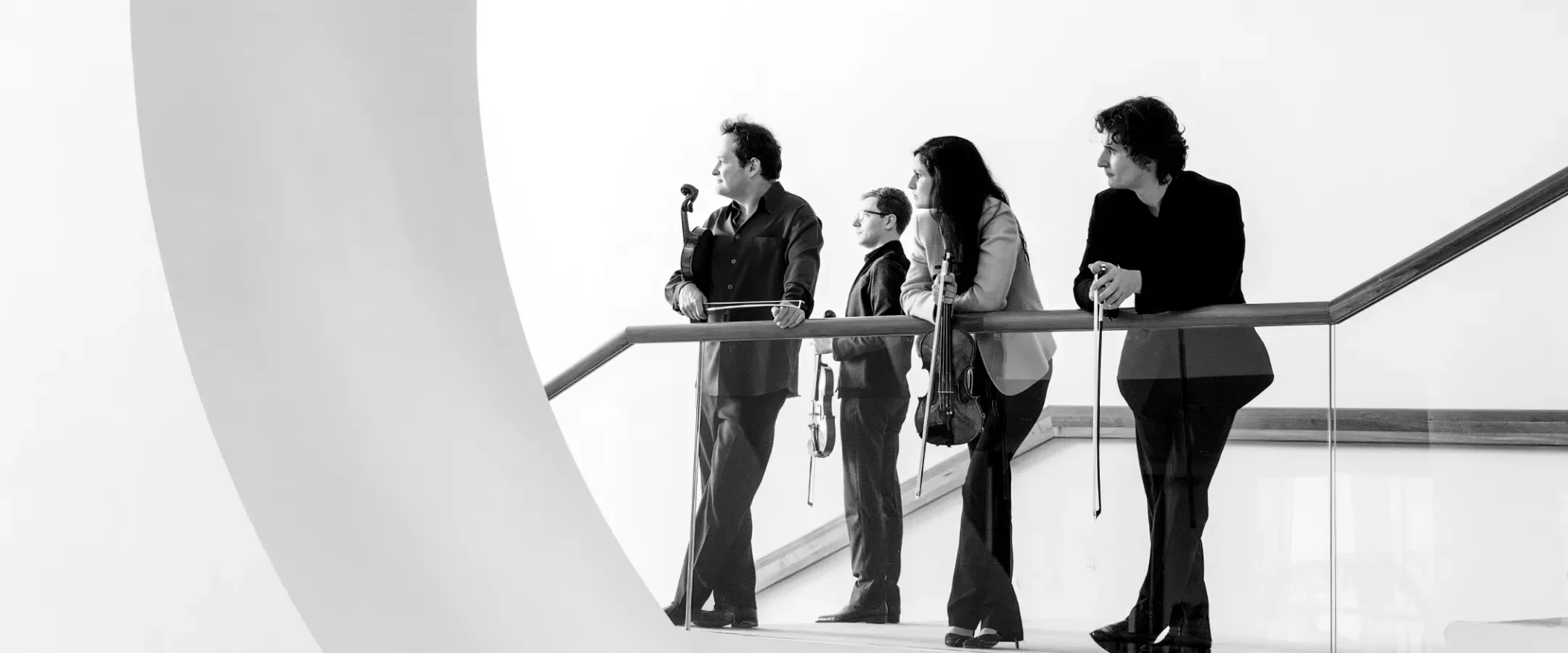
The Belcea Quartet are not confined by traditional boundaries. Perhaps their diverse cultural backgrounds are the reason behind their dynamic and free interpretative style. Formed at the Royal College of Music in 1994, the quartet were subsequently invited to join the BBC New Generation Artist scheme, before winning the Gramophone Debut Disc award in 2001. Two decades later, the group, led by Corina Belcea, have developed a reputation both for acclaimed performances in the core string quartet repertoire, as well as contemporary music.
Corina Belcea
Corina Belcea was born in Romania in 1975 and studied the violin with Radu Bozgan and Stefan Gheorghiu. At the age of 16, she moved to London to study at the Yehudi Menuhin School with Natalia Boyarskaya and finished her studies at the Royal College of Music with Felix Andrievsky. It was there that the Belcea Quartet was born and Corina has been its founding member and first violin for 23 years. She has performed with the quartet and solo around the world and holds a teaching position at the Hochschule der Kunste Bern.
Pablo Hernan Benedí
Violin player Pablo Hernán Benedí was born in Madrid. In 2009, he moved to London to continue his studies at the Guildhall School of Music and Drama with David Takeno and András Kellerand. He is a founding member of the Trio Isimsiz and as a soloist, he has performed with the London Chamber Players and the Concerto Budapest, amongst others. He also works regularly as leader or section leader with Arcangelo, Concerto Budapest, the Chamber Orchestra of Europe and the Swedish Radio Orchestra.
Krysztof Chorzelski
Krzysztof Chorzelski was born in Warsaw in 1971. After winning the Wronski Solo Violin Competition in 1992, he has subsequently performed as a recitalist and soloist in Europe. In 1996 he became the viola player in the Belcea Quartet and in 2006 he was invited by the Alban Berg Quartet to perform as a guest violist. He also has a keen interest in commissioning new works for the viola from today’s leading composers. Recent premieres include a Viola Sonata by Pawel Szymanski and Letters from Warsaw by Joseph Phibbs.
Antoine Lederlin
French cellist Antoine Lederlin (1975) completed his studies at the Conservatoire National Supérieur de Paris in the class of Roland Pidoux. He became principal cello at the Orchestre Philharmonique de Radio France at the age of 19 and is currently principal cello with the Sinfonieorchester Basel. He recorded the Schoeck cello concerto with Armin Jordan and Orchestre de chambre d’auvergne and plays trio concerts regularly with violin player Midori and pianist Jonathan Biss. Antoine Lederlin has been the cellist of the Belcea Quartet since 2006.
main partners
Klara, KPMG, Nationale Loterij-meer dan spelen
festival & event partners
Belfius, Brouwerij Omer Vander Ghinste, Interparking, Proximus
public funding
BHG, Nationale Bank van België, Vlaamse Gemeenschap, Vlaamse Gemeenschapscommissie
cultural partners
AB, Bozar, Concertgebouw Brugge, DESINGEL, Flagey, Kaaitheater, Muntpunt, Passa Porta, Théatre Varia
official festival suppliers
Café Costume, Café Victor, Casada, Daniel Ost, Fruit at Work, Greenmobility, Levi Party Rental, Piano’s Maene, Ray & Jules, Thon Hotels
media partners
BRUZZ, BX1, Canvas, Clearchannel, Davidsfonds, De Standaard, Eén, La Libre, La Première, La Trois, MIVB, Musiq3, Radio 1, Ring TV, visit brussels