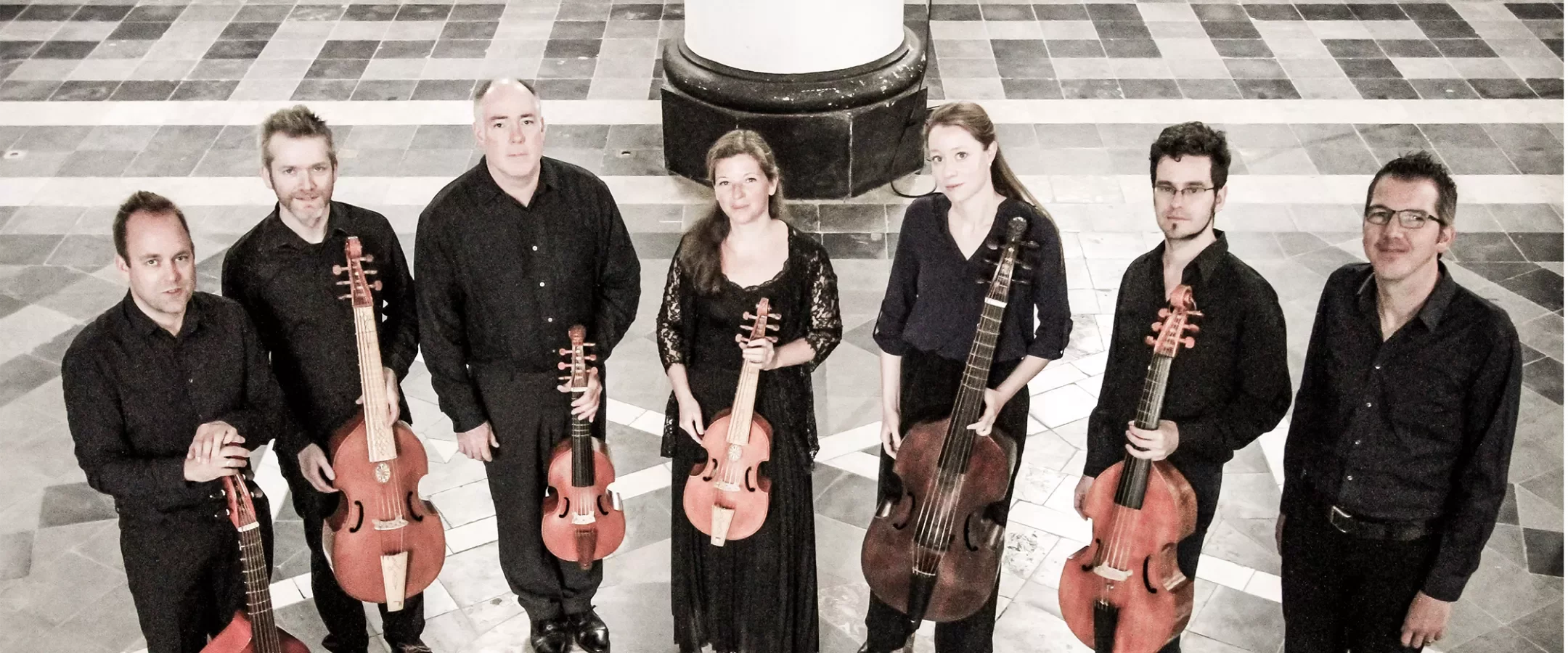
Hathor Consort, Oltremontano & Pluto Ensemble
L.E.D.
A very warm welcome to Klarafestival!
Flanders Festival Brussels, Klara and our partners are delighted to greet you once again. “I believe audiences aren’t just listening. They are actively contributing”, festival artist Barbara Hannigan remarked in an interview. Concerts are an interaction between the audience, artists and anyone who is contributing to those magic moments in front of or behind the scenes. Together we ‘become’ music.
As a conductor and soprano, Hannigan is a global reference point. With her, classical music becomes a contemporary and unique experience. This is an inspiration to Klarafestival as the largest broadcast festival in Belgium. Her versatile talent is sure to enrapture you, as is that of the many Belgian and international artists who connect past and present with musical stories.
Klarafestival opens in style with Hannigan as conductor of the London Symphony Orchestra. After that, you will hear and see her with young musicians from her mentorship project Equilibrium Young Artists. In no fewer than 25 concerts, we present top talent including Les Talens Lyriques, the City of Birmingham Symphony Orchestra with Mirga Gražinytė-Tyla and Vilde Frang, and the St. Louis Symphony Orchestra with Víkingur Ólafsson. Klarafestival also treasures creation. The film concert Reich/Richter as a symbiosis of Gerhard Richter’s paintings and the music of Steve Reich; the creation Counterforces by composer Frederik Croene to text by poet Dominique de Groen; and the music theatre production Prey by Kris Verdonck with a composition by Annelies Van Parys will surprise you!
This and all other concerts are possible thanks to the collaboration with our cultural partners:
Bozar, Flagey, Kaaitheater, Théâtre Varia, Muntpunt, Concertgebouw Brugge and DE SINGEL. Thanks to our private partners KPMG, Proximus, Brewery Omer Vander Ghinste, Belfius, Interparking and the players of Belgium’s National Lottery. We are grateful for the support of the Flemish Community and the Brussels Capital Region. And finally, thanks to Klara and VRT: there would be no broadcast festival without their valued collaboration.
Joost Fonteyne
Intendant Klarafestival
Hathor Consort
Romina Lischka, artistic direction and bassa da viola
Pluto-ensemble
Marnix De Cat, artistic direction and countertenor
Oltremontano
Wim Becu, artistic direction and bass trombone
coproduction Klarafestival, Bozar
presentation by Carlo Siau
broadcast by Klara (live)
–
Marnix De Cat (°1967)
In tenebris…
Francesco Guami (1544-1601)
Ricercar n°3
Marnix De Cat
De Profundis
Ritornel 1: Sleep
Heinrich Schütz (1585-1672)
In lectulo per nocte
J. Hentzschel (1648-1669)
Canzone à 8
Ritornel 2: Awakening
Christoph Strauß (1580-1631)
Eripe me
Giovanni Valentini (1582-1649)
O vos omnes
Gioseffo Guami (1540-1611)
Canzone à 8
Girolamo Priuli (1575-1626)
O quam dulcis
Christoph Strauß
Missa pro Defunctis: Symphonia ad imitationem campanae
Introitus: Requiem aeternam
Te decet hymnus
Kyrie
Francesco Cavalli (1602-1676)
Canzone à 10
Christoph Strauß
Missa pro Defunctis: Symphonia ad imitationem campanae
Offertorium: Domine Jesu Christe
- intermission -
Heinrich Biber (1644-1704), arr. Marnix De Cat
Ritornel 3: TRMPTS / Sonata S. Polycarpi
Christoph Strauß
Missa pro Defunctis: Symphonia ad imitationem campanae
Sanctus
Johann Stadlmayr (1575-1648)
Sonata à 13
Christoph Strauß
Missa pro Defunctis: Symphonia ad imitationem campanae
Requiem aeternam
Marnix De Cat
Ritornel 4: LUCE
Giovanni Priuli (1575-1626)
Sonata prima in due cori
Claudio Monteverdi (1567-1643)
Laudate Dominum omnes gentes 1 (SV 272, Selva Morale et spirituale, 1641)
Johann Stadlmayr
Canzone in Dm - à14
Claudio Monteverdi
Magnificat 1 (SV 281, Selva Morale et spirituale, 1641)
end scheduled at 22:00
L.E.D. Luceat Eis, Domine
It is known that the fascination for Italian music in the German-speaking regions increased in the first half of the 16th century and that the stile moderno would come to dominate from around 1600 onwards. Not only was Italian repertoire imported and distributed in prints and manuscripts, but musicians from Italy also held central posts in court chapels, while conversely German musicians received their training in Italy and familiarised themselves with the latest developments there. The importance of Italy for the German-speaking regions and the resulting cultural transfer can hardly be overestimated and led to a true an 'Italianisation' of musical taste. That such phenomena are often not only (or not primarily) intrinsically motivated, but also related to external factors, is demonstrated in this concert programme. It allows us to follow the stylistic changes at the Habsburg imperial court, especially under Ferdinand II (1578-1637) and his entourage - a process in which political and confessional considerations were also decisive.
While musical life at the imperial court of Rudolph II (1552-1612) and his brother and successor Matthias (1557-1619) was still heavily dominated by Franco-Flemish composers, this was to change radically under Ferdinand. With Matthias' death, rule passed to the Habsburg branch from Inner Austria. Ferdinand’s music chapel was dissolved and he and his staff moved from Graz to Vienna, where he stayed until his death in 1637.
Already in Graz, Ferdinand's musical tastes coloured Italian, with a fondness for Venice. However, this was not only related to a personal interest, perhaps influenced by Ferdinand's Grand tour to Italy in 1598, but was mainly politically-religiously motivated. Unlike the old imperial court, where many Protestants were active, he saw Italy as an important ally in the effort to a re-catholisation of the Holy Roman Empire. Relations with the south were to be considerably strengthened by a convenient marriage policy, when Ferdinand married Eleonora Gonzaga (1598-1655), the daughter of Duke Vincenzo I of Mantua and Eleonora de' Medici, in 1622.
From the biographies and oeuvres of the composers in this concert programme, we can trace the increasing Italianisation and accompanying cultural exchange in the imperial milieu. For instance, Christoph Strauß (c. 1575/1580-1631), who comes from a musical family that served the Habsburgs for several generations, was for a short time Kapellmeister under Emperor Matthias. After the latter's death, however, Strauß lost his post to Giovanni Priuli (c. 1575-1626), who came from Venice, and from 1628 he was Kapellmeister of the Stephansdom in Vienna.
Priuli was already in charge of Ferdinand's court chapel in Graz and moved with him to Vienna after his coronation as emperor. Priuli marked the beginning of an era of dominance of Italian music at the imperial court that would last almost a century. It was not until 1711, when Johann Joseph Fux took over, that the long line of imperial court musicians of Italian origin came to an end. Priuli's successor Giovanni Valentini (1582/1583-1649) was also from Venice. After working at the Polish royal court in Warsaw, he was first organist at Ferdinand's court in Graz, moved with him to Vienna in 1619 and was appointed imperial Kapellmeister in 1626. He was also responsible for the musical education of Ferdinand's children. Several of his collections, for which he travelled repeatedly to Venice for printing, are dedicated to Ferdinand and other members of the Habsburg entourage, suggesting a politically motivated publishing strategy.
Like his successors Priuli and Valentini, Christoph Strauß was also an organist. The fact that instrumentalists - and not singers, as had still been the case with the Franco-Flemish composers - were now in charge of the Hofkapelle shows the growing importance of instrumental music. This emerges impressively in their oeuvres. The composers excel in contrasting effects (in terms of instrumentation, texture, register, etc.) and a combination of different sound groups, alluding to Venetian polychorality, is ubiquitous. For instance, in Priuli's O quam dulcis, two mainly homophonic choruses alternate at relatively short intervals. After a passage in ternary metre at the end of the first movement, Priuli, using increasingly shorter note values, introduces imitative sections interspersed with syncopations, culminating in the concluding Alleluia. Valentini achieves contrast in his expressive O vos omnes for five voices and basso continuo in a different way. While the two cantus and tenor voices recite the despairing lines from the Lamentations of Jeremiah ("O vos omnes qui transitis per viam, attendite, et videte si est dolor similis sicut dolor meus"), he places the altus at a spatial distance from the other voices and has it sing, almost like a refrain, the hopeful triple invocation "O dulcis amor Iesu, o caelestis amor, o grandis amor".
While Strauß still relies on a fairly conventional polyphonic style in his Eripe me, printed in 1613, the influence of the Viennese milieu is unmistakable barely 20 years later in his Missa pro defunctis, published in 1631 as part of a collection dedicated to Emperor Ferdinand II. In this "missa concertata" for ten string instruments, voices and basso continuo, the composer achieves a contrasting effect, partly by changing the texture and register at very short intervals and by combining several motifs simultaneously. Chordal passages are used to underline important elements of the text, such as the imperative "exaudi" (Introitus), the "nil in ultum remanebit" (Dies irae) or the passages marking light (and thus hope): the "in lucem sanctam" (Offertorium) and the "luceat eis Domine" at the beginning of the Communio, which inspired the concert's title. Moreover, Strauß creates differences in dynamics and timbre by indicating exactly when the instruments should play together with the voices or when they should stop.
Claudio Monteverdi's ties with the Viennese imperial court can be explained mainly by Ferdinand's marriage to Eleonora Gonzaga. Monteverdi, who received his first permanent appointment at the court of Mantua, would keep in touch with the Gonzagas even after his move to San Marco in Venice until the end of his life. A clear sign of this is the collection Selva morale e spirituale (1640-1641), which he dedicated to Eleonora Gonzaga a few years before his death. The stylistic variety of this collection, from which we hear the Magnificat primo "a 8 voci e due violini e quattro viole overo quattro trombone" (note the use of the stile concitato, which is especially characteristic of the Madrigali guerrieri e amorosi, in the recurring "fecit potentiam"), and a setting of the psalm Laudate Dominum omnes gentes, can be seen as a synthesis and highlight of Monteverdi's religious music.
That the imperial court is only one - albeit very important and prominent - example of the Italianisation of music in the German-speaking regions is underlined by other composers in this programme. Heinrich Schütz (1585-1672), for instance, self-consciously addresses the influence of his stays in Venice in several collections. In the dedication (to the Saxon crown prince Johann Georg, the future elector Johann Georg II [1613-1680]) to the first volume of the Symphoniae Sacrae printed in la Serenissima in 1629, he characterises the new way of composing as an attempt to "please modern taste with a new kind of excitement". To this end, he works with a varied instrumentation, evidenced by, among other things, the setting of the Song of Songs text In lectulo meo - for soprano and alto, three violas or bassoons and basso continuo.
After their training at St Mark's Basilica in Venice, brothers Gioseffo (1542-1611) and Francesco (1543-1602) Guami started their professional careers at the court of the Bavarian Duke Albrecht V. Gioseffo was recruited in 1568 by none other than Orlando di Lasso (c. 1532- 1594) and was organist and capo dei concerti, Francesco was trombonist. From the latter we hear a two-part ricercar with which the concerto opens cautiously, and from Gioseffo Guami a beautiful instrumental double-choir canzona. Johann Stadlmayer (c. 1575-1648), who from 1608 served as Kapellmeister at the court of Archduke Maximilian III (1558-1618) in Innsbruck and also under his successor Leopold V (1586-1632), can also boast a highly varied oeuvre, strongly influenced by various facets of the stile moderno. His Apparatus musicus, printed in 1645 - a compendium of works with different instrumentations - provides particularly impressive evidence of this.
Katelijne Schiltz, University of Regensburg
Hathor Consort
The Hathor Consort was founded in 2012 by Romina Lischka. Under her artistic direction, the consort devotes itself to Renaissance and Baroque music in which a string ensemble of violas takes centre stage. At the same time, the group seeks new ways of expression in which this refined chamber music repertoire of European origin is combined in multidisciplinary and intercultural concert forms with early music from other continents and with contemporary music, world music and dance.
Pluto-ensemble
The Pluto ensemble is a vocal ensemble founded in 2009 by singer, conductor and percussionist Marnix De Cat. The ensemble explores the music of the 14th-century Ars Nova, the Ars Subtilior and Renaissance polyphony, but equally Baroque masterpieces and contemporary polyphonic and minimalist music. In small or large choral settings, Pluto Ensemble often collaborates with Hathor Consort, Il Gardellino or the dance company ECCE.
Oltremontano
Founded in 1993 by Wim Becu, Oltremontano is one of the top international historical brass ensembles. The name Oltremontano refers to the leading Flemish composers who defined musical life in Europe in the 15th- and 16th-centuries and were known in Italy as "Oltremontani" ("they from over the mountains"). The core of the ensemble consists of baroque trombones and cornetti. The ensemble regularly collaborates with Capilla Flamenca, Cinquecento and Psallentes.
19:00
Klarafestival LOUNGE
interview with Romina Lischka & Marnix De Cat (English)
De Profundis clamavi (psalm 130)
From the depths I cry to you O Lord.
Lord, hear my voice;
Be attentive, lay your ear to hear
To my supplications.
If Thou continue to remember the iniquities,
Lord, endure?
In lectulo per noctes SWV 272
By night in bed I sought him whom my soul loveth: and he answered me. I will rise now, and go about the city in the streets, and in the broad ways I will seek him whom my soul loveth.
Eripe me Domine
Deliver me, O Lord, from the evil man: and preserve me from the wicked man. Who imagine mischief in their hearts: and stir up strife all the day long. They have sharpened their tongues like a serpent: adders' poison is under their lips.
O vos omnes
O all you who pass by the way, look up and see if a pain is like my pain.
O sweet love of Jesus, O heavenly love, O great love.
O quam dulcis
Oh, how sweet, how gentle the Saviour of the world, your most holy face in us, at whom the angels long to look Indeed, nothing is more pleasing to the eye, nothing is thought sweeter, nothing is more blissful to be cultivated than the face of God's Son. Let us therefore ask, pious Jesus, that we mortals here may venerate your face with dignity, and that we may see and enjoy you in heaven.
MISSA pro Defunctis
Introitus
Grant them eternal rest, O Lord;
and may perpetual light shine upon them.
A hymn in Zion befi ts you, O God,
and a debt will be paid to you in Jerusalem.
Hear my prayer:
all earthly flesh will come to you.
Kyrie
Lord, have mercy upon us. Christ, have mercy upon us. Lord, have mercy upon us
Offertorium
O Lord Jesus Christ, King of Glory: deliver the
souls of all the faithful dead from the pains of
hell and from the deep pit; deliver them from
the mouth of the lion; that hell may not swallow
them, and that they may not fall into darkness.
But may the holy standard-bearer Michael show
them the holy light; which you once promised
to Abraham and his descendents.
We o er to you, O Lord, sacrifi ces and prayers.
Receive them on behalf of those souls whom
we commemorate today. Grant, O Lord, that
they might pass from death into that life which
you once promised to Abraham and his descendents
Sanctus
Holy, holy, holy, Lord God of Sabaoth.
Heaven and earth are filled with your glory.
Hosanna in the highest!
Blessed is he that comes in the name of the Lord.
Hosanna in the highest!
Communio
Let eternal light shine upon them, O Lord, with
your saints forever; for you are merciful.
Grant them eternal rest, O Lord,
and may perpetual light shine upon
Magnificat anima mea Dominum.
My soul revers the greatness of the Lord,
and my spirit rejoices in God, my savior
for he has gazed upon his lowly handmaid.
Behold, from henceforth I shall be called blessed
by all generations, for He has done great things
He who is mighty, and holy is His name
and he has mercy
on those who fear him in every lineage
He has shown great strength with his arm,
dispersed the insolent of mind and heart,
He has cast aside the mighty from their thrones
and has lifted up the lowly
He has filled the hungry with good things
and has sent the rich away with nothing.
He has aided his servant, Israel
He remembered his compassion,
just as he spoke
to our fathers, to Abraham and his children for ever.
Glory to the Father, and to the Son,
and to the Holy Spirit.
As it was in the beginning, is now,
and ever shall be, world without end.
Amen.
Hathor Consort
Veronika Skuplik, Marrie Mooij, violin
Liam Fennelly, descant- & bass viola da gamba
Thomas Baeté, Kaori Uemura, bass viola da gamba
Nick Milne, Irene Klein, consort bass viola da gamba
Matthias Müller, violone
Francis Jacob, organ
Thomas Boysen, Matthias Spaeter, theorbo & archilute
Romina Lischka, descant- & bass viola da gamba & artistic direction
Pluto-ensemble
Claire Lefilliâtre, Hannah Morrison, Lieselot De Wilde, Marijke van der Harst , soprano
Marnix De Cat, countertenor & artistic director
Charles Daniels, Tore Denys, tenor
Raitis Grigalis, Matthieu Le Levreur, baritone
Harry van der Kamp, bass
Joel Frederiksen, David McCune, basso profundo
Oltremontano
Adrien Mabire, Anna Schall, cornetto
Robert Schlegl, Juan Gonzalez Martinez, Raphaël Robyns, trombone
Wim Becu, bass trombone & artistic direction
Paul Voet, Niranjan Wiewickrema, Yorick Roscam, Elke Soenen, Bart Coppé, natural trumpet
main partners
Klara, KPMG, Nationale Loterij-meer dan spelen
festival & event partners
Belfius, Brouwerij Omer Vander Ghinste, Interparking, Proximus
public funding
BHG, Nationale Bank van België, Vlaamse Gemeenschap, Vlaamse Gemeenschapscommissie
cultural partners
AB, Bozar, Concertgebouw Brugge, DESINGEL, Flagey, Kaaitheater, Muntpunt, Passa Porta, Théatre Varia
official festival suppliers
Café Costume, Café Victor, Casada, Daniel Ost, Fruit at Work, Greenmobility, Levi Party Rental, Piano’s Maene, Ray & Jules, Thon Hotels
media partners
BRUZZ, BX1, Canvas, Clearchannel, Davidsfonds, De Standaard, Eén, La Libre, La Première, La Trois, MIVB, Musiq3, Radio 1, Ring TV, visit brussels