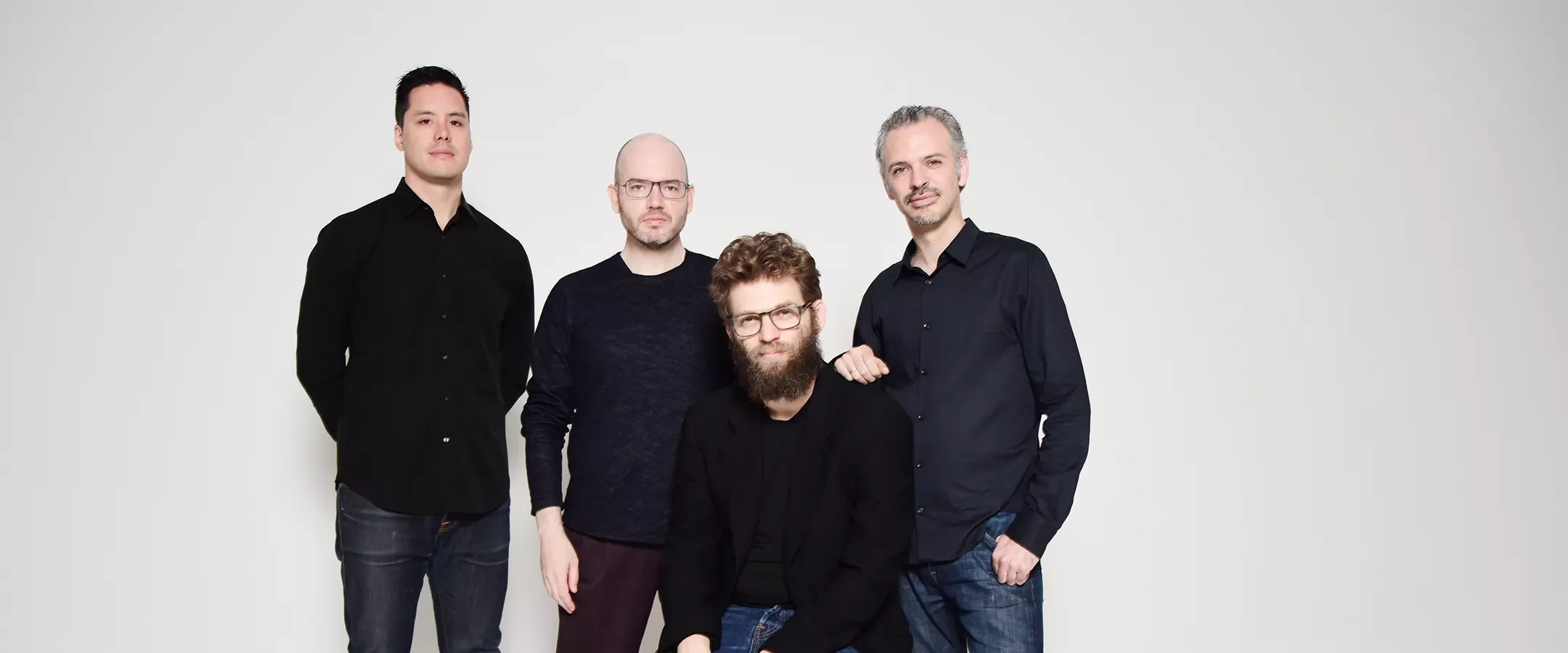
[sold out] Brooklyn Rider
the 4 elements
A very warm welcome to Klarafestival!
Flanders Festival Brussels, Klara and our partners are delighted to greet you once again. “I believe audiences aren’t just listening. They are actively contributing”, festival artist Barbara Hannigan remarked in an interview. Concerts are an interaction between the audience, artists and anyone who is contributing to those magic moments in front of or behind the scenes. Together we ‘become’ music.
As a conductor and soprano, Hannigan is a global reference point. With her, classical music becomes a contemporary and unique experience. This is an inspiration to Klarafestival as the largest broadcast festival in Belgium. Her versatile talent is sure to enrapture you, as is that of the many Belgian and international artists who connect past and present with musical stories.
Klarafestival opens in style with Hannigan as conductor of the London Symphony Orchestra. After that, you will hear and see her with young musicians from her mentorship project Equilibrium Young Artists. In no fewer than 25 concerts, we present top talent including Les Talens Lyriques, the City of Birmingham Symphony Orchestra with Mirga Gražinytė-Tyla and Vilde Frang, and the St. Louis Symphony Orchestra with Víkingur Ólafsson. Klarafestival also treasures creation. The film concert Reich/Richter as a symbiosis of Gerhard Richter’s paintings and the music of Steve Reich; the creation Counterforces by composer Frederik Croene to text by poet Dominique de Groen; and the music theatre production Prey by Kris Verdonck with a composition by Annelies Van Parys will surprise you!
This and all other concerts are possible thanks to the collaboration with our cultural partners: Bozar, Flagey, Kaaitheater, Théâtre Varia, Muntpunt, Concertgebouw Brugge and DE SINGEL. Thanks to our private partners KPMG, Proximus, Brewery Omer Vander Ghinste, Belfius, Interparking and the players of Belgium’s National Lottery. We are grateful for the support of the Flemish Community and the Brussels Capital Region. And finally, thanks to Klara and VRT: there would be no broadcast festival without their valued collaboration.
Joost Fonteyne
Intendant Klarafestival
Johnny Gandelsman, violin
Colin Jacobsen, violin
Nicholas Cords, viola
Michael Nicolas, cello
coproduction Klarafestival, Flagey
presentation by Carlo Siau
broadcast by Klara (live)
–
Colin Jacobsen (1978)
A Short While to Be Here… (based on American Traditional songs as collected by Ruth Crawford Seeger)
Akshaya Tucker (1992)
Hollow Flame
Andreia Pinto Correia (1971)
Aere senza stelle
Henri Dutilleux (1916-2013)
Ainsi la nuit
-Intermission -
Dmitri Shostakovich (1906-1975)
String Quartet No. 8 in C minor, Op. 110
Osvaldo Golijov (1960)
Tenebrae
end scheduled at 21:45
Combining elements
A conversation with Brooklyn Rider’s violist Nicholas Cords
Every program Brooklyn Rider presents seems to convey a bigger narrative or dramaturgy. Why is that important to you as a string quartet and how did the idea originate behind The Four Elements?
Nicholas Cords: “For us, the idea of assembling a collection of established masterpieces just somehow isn’t satisfying. We’re always looking to merge old and new in what we do, and to deliver a narrative or frame to an audience. The process through which we decide on a program is very much a conversation between every member of the quartet. The idea behind the four elements emerged both as a reference to planet Earth, and as a metaphor for the conversation which is the string quartet. Four unique elements, each with its own elemental force, together become capable of producing a wide variety of things in both the physical and the musical universe.”
How did you end up selecting four chamber music works from the past 100 years that symbolise earth, fire, water and air?
Cords: “Some pre-existing works symbolically embody these elements to us. For example, Shostakovich’s Eighth String Quartet was written in the post-World War II era when he was visiting Dresden, which was almost entirely firebombed. The piece became a dedication to victims of fascism and war because of the incredible impression it made on Shostakovich. To us, it has a natural connection to fire. The same can be said of Dutilleux’s Ainsi la nuit: it just feels like it’s full of air. By that, I don’t just mean the space between notes; to us it’s essentially a piece about the mind, about musical memory. The way musical elements recur throughout the piece remind us of thought patterns, the weaving together of experience, all immaterial, happening in the mind. Osvaldo Golijov’s Tenebrae is a beautiful reflection of two contrasting experiences he had. After visiting Israel at a time of great strife and conflict, he returned to New York and passed by the planetarium at the American Museum of Natural History. There, he saw these incredible images from space of planet Earth and a feeling of peace came over him. In this piece he combined both contrasting experiences: zooming in and experiencing conflict, zooming out and witnessing something beautiful. Of course, what you mainly see from outer space when looking at planet Earth is water, which the music tells by the rippling of sound, of waves. To end with the element of earth: Ruth Crawford Seeger was a great composer of modernist music, but she also collected American folk songs along the way. She’s a bit like our American Bartók. Interestingly, the folk songs she collected are about animals, which to us represent earth. Colin Jacobson from our quartet reimagined these songs into a new musical composition.”
You also commissioned several new compositions inspired by the four elements. Should we interpret their answer as a call to action, considering the unnerving state of our planet?
Cords: “We assigned an element to each composer, but the approach was deliberately left open. The only thing we asked was to somehow place the idea of the four elements in the present, perhaps by drawing attention to a contemporary issue, or simply by admiring their beautiful and destructive force. In this project, we really do not want to tell the audience what to think or do. We want the music to create a shared experience from which people can have their own takeaway.”
During Klarafestival, you will be performing two of the four commissioned works: Hollow Flame by Akshaya Tucker and Aere senza stelle by Andreia Pinto Correia. How was it working with them and how did they turn fire and air into music?
Cords: “Akshaya Tucker is such an interesting composer. Just one of the many reasons we chose her was we wanted to feature composers under the age of 30. When we’re thinking about the future of our planet, I think we really have to give young people a voice. Hollow Flame conjures the destruction caused by recent wildfires in the state of California and all the way up and down the West Coast. In this piece, she imagines how the trees inhale carbon dioxide and release it into the atmosphere, which evokes a sense of uneasy breathing. Andreia Pinto Correia has written a piece about the dust storms that originate in the Sahara and whose frequency and severity are affected by climate change. The piece reimagines the string quartet as a sonic cloud, with swirling effects, but also a feeling of static. You could light a match with the tension that is in the air, like the moments before a storm. We premiered the piece at the Vail Dance Festival in Colorado and now Andreia is in the process of making a sizable revision to the piece. Akshaya equally delivered several drafts of the score and we got to work closely on the piece with her.”
Is that something you look for in a composer, an artistic dialogue?
Cords: “Yes, I guess we do. One of the things we love as a string quartet is to be very close to the source of creativity. We want to have a conversation; we want to feel that a composer becomes a member of our string quartet family. We’re not interested in dictating the composer what to write, but in exploring ideas together. Compared to an orchestra, a string quartet is very portable and flexible. Actually, one of the reasons why we chose the name Brooklyn Rider is because it doesn’t have “string quartet” in the title. To us, the descriptor string quartet communicates a somewhat fixed idea, whereas we wanted a name that communicates openness and generates conversation.”
Interview by Lalina Goddard
composer’s notes
Aere senza stelle (2022)
Andreia Pinto Correia
The inspiration for Aere senza stelle (Air Without Stars) was the tempestades de poeira—or dust storms — that travel from the Sahara Desert to the Iberia Peninsula, a phenomenon experienced during my youth in Portugal. From the descriptions of “blood rains” as bad omens epics by Homer, Hesiod, and Plutarch, to scientific observations by Darwin and Ehrenberg in the nineteenth century, up until today, the reporting of desert dust storms has evolved from descriptive narratives to encompassing an entire field of environmental research.
Re-reading Dante Alighieri’s Inferno, I recognized a profound poetic connection to climate change, and so I mirrored the structure of Canto III, 22-30 dividing the work into three sections. In the final measures, the string quartet creates a sonic cloud, as though carrying an infinite stream of particles from the desert to other parts of the world.
I. Lacrimoso, quasi recitativo – the starless air: lyrical and static.
II. Agitato, strepitoso – a tumult of voices: dense, angular and dissonant.
III. Misterioso, senza misura. Inquieto – time suspended. A whirlwind of sands, vanishing into infinity.
Commissioned by the 2022 Vail Dance Festival, Damien Woetzel - Artistic Director - Aere senza stelle is dedicated in admiration to António Guterres, for his life dedication to climate change issues, and to Catarina Vaz Pinto. A special thank you to Brooklyn Rider.
Hollow Flame (2022)
Akshaya Avril Tucker
Here in California, fire is at our doorstep. Although I am a relatively new arrival to the state, it's still frightening. Fire has already had a devastating impact especially on Northern California communities (and completely wiped out the town of Paradise in 2018). Across California, we have been experiencing extreme drought for years. All these conditions, from drought to fire to mudslides, are predicted to worsen as our planet warms.
My string quartet, Hollow Flame, is like a journal entry of moments recorded over many months in which I try to grapple with what is happening in the climate crisis: the loss of so much, from human lives to old-growth forests, let alone human health and the well-being of our ecosystems. Hollow Flame is an attempt to witness my own numbness, my own inability to even form words when I try to talk about this. The sections of the piece (as listed within the score) are as follows: Chantlike, through a cathedral of trees; Suddenly bright; Frenzied; The Earth; and Echoes of the empty forest.
My research for this project began in 2020, and led me through a number of writings on the climate crisis. My participation in Composing Earth, a program from the Gabriela Lena Frank Creative Academy of Music, has been essential throughout this process. Something like a book club or a support group, this program has opened a space for all the difficult feelings the climate crisis opens in us: grief, fear, anxiety, empathy, anger. Researching this topic, alone at first, felt extremely isolating, even impossible. But in a group, however small, we could share our experiences and know that – no, we aren't crazy – for feeling maddeningly frustrated by the apathy of millions, by our own numbness.
I want to commend Brooklyn Rider for their courage in choosing this topic, which is so difficult to write and speak about; and I am grateful to Bagaduce Music and Carnegie Hall for co-commissioning this piece. — Akshaya Avril Tucker
Brooklyn Rider
With their gripping performance style and unquenchable appetite for musical adventure, Brooklyn Rider has carved a singular space in the world of string quartets over their fifteen-plus year history. Defining the string quartet as a medium with deep historic roots and endless possibility for invention, they find equal inspiration in musical languages ranging from late Beethoven to Persian classical music to American roots music to the endlessly varied voices of living composers.
Johnny Gandelsman
Grammy award winning violinist and producer Johnny Gandelsman's musical voice reflects the artistic collaborations he has been a part of since moving to the United States in 1995. The New Yorker described him as “revelatory” in concert, placing him in the company of “radically transformative” performers like Maurizio Pollini, Peter Serkin and Christian Zacharias. As a founding member of Brooklyn Rider and a member of the Silkroad Ensemble, he has closely worked with such luminaries as Bela Fleck, Martin Hayes and Yo-Yo Ma.
Colin Jacobsen
Violinist and composer Colin Jacobsen is “one of the most interesting figures on the classical music scene” (Washington Post). Since the early 2000’s, Jacobsen has forged an intriguing path, collaborating with a wide range of artists across diverse traditions and disciplines. For his work as a founding member of Brooklyn Rider and orchestra The Knights, Jacobsen received a United States Artists Fellowship. He is an Avery Fisher Career Grant-winning soloist, has toured with Silkroad since its founding and is the Artistic Director of Santa Fe Pro Musica.
Nicholas Cords
For more than two decades, omnivorous violist Nicholas Cords has been on the front line of a growing constellation of projects as performer, educator, and cultural advocate. As former Co-Artistic director of Silkroad, viola and chamber music faculty member at New England Conservatory, violist of Brooklyn Rider, he is deeply committed to music from a broad variety of traditions and epochs, with a particular passion for the cross-section between the long tradition of classical music and the wide range of music of today.
Michael Nicolas
A “long-admired figure on the New York scene” (New Yorker), cellist Michael Nicolas enjoys a diverse career as chamber musician, soloist, recording artist, and improvisor. His eclectic tastes and adventurous spirit have led him to forge a musical path of uncommon breadth, where his activities range from performing the masterpieces of the past in the world’s most prestigious concert halls, to free improvisation in downtown New York experimental venues, to working with contemporary composers of all styles, pushing the boundaries of musical expression and meaning.
combi concert
Adelphi quartet
18:30 Flagey, Studio 1
main partners
Klara, KPMG, Nationale Loterij-meer dan spelen
festival & event partners
Belfius, Brouwerij Omer Vander Ghinste, Interparking, Proximus
public funding
BHG, Nationale Bank van België, Vlaamse Gemeenschap, Vlaamse Gemeenschapscommissie
cultural partners
AB, Bozar, Concertgebouw Brugge, DESINGEL, Flagey, Kaaitheater, Muntpunt, Passa Porta, Théatre Varia
official festival suppliers
Café Costume, Café Victor, Casada, Daniel Ost, Fruit at Work, Greenmobility, Levi Party Rental, Piano’s Maene, Ray & Jules, Thon Hotels
media partners
BRUZZ, BX1, Canvas, Clearchannel, Davidsfonds, De Standaard, Eén, La Libre, La Première, La Trois, MIVB, Musiq3, Radio 1, Ring TV, visit brussels