[sold out] LEONKORO QUARTET
Janáček & Schumann
Welcome to the 19th edition of Klarafestival! The theme Crossroads - Come Together keenly evokes the convergence of the audience, the artists and their inspiring concerts. A meeting place where the leading lights of international classical music enter into dialogue with challenging creations and young talent.
The inspiration for this edition comes from festival artist Claron McFadden. As she told us in an interview, “I stand at a crossroads where styles and generations cross, meet, and collide”. This notion forms the core of the programme. We hope you will enjoy Klarafestival as a sanctuary of hope, polyphony and beauty in all its forms. As a place where the familiar takes on new meaning and where new experiences take you by surprise.
Jan Raes, chairman
Joost Fonteyne, intendant
Chantal Pattyn, manager Klara
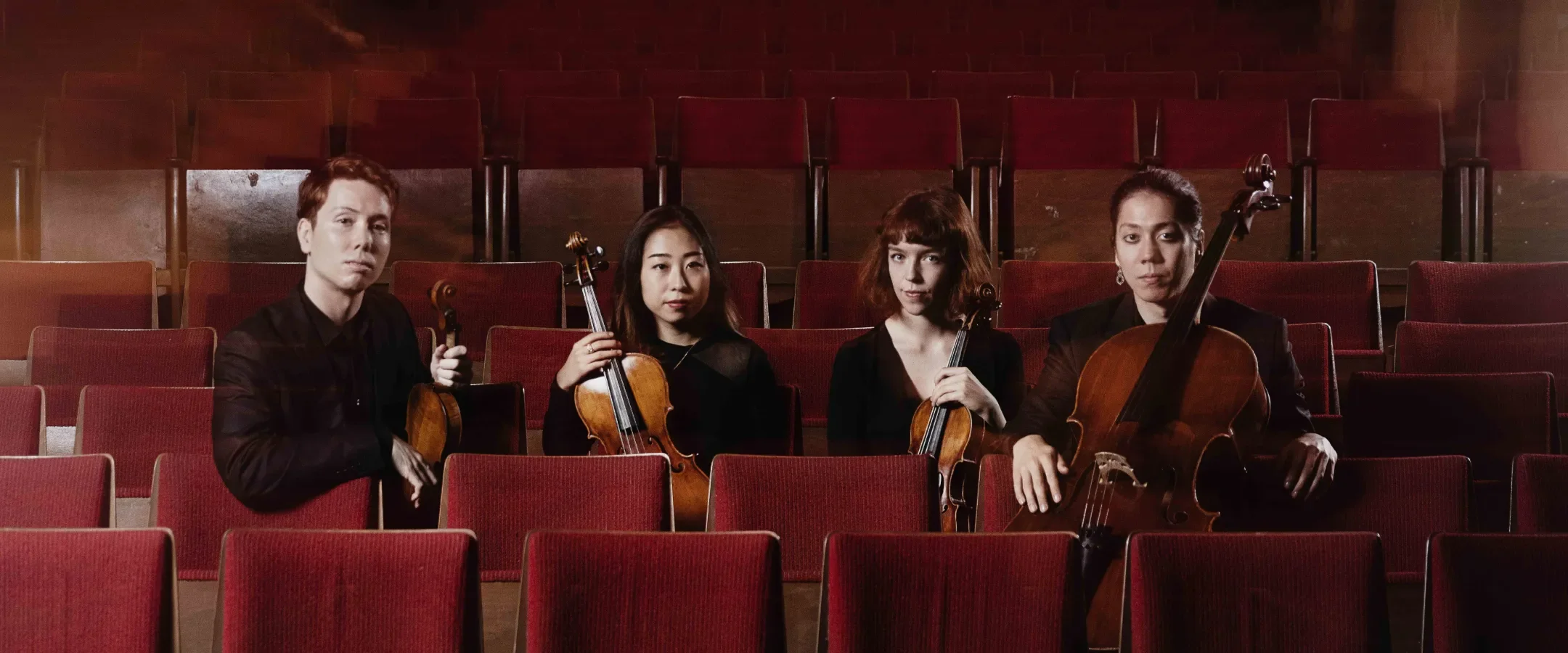
Jonathan Schwarz – violin
Amelie Wallner – violin
Mayu Konoe – viola
Lukas Schwarz – cello
Coproduction: Klarafestival, Flagey
In the context of Entre Chien et Loup 23/24
–
Leoš Janáček (1854-1928)
String Quartet No. 1, ‘Kreutzer Sonata’
I. Adagio – Con moto
II. Con moto
III. Con moto – Vivo – Andante
IV. Con moto – (Adagio) – Più mosso
Robert Schumann (1810-1856)
String Quartet in A Major, Op. 41 No. 3
I. Andante espressivo – Allegro molto moderato
II. Assai agitato
III. Adagio molto
IV. Finale. Allegro molto vivace
How often do we find that love is the basis of a composition, a painting, a poem or another work of art? Love inspires artists to surpass themselves and explore new paths. The composers Leoš Janáček and Robert Schumann are excellent examples of this. Both turned to the string quartet hoping to win the admiration of their respective muses.
A one-sided love
‘I imagined a poor woman, tormented and exhausted, just as the Russian author Tolstoy described in his Kreutzer Sonata.’ These are the words used by the 69-year-old Czech composer Leoš Janáček in a 1923 letter describing his first string quartet to his friend Kamila Stösslová. She was the 38-years-younger wife of a Jewish antiquary. Their meeting in 1917 marked the beginning of one of the most productive periods of Janáček’s life. He composed all his works with Kamila in mind, as he wrote to her: ‘You are behind every note, you, vibrant, strong, loving. The scent of your body, the glow of your kisses. My notes kiss everything of yours.’ His words overflow with passion and longing. Nourished by these feelings, he composed his First String Quartet, the musical expression of his unrequited love for his muse.
From arousal to uncontrollable urges
Janáček took inspiration for his quartet from the dark atmosphere of Leo Tolstoy’s (1828-1910) novella, The Kreutzer Sonata. In the novella, an inconsolable man tells of how, in a fit of jealousy, he murdered his apparently unfaithful wife. The emotional experience of the main character is at its heart. The title of the novella refers to the central role of the eponymous violin sonata by Ludwig van Beethoven in the story. Tolstoy describes how the frenzied presto passages in the first movement of the violin sonata evoke the arousal that eventually evolves into uncontrollable urges such as musical ecstasy, sexual desire and jealous rage. Janáček avoids making direct connections with the novella in his string quartet. Even so, it is not difficult to hear the emotional evolution of Tolstoy’s story in the intense musical gestures and the build-up to the eventual climax. On the contrary, the role of the thematic material from the first part of Beethoven’s Kreutzer Sonata is unmistakable. For example, Janáček uses a variation of Beethoven’s swift main theme from the third bar of the opening movement (in the form of a folkish melody) and opens the third movement with the restrained second theme of the famed violin sonata.
An emotional release
Janáček loved to construct his music from short, powerful motifs rather than extended themes. In the opening movement, this is expressed as a main theme that consists of two sections: the two slow, dramatic opening bars are followed by the aforementioned fast, folkish melody. The two sections are repeated three times, whereupon the second theme commences, reverting to the opening bars. Despite the limited number of motifs, Janáček evokes a wide range of sensations and emotions. This is because the motifs recur again and again in other transformations thanks to variations in rhythm, dynamics and playing techniques (such as tremolos, sul ponticello, pizzicatos etc.). Again in the second movement, Janáček plays with contrasting passages and folkish melodies. Many hear in this movement the arousal referred to in Tolstoy’s novella. However, the third movement is even more effective with the canonical use of the lyrical second theme of Beethoven’s Kreutzer Sonata. Does this canon represent a dialogue between the wife and the supposed lover? The canon is repeatedly interrupted by shrill, repeating notes that are a musical expression of the husband’s madness. The final movement repeats, in an almost elegiac manner, the first bars of the opening movement; the calm before the storm. Soon, the movement is characterised by an emotional release of remorse and reckless desperation.
Quartet-like thoughts
As in the case of Janáček, the string quartet genre has a modest place in the oeuvre of the German composer Robert Schumann. Schumann was more at home writing short piano pieces and songs. It is only thanks to the encouragement of his wife Clara that he started to take on weightier genres such as symphonies and string quartets in 1841 – the year of their marriage. His three string quartets, collected in his Opus 41, date from 1842. During that year he was captivated by what he called ‘quartet-like thoughts’. Over the course of several months, he listened to and studied quartets by Joseph Haydn, Wolfgang Amadeus Mozart and Ludwig van Beethoven, and soon afterwards completed the three works he gave to his new wife as a birthday gift.
The fantasist and the dreamer
It is clear from the opening bars that Schumann’s third string quartet is inspired by those of his predecessors. He borrows Haydn’s idea of beginning the quick opening movement (Allegro molto moderato) with a slow introduction (Andante espressivo). Mozart and Beethoven can be heard in the tonal ambiguity and daring chromatic harmonies in these opening bars. In his string quartets, however, Schumann wanted to take a step forward in the evolution of the genre: ‘When I think of the highest calibre of music that Bach and Beethoven left us, I attach great importance to the rare states of mind that the composers reveal to me. I wish for each of their works to take us a step further into the spiritual realm of art. I wish for poetic depth and novelty in every detail and as a whole.’
What Schumann brings to the genre is the expressive variation between restrained and turbulent passages which many associate with the dualistic emotional life of the composer. He was hypersensitive and manic-depressive, and he embodies this in his compositions in the form of two characters: ‘Florestan’, the capricious, impetuous fantasist, and ‘Eusebius’, the inconsolable, introverted, contemplative dreamer. These pseudonyms are in dialogue with each other in the opening movement of his quartet by means of contrasting themes and characters. No less personal is his treatment of the second movement, the Scherzo, which he casts in the variation form. Mozart and Beethoven only used this form for slow movements. In contrast, Schumann starts from an agitated, syncopated theme upon which he bases five highly contrasting variations. The movement ends serenely and thus introduces the intense third movement, Adagio. This is the longest movement of the quartet and again, Schumann’s restless alternation between poignant lyricism and rhapsodic passages returns. The disquiet only dissolves in the grandiose final movement, which is particularly cheerful and festive. Happy birthday, Clara!
Waldo Geuns, translated by ISO Translation & Flagey
Leonkoro Quartet
The young Leonkoro Quartet, founded in Berlin in 2019, has been showered with international praise since its breakthrough in 2022. Thanks to this growing interest, the quartet will make its debut this year at major concert halls such as the Berliner Philharmonie, the Concertgebouw Amsterdam and the Konzerthaus Wien. The ensemble has received several prestigious awards, including first place at the Wigmore Hall International String Quartet Competition and the Concours International de Quatuor à Bordeaux. Esperanto for Lionheart, the name Leonkoro is a nod to the book The Brothers Lionheart by Astrid Lindgren, which, like the quartet's repertoire, aims to show how darkness and comfort can coexist.
There are still tickets left for the concert with Minguet Quartett at 8 p.m. in Studio 4.
presenting partners
Klara, KPMG
event partners
Belfius, BMW, Proximus, Brouwerij Omer Vander Ghinste, Interparking
public funding
Brussels Hoofdstedelijk Gewest, Nationale Bank, Nationale Loterij-meer dan spelen, Vlaamse Gemeenschap, Vlaamse Gemeenschapscommissie
cultural partners
Bozar, Flagey, Ancienne Belgique, Kaaitheater, Muntpunt
festival suppliers
Maison De La Poste, Fruit at Work, Levi Party Rental, Drukkerij Bosmans, Café Victor, Brussels Booking Desk, Ray & Jules, Maison Dandoy
media partners
VRT 1, VRT Canvas, Radio 1, Bruzz, De Standaard, Knack / Le Vif, La Libre, Musiq3, La Première, La Trois, Ring TV, visit.brussels