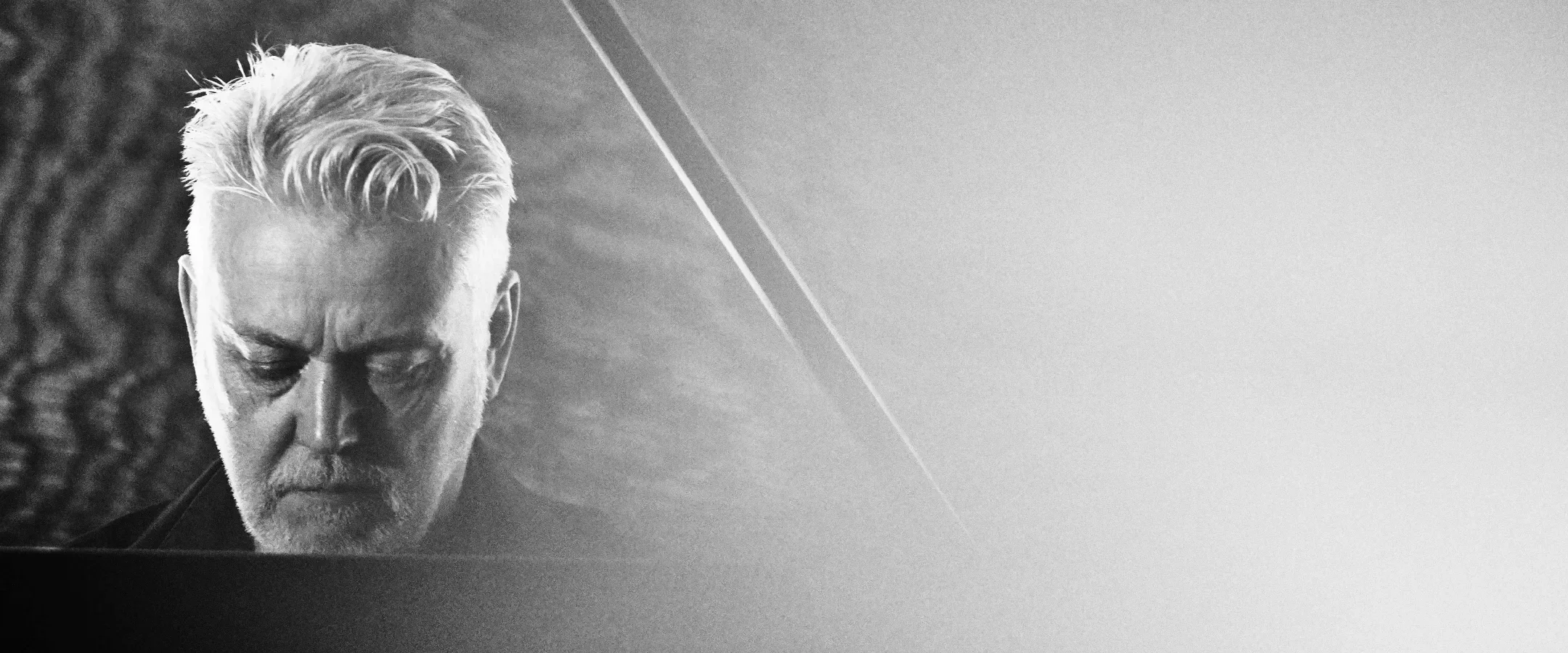
Belgian National Orchestra & Bas Wiegers
Ode to Wim Henderickx
Welcome to the 19th edition of Klarafestival! The theme Crossroads - Come Together keenly evokes the convergence of the audience, the artists and their inspiring concerts. A meeting place where the leading lights of international classical music enter into dialogue with challenging creations and young talent.
The inspiration for this edition comes from festival artist Claron McFadden. As she told us in an interview, “I stand at a crossroads where styles and generations cross, meet, and collide”. This notion forms the core of the programme. We hope you will enjoy Klarafestival as a sanctuary of hope, polyphony and beauty in all its forms. As a place where the familiar takes on new meaning and where new experiences take you by surprise.
Jan Raes, chairman
Joost Fonteyne, intendant
Chantal Pattyn, manager Klara
Belgian National Orchestra
Bas Wiegers – musical direction
Sophia Burgos - soprano
Coproduction: Klarafestival, Bozar, Belgian National Orchestra
With the support of: Ambassade van het Koninkrijk der Nederlanden in België
–
Claude Vivier (1948-1983)
Lonely Child
Wim Henderickx (1962-2022)
TEJAS (What does the sound of the universe look like?)
– interval –
Igor Stravinsky (1882-1971)
Le Sacre du printemps
Music as primal experience
The three works in this concert’s programme share a fascination for music as a kind of primal experience: as the expression of a child’s earliest impressions, as a quest for the universe’s very first sounds, and as an expression of primary rhythmic pulses. The composers are guided by the spirituality of eastern music or by the primitive musical culture of their own homeland. Claude Vivier undertook a long journey through South-East Asia and his musical experiences there would have a lasting influence on his own compositions, as one hears in Lonely Child (1980). Wim Henderickx also looked for musical and spiritual profundity while on a pilgrimage through India and Nepal. The major orchestral work TEJAS (2009), like many of his compositions, can be heard as a personal echo of that journey. Finally, Igor Stravinsky’s Sacre du Printemps (1913) broke with virtually all musical conventions and, conceived as a return to the primal experience of musical language, laid the foundations of 20th century musical modernism.
Lonely Child
The Canadian composer Claude Vivier is known as a representative of spectral music, though this term hardly does justice to the unique character of each of his compositions. What is distinctive is rather his constant quest for a personal musical language. In 1971, this quest took him to Cologne and Karlheinz Stockhausen, one of the Western-European avant-garde’s most radical musical exponents. In 1974, Vivier returned to Montreal where he processed the results of his studies in his own unique way. Equally important was his trip to Bali, Japan and Thailand in 1976-77, where he fell under the spell of Gamelan and other Eastern percussion instruments.
Lonely Child (1980) for soprano and orchestra is a powerful, autobiographically-tinged work. To fully understand the context of this work, it is vital to know that his mother placed the newborn Vivier in an orphanage. The lifelong search for his birth mother became an essential theme in his music. The longing to be soothed to sleep by a mother figure is heard in the text’s opening lines, written by Vivier himself: ‘Bel enfant de la lumière dors, dors, dors, toujours dors.’ [‘Beauteous child of light, sleep, sleep, sleep, forever sleep.’] Moments later, Vivier switches to an ‘invented language’ of syllables chosen for their expressive value. At the close of the text appears the name ‘Tazio’, possibly a reference to the youth Tadzio in Thomas Mann’s Death in Venice and an allusion to the homo-eroticism that played such an important role in Vivier’s life, and in his untimely death (Vivier became the victim of homophobic violence, ed.).
Lonely Child is a powerfully lyrical composition. In the opening segment, a long melody resonates between strings and clarinets, with rhythmic punctuation from the rin (a percussion instrument that Vivier got to know in Japan and that provides a ritual character to the music). With the soprano’s entrance begins what Vivier describes as a ‘play of colours’, and what would later be defined as spectral music. Through the addition of intervals (expressed in frequencies or oscillations) new intervals appear, often in the form of quarter tones that lie between the notes on the piano. Together these form what are no longer recognizable as chords, but timbres or colours. This results in a unique sound that is both recognisable and liberating.
TEJAS
Like Vivier, Wim Henderickx drew inspiration from Eastern thinking, despite avoiding any direct imitation of Eastern music. Instead of ‘multicultural’ music, Henderickx preferred the term ‘intercultural’ music, in which cultures meet and learn from each other, while retaining their distinctiveness. A good example of this is Tantric Cycle (2004 – 2010), a cycle of seven compositions in which Henderickx shaped his travel impressions of the Himalayan mountain range. TEJAS (2009) forms the sixth part of the cycle, and includes the subtitle ‘What does the sound of the universe look like?’ The word ‘Tejas’ has several meanings in Sanskrit: fire, light and creative energy.
The composer divided the work into seven large segments, with three interludes or ‘Gunas’ during which various orchestral instruments perform solos in the foreground. The work begins with a sort of ‘Big Bang’, an overpowering chord containing the embryo for the entire work. This material is then fragmented and heard in wind instruments and strings as trills or vibrations, representing the oscillations of the universe (as the energy from which stars, planets and all other matter is created).
Besides these vibrations, it is above all the rhythmic impulses that underpin and give form to the work, through an immense percussive structure operated by five musicians. As a percussionist himself, Henderickx was fascinated by percussion instruments from around the world, and in this work we hear, besides Western instruments, exotic examples such as Japanese drums, Thai gongs and Indian bells. But above all, this massive percussive structure is there to create the most diversified combinations of sounds and colours. Following the unusually inventive exploration of these sonorities, the epilogue contains what the composer describes as ‘frozen time’: a standstill in time, eventually vanishing into nothingness with a few last ethereal tones from the solo first violin.
Le Sacre du printemps
The premiere of The Rite of Spring, on 29 May 1913, caused one of the biggest scandals in Western musical history. This was the third ballet written by Stravinsky for Diaghilev’s ‘Ballets Russes’ and this time choreography was in the hands of the young dancer Vaslav Nijinsky. Contemporary reports appear to affirm that it was not the music (which couldn’t be heard anyway, because of the riot taking place in the theatre) but the primitive motions of the dancers that caused the greatest outrage: the contrast with the fairy-tale or folkloric choreography of The Firebird or Petrushka was too much for many in the audience.
The Rite of Spring later caused further sensation, not as a ballet but as an orchestral piece. The structure of the work still reflects its origins in the theatre. The first part, ‘The Adoration of the Earth’ consists of a succession of dances in which Stravinsky wished to convey the connection to the earth with the arrival of spring. He was inspired by Russian folk melodies which he radically transformed. The second part, ‘The Sacrifice’, portrays an ancient pagan ritual at which a selected young girl dances to death in the presence of the elders, in order to placate the spring deity.
The influence of The Rite of Spring on 20th century music was immense. The dissonant sonorities resulting from chords stacked one on top of the other, the irregular rhythmic accents, the constant changes of metre and the use of short, motivic cells, permanently changed the post-1913 musical world. Stravinsky’s score in itself became a sort of primal experience or ‘Big Bang’, whose tremors continue to be felt.
Kristof Boucquet, translated by Patrick Goddard
Belgian National Orchestra
The Belgian National Orchestra has long had the Centre for Fine Arts (Bozar) as its home base. The orchestra plays most of its concerts in the Henry Le Bœuf Hall, but also regularly performs in all the provincial capitals of Belgium thanks to its permanent collaboration with the Festival van Vlaanderen and Festival de Wallonie. In addition, it maintains an international presence through tours abroad and by providing accompaniment during the Queen Elisabeth Competition. The focus of the orchestra is on classical-romantic symphonic music, regularly combined with contemporary works and film music. Since 2022, BNO has been led by Dutch chief conductor Antony Hermus.
Bas Wiegers
Bas Wiegers is a Dutch conductor with a repertoire ranging from Baroque to contemporary music. He has led orchestras and ensembles such as the Netherlands Philharmonic Orchestra, WDR Sinfonieorchester Köln, Ensemble Modern and Klangforum Wien and performed on opera stages such as Oper Köln, Opéra national de Lorraine and the Tiroler Festspiele Erl. He also regularly collaborates with contemporary composers such as Georg Friedrich Haas, Helmut Lachenmann, Salvatore Sciarrino and Rebecca Saunders. This season, he is permanent guest conductor with the Munich Chamber Orchestra and will make his debut with, among others, the Belgian National Orchestra, ORF Radio-Symphonieorchester Wien and the Concertgebouw Orchestra.
Sophia Burgos
Puerto Rican-American soprano Sophia Burgos has built an international reputation in recent years. She has sung as a soloist with ensembles and orchestras such as the London Symphony Orchestra, Los Angeles Philharmonic, Symphonieorchester des Bayerischen Rundfunks, Monteverdi Ensemble, Klangforum Wien and Ensemble Intercontemporain. She has also performed both classical and contemporary opera roles on the stages of La Monnaie, National Opera Amsterdam, Angers-Nantes Opéra, Volksoper Wien and the Edinburgh International Festival. Burgos is committed to new music and has created works by composers such as Beat Furrer, Johannes Maria Staud, François Paris and Michael Gandolfi.
Claude Vivier
Lonely Child
Bel enfant de la lumière dors, dors, dors, toujours dors.
Les rêves viendront, les douces fées viendront danser avec toi.
Merveille, les fées et les elfes te fêteront, la farandole joyeuse t'enivrera.
Ami.
Dors, mon enfant, ouvrez-vous portes de diamant, palais somptueux,
mon enfant, les hirondelles guideront tes pas.
Kuré nouyazo na-oudè waki nannoni eudou-a.
Dors, mon enfant.
Dadodi yo rrr-zu-i yo a-e-i dage dage da è-i-ou dage dage ou-a-è dagè dadoudè dagè dagè dagè
na-ou-è ka jadè-do yanousè mayo rès tè de-i-a wè nanoni nowi i-è ka.
Les étoiles font des bonds prodigieux dans l'espace, temps, dimensions zébréés de couleurs.
Les temps en paraboles discutent de Merlin, les magiciens merveilleux embrassent le soleil d'or,
les acrobates touchent du nez les étoiles pas trop sages, les jardins font rêver aux moines mauves.
Rêves d'enfant, donnez-moi la main et allons voir la fée Carabosse, son palais de jade sis au millieu des
morceaux de rêves oubliés déjà flotte éternellement.
Oh reine des aubes bleues donne-moi s'il te plaît l'éternité.
Oh Reine.
Koré noy Tazio.
Koré kore Tazio Tazio Tazio.
Koré noy na-ou yasin kè.
L'hélianthe douce dirige vers les étoiles l'énergie sublime, Tazio, la langue des fées, tu la parleras
et tu verras l'amour, Tazio, tendrement tes yeux verts, puiseront dans les lambeaux de contes surannés pour en créer un vrai le tien, Tazio, donne-moi la main, Tazio, Tazio, et l'espoir du temps, du temps.
Hors temps apparaît mon enfant, les étoiles au ciel brillent pour
toi, Tazio, et t'aiment éternellement.
Beauteous child of light sleep, sleep, sleep, forever sleep.
The dreams will come, the gentle fairies will come and dance with thee.
Wonder, the fairies and the elves will fête thee and the merry farandole will inebriate thee.
Friend.
Sleep, my child. Open up, doors of diamond, sumptuous palaces,
my child, the swallows will guide thy steps.
Kuré nouyazo na-oudè waki nannoni eudou-a.
Sleep, my child.
Dadodi yo rrr-zu-i yo a-e-i dage dage da è-i-ou dage dage ou-a-è dagè dadoudè dagè dagè dagè
na-ou-è ka jadè-do yanousè mayo rès tè de-i-a wè nanoni nowi i-è ka.
The stars make prodigious leaps in space, time, dimensions striped with colored zebra-markings.
The times discuss Merlin in parables, the wondrous magicians splash the glowing sun with gold, the
acrobats touch with their nose the mischievous stars, the gardens make the mauve monks dream.
Children’s dreams, give me your hand and let us go and look up the fairy Carabosse.
Her palace of jade, lying amidst pieces of forgotten dreams, is already floating in eternity.
Oh, queen of blue dawns, give me, please, eternity.
Oh, Queen.
Koré noy Tazio.
Koré kore Tazio Tazio Tazio.
Koré noy na-ou yasin kè.
The gentle helianthus directs the sublime energy towards the stars, Tazio.
The language of the fairies, you will speak it and you will know love, Tazio.
Tenderly, your green eyes will dip into dregs of outmoded tales to create a real one, yours, Tazio.
And the hope of time, of time.
Beyond time, my child appears, the stars in the sky are shining
for you, Tazio, and will love you forever and ever.
presenting partners
Klara, KPMG
event partners
Belfius, BMW, Proximus, Brouwerij Omer Vander Ghinste, Interparking
public funding
Brussels Hoofdstedelijk Gewest, Nationale Bank, Nationale Loterij-meer dan spelen, Vlaamse Gemeenschap, Vlaamse Gemeenschapscommissie
cultural partners
Bozar, Flagey, Ancienne Belgique, Kaaitheater, Muntpunt
festival suppliers
Maison De La Poste, Fruit at Work, Levi Party Rental, Drukkerij Bosmans, Café Victor, Brussels Booking Desk, Ray & Jules, Maison Dandoy
media partners
VRT 1, VRT Canvas, Radio 1, Bruzz, De Standaard, Knack / Le Vif, La Libre, Musiq3, La Première, La Trois, Ring TV, visit.brussels