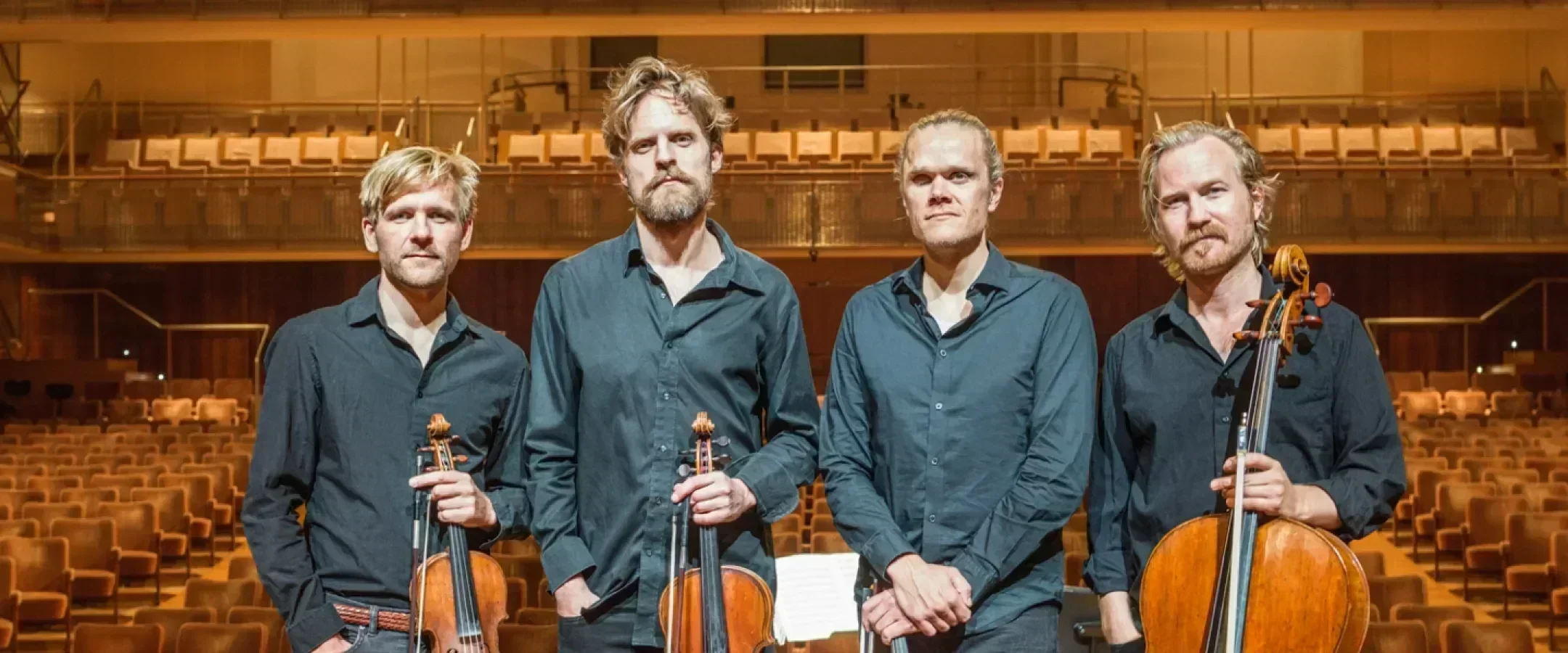
Danish String Quartet
Doppelgänger I
Welcome to the 20th Klarafestival!
Under the title We Are Now, this special anniversary edition pays tribute to the here and now. No one embraces the magic of the moment more fearlessly than festival artist Patricia Kopatchinskaja. Wherever and whatever she plays, this Moldovan violinist and composer sets the stage alight. For her, every concert is a new beginning, a full moment in which anything can happen. Klarafestival 2025 paints a multifaceted portrait of Patricia Kopatchinskaja as a violinist, composer and inspiring presence.
In honour of our 20th anniversary, we are launching a new tradition: for one day, Mont des Arts will be transformed into the Muziekberg /Mont des Musiques. Alongside concerts and performances at various venues, a new ensemble will also see the light. Sound of Brussels Orchestra goes in search of the exceptional sound of our capital.
We live in challenging times, and some of the festival projects reflect on this. At the same time, they demonstrate how much hope can lurk between the notes of a Stabat Mater or a Dies Irae. How music can move and inspire us. For Patricia Kopatchinskaja, music is no abstract matter: ‘Music is there for us to do something with it. Even when it has no concrete message or function, it appeals to us. It wants to be heard. I don't believe in absolute music. Not really.'
Let the celebration begin!
Joost Fonteyne, intendant
Jan Raes, chairman
Chantal Pattyn, network manager
Frederik Øland – violin
Yura Lee – violin
Asbjørn Nørgaard – viola
Fredrik Schøyen Sjölin – cello
Coproduction: Klarafestival, Flagey
Franz Schubert (1797-1828)
String Quartet No. 15 in G Major, Op. Posth. 161, D 887
-
Allegro molto moderato
-
Andante un poco moto
-
Scherzo. Allegro vivace – Trio. Allegretto
-
Allegro assai
– interval –
Bent Sørensen (1958)
Doppelgänger
I.
II.
Franz Schubert / arr. Danish String Quartet
‘Der Doppelgänger’, from Schwanengesang
Doubles
The Danish String Quartet finally presents the long-awaited first part of the DOPPELGÄNGER project (canceled during the COVID-19 crisis). In this project, the internationally acclaimed quartet offered a new programme over four years, in which one of Franz Schubert's chamber music works was associated with a new commissioned composition. The composers involved are significant figures: Bent Sørensen (Denmark), Lotta Wennäkoski (Finland), Anna Thorvaldsdóttir (Iceland), and Thomas Adès (United Kingdom). Each of these composers inspired their new composition on Schubert's String Quintet or one of his last three string quartets. The new works thus became Doppelgängers of the famous masterpieces of the past.
A Unique Sense of Time
The central work of Schubert around which Danish String Quartet’s DOPPELGÄNGER I is built is the String Quartet No. 15 in G major. This last completed quartet by Schubert is a highlight in the history of the genre. As a teenager, writing string quartets was one of Franz Schubert's favourite pastimes. Most of his early quartets were either exercises in a certain style or technique, or written for domestic use, where friends or family members gathered in intimate settings to perform the music. Schubert himself was often the violist in such performances.
In this context, he completed eleven string quartets by 1816. Over the next eight years, he composed no music for quartet except for his Quartettsatz, the first movement of his unfinished String Quartet No. 12. His last three completed quartets then date from the years 1824-1826. In 1824, he completed the Rosamunde Quartet (No. 13) and Death and the Maiden (No. 14), and he finally wrote his String Quartet No. 15 in G major in June 1826 in an astonishingly short period of ten days.
Schubert gives almost symphonic proportions to his fifteenth string quartet by greatly extending the length of the movements (the opening movement alone lasts about 20 minutes) and by his highly contrasting treatment of rhythms, dynamics, and textures. The opening movement, ‘Allegro molto moderato’, is characterized by the use of dotted rhythms and tremolos, giving the music a particularly tense character. In this movement, Schubert experiments with the alternation between major and minor tonality, creating a musical interplay between light and dark, somber and triumphant. This tonal ambiguity is only resolved in the closing bars, where the key of G major is affirmed.
Schubert also greatly extends the second movement, ‘Andante un poco moto’. The elegiac character with which the movement opens is agitatedly interrupted in the middle passage by the dotted rhythms and tremolos from the opening movement. The following ‘Scherzo Allegro vivace — Trio. Allegretto’ is again predominantly lighthearted, with the slower trio (a Ländler) providing a moment of calm within the overall quartet. In this movement, the tonal ambiguity returns, with numerous references to the tense dotted rhythms of the other movements. It is the harbinger of the powerful and restless final movement. Schubert bases this ‘Allegro assai’ (like the final movement of Quartet No. 14, Death and the Maiden) on a wild Italian tarantella. Only in the closing passage does it become clear which character wins the interplay between light and dark: Schubert ends his grand quartet in a majestic and triumphant manner in the key of G major.
According to violist Asbjørn Nørgaard, the monumental proportions of the quartet influence the perception of time for both performers and audience: ‘Somehow, you get caught in the tangle of Time, where you don’t know if you’ve been playing for one minute or eight hours. This is because Schubert’s style is repetitive. The same melodies keep coming back, but always in a different way, with a slightly different color.’
A Musical Hall of Mirrors
‘The influences from the past touch an enigma within me, where they melt away.’ This is how the Danish composer Bent Sørensen (b. 1958) describes his engagement with the great examples of the past. His style is usually characterized by an introspective, refined, sometimes even meditative character, as he works with microtonal soundscapes.
With Doppelgänger, Sørensen returns to the string quartet genre after a long hiatus. His previous four quartets were written for the Arditti Quartet between 1984 and 1993. Doppelgänger dates from 2020 and is inspired by the aforementioned tonal ambiguity between major and minor tonality in Schubert’s String Quartet No. 15. According to the composer, Doppelgänger contains ‘some recurring clean and pure G major chords often transformed, as in the Schubert quartet, to g-minor.’ Furthermore, he builds his two-part work with mirrors, found both within the movements and in the macrostructure: ‘Shadows of music arrive and create new contours. A fugue emerges, and later the fugue can be seen from behind, when it is played backwards. There I was thinking of Schubert. His fight with fugues. A fight I took on…’ The long developmental passages and the continuously shifting pulsation that result from this create a similar sense of time during the performance as in Schubert’s quartet. As violist Nørgaard writes: ‘In some way, Sørensen achieves the same state of mind as Schubert, but through a different kind of time manipulation. It’s like a timeless space,’ a hall of mirrors with countless hidden rooms and a play of shadows and memories that express the composer’s imagination.
A Ghostly Self-Reflection
When Schubert died on November 19th, 1828, he left behind, among other things, fourteen songs on verses by poets Ludwig Rellstab (1799–1860), Heinrich Heine (1797–1856), and Johann Gabriel Seidl (1804–1875). The composer probably did not intend to group them into a cycle, but his publisher Tobias Haslinger saw commercial potential in doing so. He published the songs in 1829 as the famous song cycle Schwanengesang, D 957. Der Doppelgänger, on a text by Heinrich Heine, is the penultimate song in the collection. For the title, it is based on the third and final stanza of Heine's poem:
Du Doppelgänger, du bleicher Geselle!
Was äffst du nach mein Liebesleid,
Das mich gequält auf dieser Stelle
So manche Nacht, in alter Zeit?
(“You Doppelgänger, pale travelling companion!
Why do you ape my song of pain,
That torments me now upon this spot
So many a night, and so long ago?”
(translation by Donald Gíslason))
The poem is about a man who sees a ghostly figure deep in thought at the house where his beloved once lived. In the figure, he recognises himself, overwhelmed by the loss of his love, full of pain and heartbreak. Musically, Schubert refers to the works of Johann Sebastian Bach. For example, the stately accompaniment is a baroque passacaglia, and he quotes the Fugue in F-sharp minor, BWV 849, from Das wohltemperierte Klavier I in the opening notes of the vocal melody. Der Doppelgänger is one of Schubert's most intense compositions. The predominantly recitative vocal line expresses the hopeless situation of the poem’s protagonist, a figure whom the composer, weakened by illness, undoubtedly saw as his own emotional Doppelgänger.
Waldo Geuns
Danish String Quartet
The Danish String Quartet, founded in 2004, is known for its inventive concert programmes, with a repertoire ranging from classical and contemporary works to arrangements of folk music. In addition, the quartet seeks to appeal to a new audience through original projects such as the DSQ Festival, a festival featuring experimental concert formats and new repertoire. In the four-part concert series DOPPELGÄNGER, the Danish String Quartet always pairs a string quartet or quintet by Franz Schubert with a commissioned work by a contemporary composer. The quartet has won several awards, including the Musical America Award for Ensemble of the Year in 2020, and was nominated for a Grammy Award. The Danish String Quartet is currently exclusive with ECM Records and has previously recorded for DaCapo and Cavi-Music/BR Klassik. www.danishquartet.com
Structural partners
Klara, KPMG
Event partners
Belfius, Interparking, Proximus
Cultural partners
Ancienne Belgique, Belgian National Orchestra, Bozar, Brussels Philharmonic, Flagey, Kaaitheater, Muntpunt, Passa Porta
Public funding
Nationale Bank, Nationale Loterij meer dan spelen, Stad Brussel, Visit Brussels, Vlaamse Gemeenschap
Media partners
BRUZZ, De Standaard, Knack, La Première, La Trois, Le Soir, Musiq3, Radio 1, Ring TV, Le Vif, VRT Eén, VRT Canvas, VRT Max
Festival suppliers
Daniel Ost, Drukkerij VD, Fruit at Work, Tarteletto, Victor Bozar Cafe
Patrons
Wim Bossens, Alex Brabers, Tania Seynhaeve & Jan Raes, Sophie Rutten