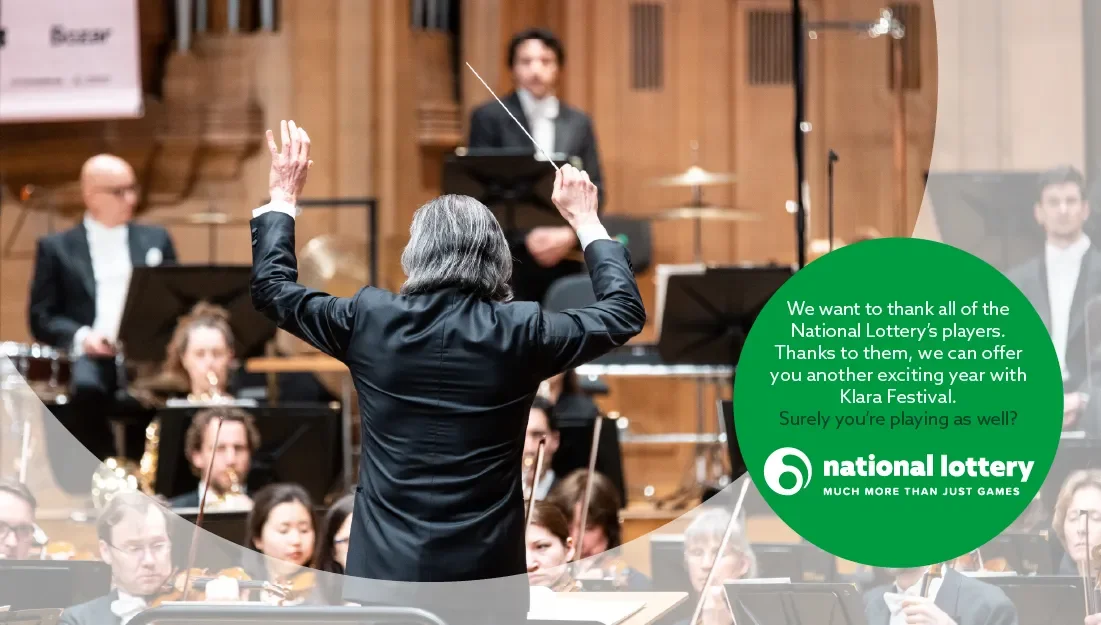
National Polish Radio Symphony Orchestra & Marin Alsop
Stabat Mater
Welcome to the 20th Klarafestival!
Under the title We Are Now, this special anniversary edition pays tribute to the here and now. No one embraces the magic of the moment more fearlessly than festival artist Patricia Kopatchinskaja. Wherever and whatever she plays, this Moldovan violinist and composer sets the stage alight. For her, every concert is a new beginning, a full moment in which anything can happen. Klarafestival 2025 paints a multifaceted portrait of Patricia Kopatchinskaja as a violinist, composer and inspiring presence.
In honour of our 20th anniversary, we are launching a new tradition: for one day, Mont des Arts will be transformed into the Muziekberg /Mont des Musiques. Alongside concerts and performances at various venues, a new ensemble will also see the light. Sound of Brussels Orchestra goes in search of the exceptional sound of our capital.
We live in challenging times, and some of the festival projects reflect on this. At the same time, they demonstrate how much hope can lurk between the notes of a Stabat Mater or a Dies Irae. How music can move and inspire us. For Patricia Kopatchinskaja, music is no abstract matter: ‘Music is there for us to do something with it. Even when it has no concrete message or function, it appeals to us. It wants to be heard. I don't believe in absolute music. Not really.'
Let the celebration begin!
Joost Fonteyne, intendant
Jan Raes, chairman
Chantal Pattyn, network manager
National Polish Radio Symphony Orchestra
NFM Choir
Marin Alsop – musical direction
Erica Eloff – soprano
Zuzanna Nalewajek – alto
Ben McAteer – baritone
Szymon Nehring – piano
Coproduction: Klarafestival, Bozar, Adam Mickiewicz Institute
In the context of the Polish Presidency of the Council of the European Union 2025
Grażyna Bacewicz (1909-1969)
Suita
Karol Szymanowski (1882-1937)
Symphony No. 4 for piano and orchestra, Op. 60, ‘Symphonie concertante’
-
Moderato. Tempo comodo
-
Andante molto sostenuto
-
Allegro non troppo, agitato ed ansioso
– interval –
Krzysztof Penderecki (1939-2020)
Ciaconna (addition to Polish Requiem)
Karol Szymanowski
Stabat Mater, Op. 53
-
Stała matka bolejąca
-
I któż widział tak cierpiącą
-
O matko źródło wszechmiłości
-
Spraw niech płaczę z tobą razem
-
Panno słodka racz mozołem
-
Chrystus niech mi będzie grodem
The father of Polish choir music, the ‘first lady’ of Polish music, and the composer who crossed many borders. That is how Szymanowski, Bacewicz and Penderecki are typified in the literature. In their scores, we see the traces of a turbulent period in Polish history, in music where tradition and innovation go hand in hand.
For Karol Szymanowski (1882-1937), authentic Polish music formed the basis of his education in the somewhat isolated village of Tymoszówka. At the age of 23, he joined the Young Poland group, a collective of composers who, in analogy with artists in other fields, sought a position of their own between conservatism and radical modernism. This broadened his musical horizon, but the new artistic possibilities didn’t always turn out to be compatible with government requirements. So Szymanowski decided to travel around Europe, even venturing as far as Morocco and Algeria. He met his contemporary Stravinsky, and Debussy who was twenty years his senior, and saw how they had found their own voices in different ways. When Szymanowski returned to Poland after the First World War, he immersed himself in local folk music. Like Stravinsky and Bartók, he saw the potential of developing a musical language through folk music: one which would be rooted in tradition but modern all the same.
In his 1926 work Stabat Mater, the connection with his homeland is extremely strong, and not only because the text is sung in Polish. The melodies and choir parts are also infused with Polish tradition. Simultaneously, though, Szymanowski pairs these elements with a subtle dissonance and pervasive expressiveness that are specific to the aesthetic of Young Poland. Thus he developed a sound that would go on to inspire later composers such as Henryck Górecki and Witold Lutosławski.
The intensity of the music cannot be separated from the context in which it was written. The first impetus for the piece was a request from the Princess of Polignac in 1924 to compose a Polish requiem. Ultimately nothing would come of that, but when the wealthy industrialist Bronisław Krystall commissioned him shortly afterwards to write a new piece in memory of his late wife Izabela, Szymanowski took up his initial ideas again. While he was composing the piece, his favourite niece, his sister’s daughter, died. This profound event both slowed down the composition process and moved Szymanowski to use the text of the Stabat Mater instead of the requiem. The text of the Stabat Mater, expressing Mary’s grief at the death of her son, taps into the emotions that Szymanowski had felt when grieving with his sister. By opting for a Polish translation rather than the Latin text, he brings the bible story closer to personal experience.
In his Fourth Symphony, Szymanowski appeals to an entirely different range of emotions. This final symphony is actually a piano concerto. He composed the piano part to play himself, making it part of the orchestral fabric rather than a virtuoso element in the foreground. In the many rhythmic passages, you hear the influence of Polish folk music. The opening bars contain a piano line that could have flowed straight from Chopin’s pen. Almost imperceptibly, this music transforms into a Bartók-like outburst of energy, followed in turn by an episode of stillness and restrained tension. The influence of Impressionism, and Debussy in particular, can also often be heard. The start of the second movement – with a combination of the flute, viola and piano – sounds like a distant echo of Debussy’s Sonata for flute, viola and harp. The way in which Szymanowski makes sophisticated use of the entire orchestral apparatus (including percussion) to shape these different musical elements into a strong overall work is typical of his personal style: eclectic but coherent.
The music of Krzystof Penderecki (1933-2020) is difficult to categorise. He composed both avant-garde ‘sound clouds’ and compelling film music, and he even made forays into the Neo-Baroque. This stylistic versatility is held together by a strong personality that always started out with a conviction that the music was necessary. As such, many of his compositions are linked to the political and social events of his time. He gained great fame with Threnody to the Victims of Hiroshima, and also with the various sections of his organically emerging Requiem, all of which are connected to specific events or people.
The Requiem grew out of a Lacrimosa that he composed in 1970 as a memorial to the victims of an anti-government uprising in 1970. He added sections through the years, the last of which was the Ciaccona in 2005. This meditative piece is dedicated to Pope John Paul II, who died earlier that year. Penderecki couples the traditional, repetitive structure of the classical chaconne with a moderately dissonant sound in which the harmony sometimes seems to flirt with the fixed schemes of the Baroque.
That Grazyna Bacewicz (1909-1969) is known today as the ‘first lady’ of Polish music does not mean that she is as famous as her male colleagues. Her symphonic music is gradually making its way onto concert programmes, albeit mainly those of Polish orchestras. In this programme, we will hear an early work, composed while she was still studying at Warsaw Conservatory. Incidentally, Szymanowski was head of the conservatory at the time. When she moved to Paris a few years later, the famous music teacher Nadia Boulanger noted that she – like most Polish students, in fact – had a sound classical basis, and that she continued to make rapid progress as a composer.
Her Suite for orchestra, from 1931, has disappeared into the folds of music history over the years. The piece is still mentioned here and there in lists of her early works, but it has hardly ever been played (indeed probably never), so we still have to wait a while for a more thorough evaluation of her music. What is certain is that Bacewicz was still working on her personal language in that period, with a Neoclassical approach as a strong basis for the many original compositions that would follow.
Klaas Coulembier
Translation: Helen White
National Polish Radio Symphony Orchestra
The National Polish Radio Symphony Orchestra debuted on the radio in 1935 and has since become one of the most important orchestras in Poland. It rose to international fame through collaborations with artists such as Leonard Bernstein, Martha Argerich and Arthur Rubinstein. In addition, the orchestra has premiered works by composers such as Witold Lutosławski, Henryk Mikołaj Górecki and Krzysztof Penderecki. Over the course of its history, the orchestra has been conducted by Jan Krenz, Jerzy Maksymiuk, Antoni Wit, Gabriel Chmura and Lawrence Foster, among others. It is currently led by Artistic Director and Chief Conductor Marin Alsop and General and Programme director Ewa Boguz-Moore.
NFM Choir
The NFM Choir was founded in 2006 by conductor Andrzej Kosendiak. For the first 15 years, it was led by Agnieszka Franków-Żelazny, until Lionel Sow became artistic director in 2021. The choir has worked with renowned conductors such as Giovanni Antonini, Zubin Mehta, Kirill Petrenko and James MacMillan and orchestras such as the Budapest Festival Orchestra, Bach Collegium Japan and the Berliner Philharmoniker. It has performed at the Royal Albert Hall London, Gewandhaus Leipzig, Lucerne Festival, Osterfestspiele Baden-Baden, Philharmonie de Paris and Warsaw Autumn, among others. The core of the NFM Choir repertoire includes premieres by composers such as Krzysztof Penderecki, Agata Zubel and Julia Wolfe.
Marin Alsop
American conductor Marin Alsop is chief conductor of the ORF Vienna Radio-Symphony Orchestra, the Polish National Radio Symphony Orchestra and the Ravinia Festival and permanent guest conductor of the Philharmonia Orchestra and the Philadelphia Orchestra. In addition, she has regularly collaborated with the London Symphony Orchestra, the New York Philharmonic and the Gewandhausorchester Leipzig. Alsop was music director of the Baltimore Symphony Orchestra for 14 years, where she organised the first European tour in years, released several successful recordings and founded the educational project OrchKids for children in vulnerable situations. She was the first and only conductor to receive the prestigious MacArthur Fellowship in 2005.
Erica Eloff
French soprano Erica Eloff specialises in opera, lieder and oratorios. She is currently a member of the ensemble of the Landestheater Linz, where she has performed the roles of Eva in Wagner's Die Meistersinger von Nürnberg, Mimi in Puccini's La Bohème and Contessa di Almaviva in Mozart's Le nozze di Figaro. She has also appeared at Oper Graz, Handel Festival Göttingen, Mozartfest Würzburg, the London Handel Festival, Garsington Opera and the theatres of Ulm, Lübeck and Bielefeld. In 2008 she won the Handel Singing Competition in London. She has also premiered works by contemporary composers such as James Wilding and Hannes Taljaard.
Zuzanna Nalewajek
Polish mezzo-soprano Zuzanna Nalewajek studied at the Fryderyk Chopin University of Music in Warsaw and at the Opera Academy of the Polish National Opera with Olga Pasiecznik, Eytan Peessen and Vesselina Kasarova, among others. She made her debut in 2021 as Dorabella in Mozart's Così fan tutte at Opera Wrocław and has since been seen at the Royal Polish Opera, the Polish National Opera, Baltic Opera Festival in Gdańsk, Kaunas Music Theater (Lithuania), Theater Endla (Estonia) and the National Taichung Theater (Taiwan). She also won first prize at the International Claudia Taev Competition in Pärnu (Estonia) and the International Song Competition in Sofia.
Ben McAteer
Northern Irish baritone Ben McAteer studied at the University of St Andrews. As an opera singer he has appeared at the Irish National Opera, the Grange Festival, Theater an der Wien, the Scottish Opera, Welsh National Opera and Northern Ireland Opera in roles such as Pangloss in Bernstein's Candide, Conte Almaviva in Mozart's Le nozze di Figaro and Papageno in Mozart's Die Zauberflöte. He has also worked with orchestras such as the Royal Scottish National Orchestra, Ulster Orchestra, Symphoniker Hamburg and the National Symphony Orchestra of Ireland. McAteer has collaborated on several CD recordings, including Maltworms & Milkmaids, a collection of orchestral songs by Peter Warlock with the BBC Concert Orchestra.
Szymon Nehring
Polish pianist Szymon Nehring reached the finals of the Fryderyk Chopin International Piano Competition in Warsaw (2015) at the age of nineteen and won the Arthur Rubinstein International Piano Master Competition in 2017. Since then, he has worked with orchestras such as the Warsaw Philharmonic, Symphoniker Hamburg and the Orchestra of the Eighteenth Century. He has performed at venues such as Carnegie Hall, Wiener Musikverein and the Auditorio Nacional de Música in Madrid. He has worked with conductor and composer Krzysztof Penderecki and played his piano concerto, among other pieces. In addition, Nehring recorded Chopin's two piano concertos with Sinfonietta Cracovia conducted by Penderecki.
NFM CHOIR
Maciej Adamczyk, Jakub Bieszczad, Agata Chodorek, Filip Chudzicki, Krzysztof Domański, Dawid Dubec, Marek Fras, Paweł Jan Frasz, Paweł Fundament, Andrzej Górniak, Magda Górniak, Michał Grabczuk, Izabela Grad, Aleksandra Hanus, Barbara Jastrząb, Jarosław Kawałko, Małgorzata Kątnik, Natalia Kiczyńska, Ewelina Koniec, Patrycja Kujawa, Dominik Kujawa, Bianka Maxim, Marta Mączewska, Aleksandra Michniewicz, Ewelina Nawrocka, Agnieszka Niezgoda, Jan Okraska, Joanna Palac, Marek Paśko, Ewa Pieronkiewicz, Jan Pieter, Michał Pytlewski, Agata Ranz, Paulina Rogóż-Migacz, Joanna Rot, Agnieszka Ryman, Jacek Rzempołuch, Marcin Scech, Lionel Sow, Kinga Tomczyk, Aleksandra Turalska, Łukasz Wilda, Błażej Wiliński, Aleksandra Winnicka, Marcin Winnicki, Bartłomiej Witczak, Ewelina Wojewoda, Piotr Woroniecki, Violetta Wysocka-Marciniak, Grzegorz Zajączkowski
NATIONAL POLISH RADIO SYMPHONY ORCHESTRA
1. Violin
Piotr Tarcholik (leader)
Sulamita Ślubowska (leader)
Grzegorz Witek
Janusz Klich
Jacek Siemek
Lucyna Fiedukiewicz
Katarzyna Laburda
Karolina Szefer-Trocha
Dorota Cieślińska
Katarzyna Jawor
Beata Ogryzek
Aleksander Daszkiewicz
Krzysztof Katana
Jan Mazur
2. Violin
Kinga Tomaszewska (leader)
Maria Strzelczyk
Beniamin Czech
Grzegorz Bartoszek
Małgorzata Bugdoł
Anita Bartłomiejczyk
Marcin Josz
Piotr Marcinowicz
Teresa Mercik-Szopa
Joanna Jasiak
Magdalena Ziętek
Michał Kowalczyk
Viola
Dawid Jadamus (leader)
Mieczysław Krzyżowski
Wincenty Krawczyk
Andrzej Żydek
Irena Jarosz-Marcinkiewicz
Eugeniusz Mikołajczyk
Joanna Tesarczyk
Agnieszka Hałuzo
Sandra Kałuża
Adam Brakowski
Cello
Adam Krzeszowiec (leader)
Natalia Kurzac-Kotula
Karolina Nowak-Waloszczyk
Roman Hałoń
Bogusław Zaremba
Magdalena Czech
Anna Tumidajska
Norbert Pióro
Double bass
Aleksander Mazanek (leader)
Krzysztof Firlus
Michał Paliwoda
Łukasz Bebłot
Krzysztof Wąsik
Marek Romanowski
Flute
Łukasz Zimnik (leader)
Małgorzata Otremba
Oboe
Karolina Stalmachowska (leader)
Urzula Lipień
Clarinet
Zbigniew Kaleta (leader)
Bartosz Pacan
Bassoon
Cezary Rembisz (leader)
Grzegorz Popławski
French horn
Krzysztof Tomczyk (leader)
Paweł Cal
Damian Walentek
Adrian Ticman
Trumpet
Piotr Pyda (leader)
Wojciech Kaszuba
Piotr Nowak
Trombone
Michał Mazurkiewicz (leader)
Zdzisław Stolarczyk
Karol Gajda
Tuba
Jakub Urbańczyk (leader)
Timpani
Wojciech Morcinczyk (leader)
Drums
Krzysztof Jaguszewski
Dariusz Brauhoff
Michał Żymełka
Adam Bonk
Harp
Krzysztof Waloszczyk (leader)
Structural partners
Klara, KPMG
Event partners
Belfius, Interparking, Proximus
Cultural partners
Ancienne Belgique, Belgian National Orchestra, Bozar, Brussels Philharmonic, Flagey, Kaaitheater, Muntpunt, Passa Porta
Public funding
Nationale Bank, Nationale Loterij meer dan spelen, Stad Brussel, Visit Brussels, Vlaamse Gemeenschap
Media partners
BRUZZ, De Standaard, Knack, La Première, La Trois, Le Soir, Musiq3, Radio 1, Ring TV, Le Vif, VRT Eén, VRT Canvas, VRT Max
Festival suppliers
Daniel Ost, Drukkerij VD, Fruit at Work, Tarteletto, Victor Bozar Cafe
Patrons
Wim Bossens, Alex Brabers, Tania Seynhaeve & Jan Raes, Sophie Rutten