Revue Blanche & Katharina Smets
Nenia
Welcome to the 20th Klarafestival!
Under the title We Are Now, this special anniversary edition pays tribute to the here and now. No one embraces the magic of the moment more fearlessly than festival artist Patricia Kopatchinskaja. Wherever and whatever she plays, this Moldovan violinist and composer sets the stage alight. For her, every concert is a new beginning, a full moment in which anything can happen. Klarafestival 2025 paints a multifaceted portrait of Patricia Kopatchinskaja as a violinist, composer and inspiring presence.
In honour of our 20th anniversary, we are launching a new tradition: for one day, Mont des Arts will be transformed into the Muziekberg /Mont des Musiques. Alongside concerts and performances at various venues, a new ensemble will also see the light. Sound of Brussels Orchestra goes in search of the exceptional sound of our capital.
We live in challenging times, and some of the festival projects reflect on this. At the same time, they demonstrate how much hope can lurk between the notes of a Stabat Mater or a Dies Irae. How music can move and inspire us. For Patricia Kopatchinskaja, music is no abstract matter: ‘Music is there for us to do something with it. Even when it has no concrete message or function, it appeals to us. It wants to be heard. I don't believe in absolute music. Not really.'
Let the celebration begin!
Joost Fonteyne, intendant
Jan Raes, chairman
Chantal Pattyn, network manager
REVUE BLANCHE
Lore Binon – soprano
Caroline Peeters – flute
Kris Hellemans – viola
Anouk Sturtewagen – harp
Katharina Smets – audio, voice, text
Frederik Neyrinck – composition
Lise Bruyneel – video
Katherina Lindekens – dramaturgy
Jannes Dierynck - technical support
RE Antwerp – costumes
Wederik De Backer – audio mix
Jurgen Delnaet – outside eye
André Verkaeren – French translation
Coproduction: LOD muziektheater, Klarafestival, CC De Factorij, Flagey
With the support of the Flemish Community
The Presence of Absence
How do you deal with the death of a loved one? What does it mean to continue living in the presence of absence? Revue Blanche are creating a new production with audio artist Katharina Smets, composer Frederik Neyrinck and video artist Lise Bruyneel. Nenia – literally ‘song for the dead’ – is somewhere between a concert, an audio play and a sound poem. A few weeks before the premiere, dramaturge Katherina Lindekens spoke to three of the artists.
Katherina Lindekens – Do you remember how the idea for this production came about?
Katharina Smets – Five years ago, we created the Misia performance and podcast. It was such a wonderful experience that we all wanted to work together again. We explored various avenues, but gradually our discussions began to centre more and more around grief and loss. There was sorrow within the group, and it became increasingly clear that this was what we wanted the project to be about.
Anouk Sturtewagen (harpist Revue Blanche) – My sister died of leukemia in August 2019.
KS – And not that long afterwards, my mother contracted exactly the same form of the illness. She died in September 2022.
AS – That was an intense period… I remember that at a certain moment I was playing in Gabriel Fauré’s Requiem with Symfonieorkest Vlaanderen. We happened to hold rehearsals in the school that my sister and I had attended together. I always loved Faurés music, but never took much notice of the meaning behind the old, Latin text. Now, suffering bereavement, and in that specific setting, I was completely overwhelmed. All at once, I experienced the full impact of that work. Afterwards, we began to wonder what a ‘requiem’ might look like for us today.
KS – What we also quickly understood, was that the five of us wanted to go a step further in our collaboration. We wanted to search for a new form, in which various sorts of text, sound and music could come together. In Misia, those worlds remain relatively demarcated; this time we wanted to let them really resonate with each other.
KL – What was it like to begin work on such a personal theme?
KS – At times it was tough. I have to admit that this project has really haunted me for the past two years. I’m also happy that a certain amount of time has since passed. So we’ve been able to work in stages and allow the material to gradually crystallise.
KL – What did that process look like?
KS – After my mother’s death, my first reflex was to talk to fellow sufferers – various people who had also been through a grieving process. These conversations were incredibly inspiring. They became an important foundation for the performance.
In addition, I wrote a lot: diary entries, dreams, poetry. During the process, those texts evolved into an associative narrative framework that binds together various layers of the performance. There are interview fragments, poems in Polish – my mother tongue – references to the Orpheus and Eurydice myth, and field recordings that I had made during a road trip with my mother.
And then there was naturally the music’s metaphorical translation. I found it so fascinating to see how meticulously Frederik read the texts, and how his music abstracted them. Lise, in her turn, brought a graphic dimension to the whole project. Through that series of transformations, the text became increasingly ‘texture’ – the raw material for an artisanal process. Our personal experiences became integrated in a much bigger story.
KL – Did the gatherings that you organised in the interim also contribute to that?
KS – For sure. During these ‘salons’, we talked to thinkers, shared sketches and fragments from the performance and asked for feedback from the audience. These were crucial ‘testing the waters’ moments for me: instead of diving straight into the depths, we could, in the meantime and on a smaller scale, experience how it felt to share this theme with an audience.
KL – Frederik, what were your starting points for the score?
Frederik Neyrinck – The quest for a formal polyphony was extremely exciting for me. How does the counterpoint between music, text and audio sound? How do you get spoken word and song to converse? The intention was to write an actual quintet for Katharina and Revue Blanche.
The musicians and I have known each other since our student days. The ensemble has been together for fifteen years, and in that time I’ve written plenty of arrangements for their unusual instrumentation (Caroline Peeters on flute; Kris Hellemans on viola; Anouk Sturtewagen on harp; and soprano Lore Binon). The assignments usually called for editing compositions in the style of, say, Debussy or Ravel. As a composer, you then have various options, depending on how closely you keep to the original. For Nenia, we really wanted to explore that entire spectrum – from the most faithful transcription to the most adventurous adaptation.
In addition, we played for a long time with the idea of treating the Revue Blanche instruments as a sort of baroque ensemble – just as Debussy did in his trio, the Sonata for Flute, Viola and Harp. Monteverdi’s L’Orfeo – one of the very first operas, was therefore an interesting source for us. Not only for its content, but also musically, since the ‘original’ of such a baroque opera by definition lies outside our reach.
KL – Could you explain?
FN – The instrumentation is totally different, and by no means is everything written down in detail. The score is more of a blueprint, leaving room for interpretation. We therefore approach L’Orfeo as a reservoir of content, from which we draw sometimes recognisable and sometimes heavily adapted passages. In Nenia, you hear these appear and then go back into hiding, like a palimpsest, where you see just a hint of the old manuscript below the new layers. The production also contains a lot of new music, including a Polish song cycle that provides structure to the whole.
AS – Yes, funnily enough, this is one of the first times that we play a ‘genuine Neyrinck’. (laughs) Nenia feels like a natural step in our collective journey.
KL – Katharina, what does L’Orfeo mean to you?
KS – The Orpheus myth has been told and depicted so often that it has become almost sacred. It’s funny with these primal stories: at first glance they seem so remote from us, but when you yourself become a ‘character’ in such a story, it suddenly comes much closer. It is simply about fundamental human experiences – precisely for that reason, these sorts of narratives are reinterpreted by each successive generation.
We, too, are now doing that, to a certain extent, with Nenia. Whilst we abstracted the plot significantly, I enjoyed relating to it. The five-act structure alone remains a useful principle. (laughs) What I also like is the collective history of these sorts of archetypal narratives. It wasn’t just one single genius who dreamed up this story. It’s been around for three thousand years, and receives new meanings with every rereading.
KL – What aspects do you focus on?
KS – What particularly struck us was the process that Orpheus – the ‘one left behind’ – goes through after Eurydice’s sudden death. Initially he is in shock. Then he is angry, inconsolable, in turmoil. He refuses to accept what has happened and descends into the underworld to retrieve his loved one. It’s all so familiar. That feeling of despair, that human urge to communicate with the dead: ‘I’m not yet prepared to accept this new state of being.’ And then that image of the descent: the sentiment of being unable to continue unless one literally faces the facts.
KL – It’s apt that you express it like that, because those eyes will still play tricks on him.
KS – Yes indeed. Orpheus’ poetry and music are so beautiful that the gods of the Underworld yield. He may take back Eurydice – but on one condition: that he does not look back at her on the return journey to the world above. Naturally, he does so anyway, and thus loses her a second time. When you see what has happened with your own eyes, then it really is final. That’s how I interpret the looking back. For example, one of the people I spoke to wants no photos of the deceased in his house, because they remind him that death is a fact.
But looking back can also be the moment when we give each other permission to continue on our paths. In Nenia, you hear my mother at her parents’ graveside, reciting a prayer that guides the souls to eternal light. That moment in the performance represents for me both a culmination and a new beginning. A beginning of acceptance.
KL – At the end of Monteverdi’s L’Orfeo, Eurydice becomes a constellation in the heavens. A metamorphosis, thanks to a deus ex machina. How do you interpret that?
KS – For us, that metamorphosis lies mostly in a series of reflections on death and the idea of an ‘afterlife’. Each of those we spoke to saw this differently. Some have a materialistic perception: we disintegrate into atoms. Others see things more spiritually. However, almost everyone in our ‘chorus of voices’ agrees that, one way or another, we are returned to nature. Incidentally, this multiperspectivity was a key intuition for the project. In Monteverdi, one follows a hero’s journey, an individual quest. We introduce a communal story around that.
AS – To me, that collective aspect feels like an essential part of bereavement. Every year, for example, on my sister’s birthday and date of death, we come together with friends and family. We go for a walk, or go swimming, as she liked to do. But besides that, I regularly speak to her friends. You could say that I’ve inherited some of her friendships. Those contacts are tremendously valuable. Thus, I really experience bereavement as a communal process. In the animal world, it’s similar. Elephants bury their dead and sing together at the graveside. And orcas carry dead members of their species with them, sometimes for days.
KL – Over the past two years, we’ve often been surprised by how present the theme of grief is in the media and arts. Is it more openly discussed than before, or is that just an impression?
KS – To my mind, that’s our personal filter. Like pregnant women who suddenly see other pregnant women everywhere. (laughs) It’s remarkable how grief only really appears on your radar when you are personally affected. One of our interviewees jokingly welcomed me to the ‘mourning club’ – and it really does feel like that. Which is why those interviews were so cathartic. Both in myself, and in the people I spoke to, I noticed how great the need is for connection when one stands close to death. It still remains a great mystery, with which we are all involved. Therefore there will probably always be new art created about loss – just like songs about love. (laughs)
KL – Perhaps the arts are also a rewarding space in which to talk about death? We can’t talk about death after dying, so we are dependent on our imaginations.
AS – In our secular society, I certainly think that is the case.
FN – What we can thank the arts for, is that different perspectives can exist, one beside the other. Which is why I’m also so pleased that in Nenia we don’t fill in everything for the listener. We certainly create a framework, but the form is deliberately kept open. That seems desirable to me, considering that each of us reacts differently to loss.
Musically, that was also a key question for me: how to deal with such an intense theme? There is the concrete layer of the text and a musical layer, where each person experiences different associations. What feels neutral for one person, may for another be mawkish or overwhelming.
I like to think about how one gets the worlds of words and music to join in dialogue. What happens when text and music give each other space, and what if they overgrow each other? When do you highlight an emotion, and when do you provide it with a musical counter voice?
KL – Anouk, how do you experience that as a performer?
AS – I find so much emotion in the score, even when it occasionally appears from somewhere unexpected. In the final Monteverdi fragment, for example, the accompaniment of Lore’s singing is muted. As if one is literally being suffocated by a crushed or blunted emotion. That’s why, paradoxically enough, I find the passage extremely moving. At the same time, Frederik’s music is rhythmically quite complex. As musicians we have to be fully focused. I like that, because thanks to this extreme focus, I’m less easily overwhelmed. I don’t want to bring my raw emotions to the stage. No, just give me some hard work to do. (laughs)
KS – That was also an issue for me during the creative process: although Nenia began with a personal experience, I wanted to find a form that would also communicate with and for others. Which in turn doesn’t mean that we wish to offer ‘help’ or solutions. Sometimes we can only say that there is no solution, and that we feel connected by that. Darkness is allowed to exist.
AS – To me, this all sounds so familiar. Life was much better with my sister. At first I resonated most with the voices in Nenia that simply express how terrible such an experience of loss feels. I had to get used to those who zoomed out and philosophised, who saw a ‘new beginning’ behind the goodbye. But after a time, I began to find these different perspectives very valuable. Each spectator will probably find a connection through different ideas.
KS – I hope that our performance can lead to a more open conversation about death and loss. The word ‘nenia’ means ‘lament’ or ‘elegy’. For me, the essence of our project lies precisely in that ritual of narrating, of conversation, of posing questions. As long as we continue to voice the names of the dead, they will continue to live – and those left behind can live on, without letting go. Grief is such an existential earthquake. The foundations of your existence are shaken, and there is no way back. You are inevitably a changed person through the experience. In that sense, it is a real transformation, a metamorphosis.
Katherina Lindekens
Revue Blanche
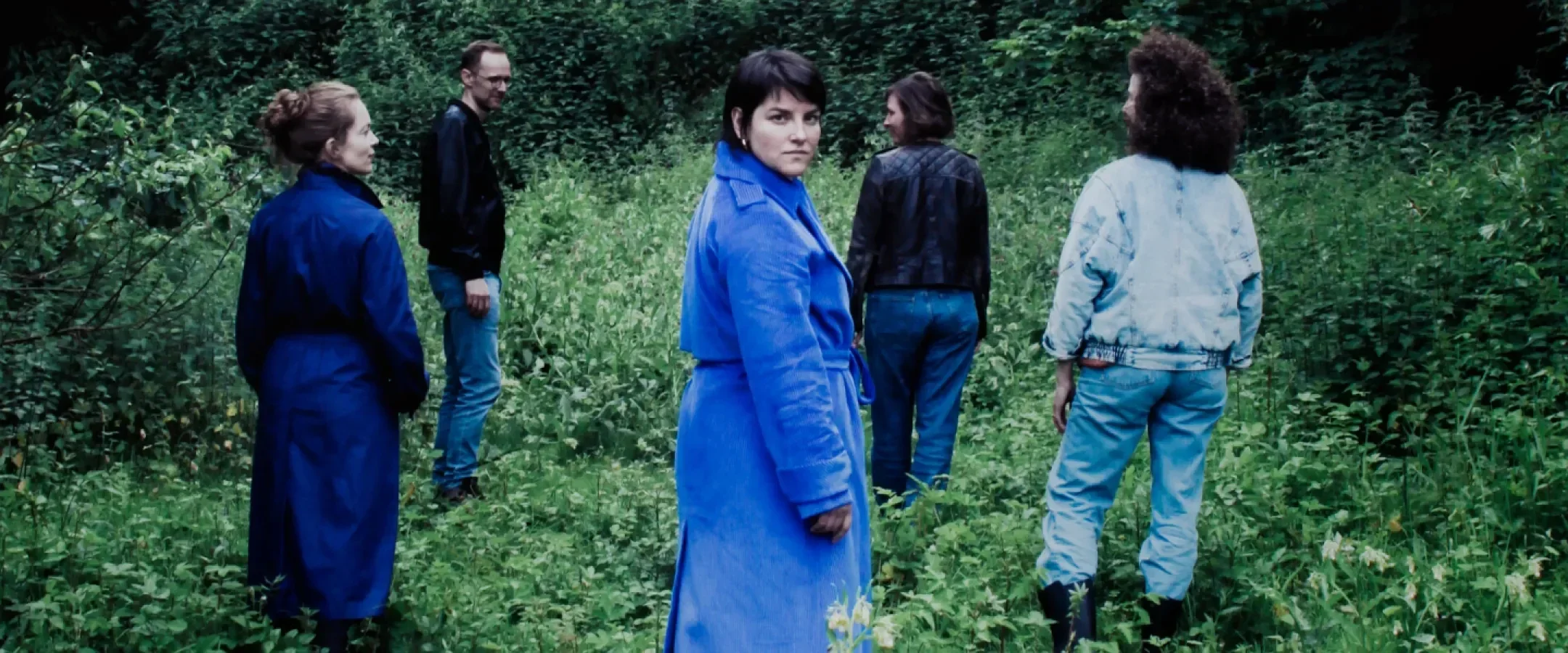
The chamber music ensemble Revue Blanche, founded in 2010, is named after the 19th-century French magazine 'La Revue Blanche'. The symbolic 'white' as the sum of all colours ties in with the multi-coloured nature of the ensemble, with its special line-up of soprano, flute, viola and harp. The idea of white as a blank slate also refers to the ensemble's wide-open search for interesting and unusual repertoire, often in multidisciplinary concert programmes with visual arts, dance, literature and electronics. Revue Blanche has been an ensemble in residence at De Bijloke and has also performed at cultural centres such as the Elbphilharmonie Hamburg, Muziekgebouw aan 't IJ Amsterdam and Opéra de Lille.
Katharina Smets
Audio artist Katharina Smets makes live performances and radio productions based on documentary materials. She works as an independent creator in Belgium, the Netherlands, Great Britain and the US. She also teaches audio storytelling at the Royal Conservatory in Antwerp and obtained her doctorate in the arts on the attitude of the audio documentary maker (University of Antwerp and Royal Conservatory, ARIA). She is a much sought-after advisor in the making of audio stories for podcasts, audio guides and theatre. Smets previously made the narrative musical performance Misia (2019) with Revue Blanche, broadcast as a podcast on Klara, and she collaborated on the podcast De Stemmen by Opera Ballet Vlaanderen.
Frederik Neyrinck
Composer Frederik Neyrinck studied in Brussels, Stuttgart, and Graz under Piet Kuijken (piano) and composers Jan Van Landeghem, Marco Stroppa, and Clemens Gadenstätter. His works have been performed by ensembles such as I SOLISTI, Revue Blanche, and SPECTRA, and he has collaborated internationally with Asko|Schönberg, Quatuor Bozzini, and Klangforum Wien. From 2020 to 2028, he is artist-in-residence at I SOLISTI. He is also active in the field of music theatre and opera, serving as artist-in-residence at LOD muziektheater. In 2023, he composed his first opera, Kruistocht, for Opera Ballet Vlaanderen. His previous collaborations include makemake produktionen (Vienna), Kopergietery, and Staatstheater Oldenburg.
Lise Bruyneel
Lise Bruyneel works at the crossroads of visual art and the performing arts. After studying cello and art history in Brussels, Berlin and Rome, she started off as a cellist, and then became a dramaturge in the opera world. In 2009, she founded la fabrique des regards, a creative platform reflecting on the combination of sounds and images in various ways and for various institutions, from publishing projects to exhibitions, from the Ruhrtriennale to the Paris Opera. Since 2013, she has been experimenting with new paths between images and music by live-mixing videos during classical concerts, in a poetical language and a musical rhythm.
Katherina Lindekens
Katherina Lindekens traverses the realms of music, words, and sound. She studied literary theory (VUB) and musicology (KU Leuven) and is active as a dramaturge in music theatre, opera, dance, and audio. She has worked with artists such as Clément Cogitore, Julian Rosefeldt, Philippe Grandrieux, Benjamin Abel Meirhaeghe, Gorges Ocloo, Femke Gyselinck, Lies Pauwels, and Alexander Vantournhout. In recent years, she has also started to develop a practice as an audio maker, with a particular passion for field recording. For Opera Ballet Vlaanderen, she created the podcast De Stemmen in collaboration with Katharina Smets and Maarten Buyl, as well as the soundscape Werelden in Wording with Inne Eysermans.
Structural partners
Klara, KPMG
Event partners
Belfius, Interparking, Proximus
Cultural partners
Ancienne Belgique, Belgian National Orchestra, Bozar, Brussels Philharmonic, Flagey, Kaaitheater, Muntpunt, Passa Porta
Public funding
Nationale Bank, Nationale Loterij meer dan spelen, Stad Brussel, Visit Brussels, Vlaamse Gemeenschap
Media partners
BRUZZ, De Standaard, Knack, La Première, La Trois, Le Soir, Musiq3, Radio 1, Ring TV, Le Vif, VRT Eén, VRT Canvas, VRT Max
Festival suppliers
Daniel Ost, Drukkerij VD, Fruit at Work, Tarteletto, Victor Bozar Cafe
Patrons
Wim Bossens, Alex Brabers, Tania Seynhaeve & Jan Raes, Sophie Rutten