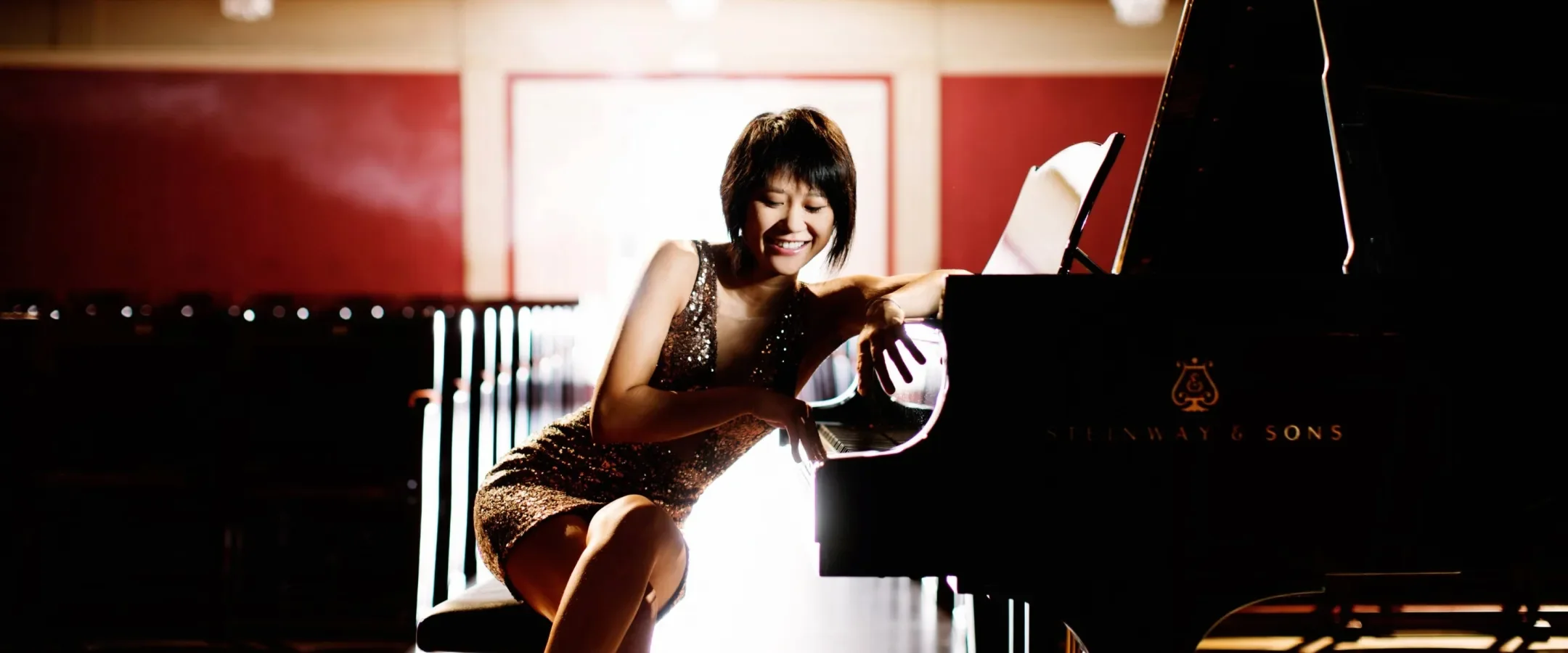
Swedish Radio Symphony Orchestra, Esa-Pekka Salonen & Yuja Wang
From Ravel to Rautavaara
Where Is Home?
Coming home in music
A man steps onto the stage, cello in hand. He looks out into the concert hall, spreads his arms and says, ‘Welcome. Tonight, you are not listeners, but participants. Our meeting is an exchange.’ Then he begins to sing and play, and everything becomes clear. He absorbs the audience’s energy like a human antenna and returns it tenfold. The concert hall shifts into an intimate living room. Everyone who witnessed it walks away transformed.
This is essentially how a concert by Abel Selaocoe unfolds. Together with this charismatic cellist, singer and composer, we warmly welcome you to the 21st Klarafestival. As a festival artist, Selaocoe will play three concerts spanning the full spectrum of his musical world. From traditional music from his native South Africa to baroque, jazz, contemporary classical and improvisation: he melds all these influences into a unique body of work, centred on identity and cultural exchange.
The theme of this year's festival is taken from the debut album of Selaocoe’s own Bantu Ensemble: Where Is Home? It is an open question with endless answers – especially in the super-diverse city of Brussels, home to 180 nationalities and 100 languages. Our capital is a crossroads, a refuge, a temporary or permanent home for countless individuals, each carrying their own story. Every day, we feel privileged that our festival can take root in such fertile soil.
Klarafestival 2026 is an ode to the city we call home. During Muziekberg/Mont des Musiques, Brussels musicians will take over the Kunstberg (Mont des Arts) for a day, from the Musical Instruments Museum to Bozar, from the Ravenstein Gallery to the Royal Museums of Fine Arts. And both Radio Lomax and the choir Les Invisibles (La Voix des Femmes Sans Papiers) will perform Brussels songs with diverse roots.
Our mission is to show as wide an audience as possible that classical music is alive and kicking. Even the most familiar works take on fresh life in the hands of the adventurous musicians we surround ourselves with. Prepare to be captivated by Bach's St John Passion as conducted by Maxim Emelyanychev. Marvel at Beethoven and Strauss with the Orchestre Philharmonique du Luxembourg. Rediscover Chopin and Scriabin in a performance by Alexandre Kantorow. Or encounter keyboard phenomenon Anthony Romaniuk: like Abel Selaocoe, he intertwines his own compositions with the established repertoire, from Bach to Björk.
This festival programme features many more musical kindred spirits. Annelies Van Parys completed the 8th symphony of her former teacher Luc Brewaeys. Pianists Kris Defoort and Stephane Ginsburgh pay tribute to their friend Philippe Boesmans, who would have turned 90 in 2026. Abel Selaocoe, in turn, improvises with like-minded souls, both old and new, and performs a brand-new cello concerto by American composer Jessie Montgomery.
None of this would be possible without the support of our partners in Brussels and beyond. Bozar, Flagey, De Munt, Ancienne Belgique, Brussels Philharmonic, Belgian National Orchestra, Passa Porta, BNA-BBOT and the Luc Brewaeys Foundation all contribute to Klarafestival’s unique DNA. Our indispensable private partners include KPMG Belgium, Proximus, Brugse Zot, Gimv/WorxInvest and Interparking. We are grateful for the support of the Flemish Community, the Flemish Community Commission, the Brussels-Capital Region and the National Lottery. Our collaboration with VRT and Klara, meanwhile, is the secret to our success as a broadcasting festival. Above all, we thank our enthusiastic audience who follow us both in the concert hall and at home on the radio and VRT MAX.
For Abel Selaocoe, ‘home’ is much more than a building or a place. 'It can be a spiritual space. It can be people. (...) It can be something you find along your travels.’ For seven years, Klarafestival has been ‘home’ for festival director Joost Fonteyne. His sense of adventure and social connection is more evident than ever in this festival programme. In April 2026, he will continue his journey and pass the torch to Jan Van den Borre. Many thanks, Joost, for the wonderful years!
The Klarafestival Team
Joost Fonteyne, intendant
Jan Raes, chairman
Chantal Pattyn, network manager Klara
Swedish Radio Symphony Orchestra
Esa-Pekka Salonen – musical direction
Yuja Wang – piano
Coproduction: Bozar, Klarafestival
In the context of The European Galas
Jean Sibelius (1865-1957)
Symphony No. 7 (in one movement), Op. 105
Einojuhani Rautavaara (1928-2016)
Piano Concerto No. 1, Op. 45
- Con grandezza
- Andante (ma rubato)
- Molto vivace
Maurice Ravel (1875-1937)
Piano Concerto in D Major, ‘For the Left Hand’
Claude Debussy (1862-1918)
La mer
- De l’aube à midi sur la mer
- Jeux de vagues
- Dialogue du vent et de la mer
Composing in the literal sense
Music history is not exactly bursting with links between Finnish and French music. But what does connect the French composers Claude Debussy and Maurice Ravel with the Finns Jean Sibelius and Einojuhani Rautavaara is their adventurous approach to composing. They didn’t worry too much about trends among their contemporaries. By putting musical elements together in highly original ways, they took the act of ‘com-posing’, putting together, almost literally. Sibelius’ Seventh Symphony, consisting of a single movement, is more of a fantasia than a traditionally structured symphony. Ravel integrated many influences from jazz into his Concerto for the Left Hand. Although the title La Mer suggests a picturesque piece, Debussy sounds the most sober of the four composers. He reveals himself as a master of fresh-sounding combinations of timbres, rhythms and harmonies. Finally, Rautavaara is the most extreme ‘com-poser’. He is a musical omnivore who brings together practically every influence that has ever fascinated him in his piano concerto.
Jean Sibelius (1865-1957) completed his Symphony No. 7 in C major, Op. 105 in 1924. Putting a symphony on the market in that year was hardly a groundbreaking act. Liszt and Wagner had already declared the death of the symphony when Beethoven died. But there was a reason why Sibelius had initially called his seventh symphony Fantasia sinfonica. The fact that he didn’t use the sonata and rondo form that are so typical of the symphony doesn’t mean that his piece has no structure. He begins and ends slowly, with an ‘Adagio’. In between, all kinds of segments and contrasting sections emerge from each other. Sibelius uses a recurring trombone theme and an ingenious variety of tempos to orient and direct the listener.
Einojuhani Rautavaara (1928-2016) studied at the Sibelius Academy in Helsinki and later with Roger Sessions and Aaron Copland in the United States. He began his professional career in the turbulent years around the Second World War. At the time, Finnish music was dominated by Neoclassicism and Neoromanticism. Rautavaara absorbed those trends but was also entranced by many other styles, from the dodecaphony of Schönberg and Webern to postwar serialism or Olivier Messiaen’s typical harmonies. ‘It’s impossible to pin me down,’ Rautavaara claimed.
He composed his Piano Concerto No. 1, Op. 45 (1969) in a period when he felt the need for expressiveness. ‘I was disappointed in the ascetic – in my view, even insipid – piano style that was so fashionable at the time,’ he wrote. ‘I wanted to restore the full richness and grandeur of the instrument in my concerto, writing a concerto in the “grand style”.’ Rautavaara certainly succeeded at that. The first movement, ‘Con Grandezza’, lasts for almost half the total duration of the concerto. You hear the grandeur in the lavishly penned piano part that sweeps across the entire keyboard, in the many extreme contrasts in volume, and in all the dramatically ascending and descending lines. Rautavaara also reveals himself as a master in the exploitation of the orchestra’s potential colours. After an almost mystical middle section comes a powerful, impressively energetic finale.
The Concerto pour la main gauche (1931) by Maurice Ravel (1875-1937) also explores all manner of boundaries. Ravel composed the piece for the pianist Paul Wittgenstein. The pianist, whose brother was the illustrious philosopher Ludwig, had lost his right arm in the First World War. His family’s wealth and renown enabled Paul Wittgenstein to commission large amounts of new piano repertoire for the left hand; besides Ravel, Richard Strauss, Benjamin Britten, Sergei Prokofiev and Paul Hindemith responded to his request.
‘In a work like this, it is important to create the impression that the texture is no thinner than that of a piece written for two hands”, Ravel himself wrote of his piano concerto for the left hand. That is reflected in the score by the many athletic leaps and the ingenious way in which Ravel combines the melody and accompaniment in a single hand. The concerto consists of three movements with no pauses between them. The piece begins with a long build-up to a climax, from the deepest regions of the orchestra, the lowest strings and wind instruments. This compelling build-up erupts into a long solo passage for the pianist, who resumes a comparable ascending movement.
In a concert tour of the United States shortly before composing this concerto, Ravel had been overwhelmed by the New York jazz scene. He visited jazz clubs with George Gershwin and Paul Whiteman, staying late into the night. This concerto is strewn with all kinds of jazz influences, particularly in the rhythm. Ravel demonstrates his masterly use of the orchestra’s entire colour palette.
We also hear a wide variety of sound colours in La Mer (1905) by Claude Debussy (1862-1918). Here Debussy uses an extended orchestra and even adds extra timbres: the brass instruments often play with mutes, and he enriches the woodwind section with a piccolo, cor anglais and contrabassoon. A tamtam and tubular bells are added to the already extensive percussion. During the 1889 Paris Exposition, Debussy had also encountered gamelan ensembles from Java and Bali. He conveys that sound idiom with the two harps.
A title like La Mer leads listeners to expect storms, seagulls and lapping waves. There is nothing to prevent you from hearing it in that way. But there is also more to the piece. Debussy’s subtitle Trois esquisses symphoniques makes it clear that his great fascination with the sea also conceals abstract composition processes. The structure, with two fast sections on either side of a central section (with an ‘Andante’ and a ‘Scherzo’) has much in common with a symphony. More still, Debussy’s compositional style, with extensive development of motif material and motifs that appear in every movement, even sounds a bit like Beethoven to the practised ear.
Elise Simoens
Translation: Helen White
What to listen out for:
Ravel
Notice how Ravel demonstrates right from the first big solo passage that five fingers are sufficient for a full, even impressive, combination of melody and accompaniment.
Debussy
The avant-garde composer Pierre Boulez was fascinated by ‘Jeux de vagues’, the middle segment of La Mer. The complex, nuanced play of rhythm and sound colour were what appealed to him most.
Rautavaara
Rautavaara loves working with contrasts. The pianist does not have much time to switch from one extreme to another. Instructions such as ‘FFF brutal’, ‘dolce’ and ‘con tutta la forza’ appear in rapid succession.
Swedish Radio Orchestra
Established in 1925 alongside the first radio broadcasts in Sweden, the Swedish Radio Symphony Orchestra is permanently based at the Berwaldhallen in Stockholm. Shaped by conductors such as Sergiu Celibidache and Herbert Blomstedt, it grew throughout the 20th century into an orchestra of international renown. Daniel Harding was chief conductor from 2007 to 2025, with Andrés Orozco-Estrada taking up the post from the 2026–2027 season. The orchestra also maintains close collaborations with principal guest conductor Maxim Emelyanychev, honorary conductor and former music director Esa-Pekka Salonen, and guest conductors including Barbara Hannigan, Antonio Pappano and Nathalie Stutzmann.
Esa-Pekka Salonen
Finnish composer and conductor Esa-Pekka Salonen is a major presence on the contemporary music scene. He is the former music director of the Los Angeles Philharmonic, the Philharmonia Orchestra, the Swedish Radio Symphony Orchestra and the San Francisco Symphony Orchestra, and will take up the position of music director of the Orchestre de Paris in the 2027-2028 season. Salonen was also co-founder and artistic director of the Baltic Sea Festival. As a conductor, he has led world premieres by composers such as Arvo Pärt, John Adams and Kaija Saariaho. In 1993, Salonen was the first conductor ever to receive the Accademia Musicale Chigiana music prize, and in 2024 he was awarded the prestigious Polar Music Prize.
Yuja Wang
Chinese pianist Yuja Wang is known worldwide for her charismatic stage presence, virtuosity and strong artistic personality. She made her international breakthrough in 2007 when she replaced Martha Argerich as soloist in Tchaikovsky's Piano Concerto No. 1 with the Boston Symphony Orchestra. Since then, she has collaborated with renowned orchestras such as the Los Angeles Philharmonic, the Vienna Philharmonic and the Royal Concertgebouw Orchestra, and with conductors such as Claudio Abbado, Daniel Barenboim, Gustavo Dudamel, Simon Rattle, Antonio Pappano and Yannick Nézet-Séguin. Her numerous recordings have been honoured with an ECHO, an Opus Klassik and a Grammy Award, among other accolades.
Structural partners
Klara, KPMG
Event partners
Brouwerij Halve Maan, Gimv | Worxinvest, Interparking, Proximus
Cultural partners
Ancienne Belgique, Belgian National Orchestra, Bozar, Brussels Philharmonic, De Munt | La Monnaie, Flagey, Muntpunt, Museum of Musical Instruments, Passa Porta
Public funding
Nationale Bank, Nationale Loterij meer dan spelen, Stad Brussel, Visit Brussels, Vlaamse Gemeenschap
Media partners
BRUZZ, De Standaard, La Première, La Trois, Le Soir, Musiq3, Radio 1, Ring TV, VRT Eén, VRT Canvas, VRT Max
Festival suppliers
Daniel Ost, Drukkerij VD, Maison Dandoy