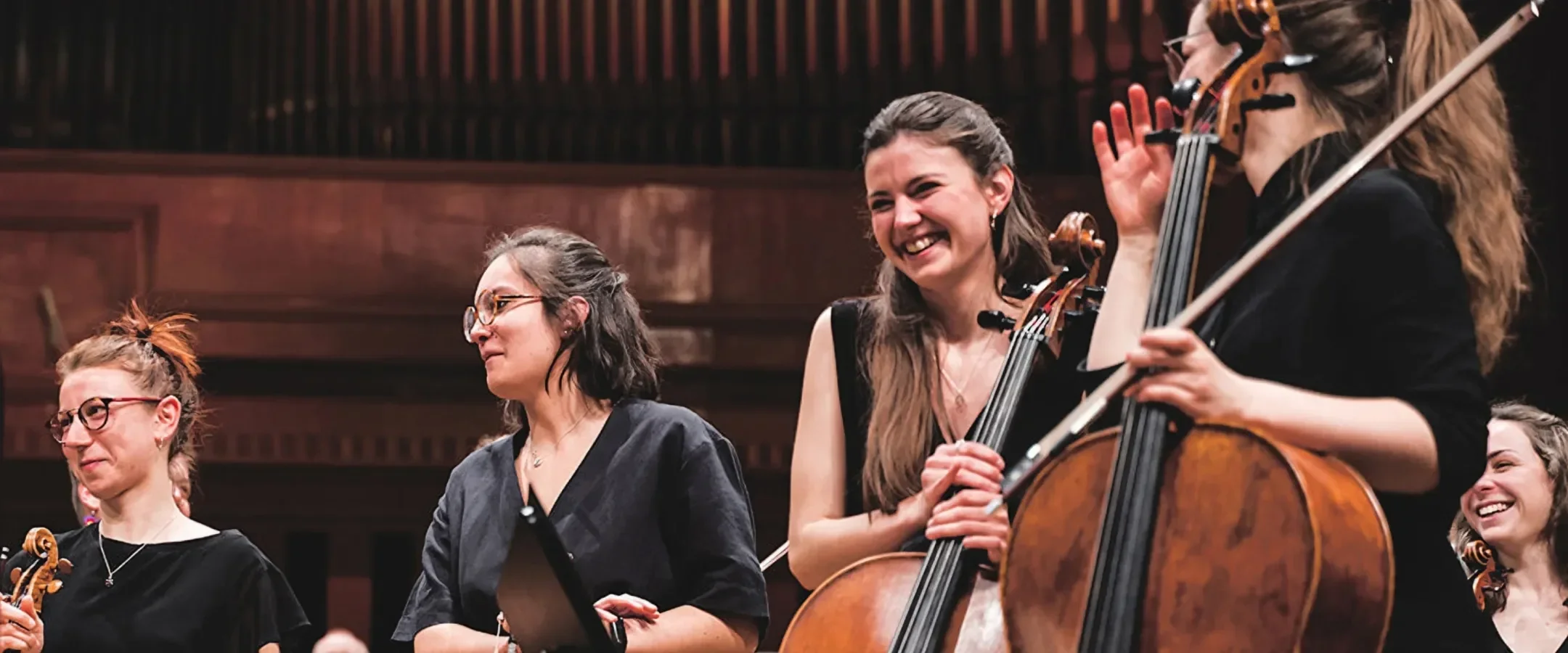
Youth Orchestra Flanders, Ilan Volkov & Joshua Brown
First Times
Where Is Home?
Coming home in music
A man steps onto the stage, cello in hand. He looks out into the concert hall, spreads his arms and says, ‘Welcome. Tonight, you are not listeners, but participants. Our meeting is an exchange.’ Then he begins to sing and play, and everything becomes clear. He absorbs the audience’s energy like a human antenna and returns it tenfold. The concert hall shifts into an intimate living room. Everyone who witnessed it walks away transformed.
This is essentially how a concert by Abel Selaocoe unfolds. Together with this charismatic cellist, singer and composer, we warmly welcome you to the 21st Klarafestival. As a festival artist, Selaocoe will play three concerts spanning the full spectrum of his musical world. From traditional music from his native South Africa to baroque, jazz, contemporary classical and improvisation: he melds all these influences into a unique body of work, centred on identity and cultural exchange.
The theme of this year's festival is taken from the debut album of Selaocoe’s own Bantu Ensemble: Where Is Home? It is an open question with endless answers – especially in the super-diverse city of Brussels, home to 180 nationalities and 100 languages. Our capital is a crossroads, a refuge, a temporary or permanent home for countless individuals, each carrying their own story. Every day, we feel privileged that our festival can take root in such fertile soil.
Klarafestival 2026 is an ode to the city we call home. During Muziekberg/Mont des Musiques, Brussels musicians will take over the Kunstberg (Mont des Arts) for a day, from the Musical Instruments Museum to Bozar, from the Ravenstein Gallery to the Royal Museums of Fine Arts. And both Radio Lomax and the choir Les Invisibles (La Voix des Femmes Sans Papiers) will perform Brussels songs with diverse roots.
Our mission is to show as wide an audience as possible that classical music is alive and kicking. Even the most familiar works take on fresh life in the hands of the adventurous musicians we surround ourselves with. Prepare to be captivated by Bach's St John Passion as conducted by Maxim Emelyanychev. Marvel at Beethoven and Strauss with the Orchestre Philharmonique du Luxembourg. Rediscover Chopin and Scriabin in a performance by Alexandre Kantorow. Or encounter keyboard phenomenon Anthony Romaniuk: like Abel Selaocoe, he intertwines his own compositions with the established repertoire, from Bach to Björk.
This festival programme features many more musical kindred spirits. Annelies Van Parys completed the 8th symphony of her former teacher Luc Brewaeys. Pianists Kris Defoort and Stephane Ginsburgh pay tribute to their friend Philippe Boesmans, who would have turned 90 in 2026. Abel Selaocoe, in turn, improvises with like-minded souls, both old and new, and performs a brand-new cello concerto by American composer Jessie Montgomery.
None of this would be possible without the support of our partners in Brussels and beyond. Bozar, Flagey, De Munt, Ancienne Belgique, Brussels Philharmonic, Belgian National Orchestra, Passa Porta, BNA-BBOT and the Luc Brewaeys Foundation all contribute to Klarafestival’s unique DNA. Our indispensable private partners include KPMG Belgium, Proximus, Brugse Zot, Gimv/WorxInvest and Interparking. We are grateful for the support of the Flemish Community, the Flemish Community Commission, the Brussels-Capital Region and the National Lottery. Our collaboration with VRT and Klara, meanwhile, is the secret to our success as a broadcasting festival. Above all, we thank our enthusiastic audience who follow us both in the concert hall and at home on the radio and VRT MAX.
For Abel Selaocoe, ‘home’ is much more than a building or a place. 'It can be a spiritual space. It can be people. (...) It can be something you find along your travels.’ For seven years, Klarafestival has been ‘home’ for festival director Joost Fonteyne. His sense of adventure and social connection is more evident than ever in this festival programme. In April 2026, he will continue his journey and pass the torch to Jan Van den Borre. Many thanks, Joost, for the wonderful years!
The Klarafestival Team
Joost Fonteyne, intendant
Jan Raes, chairman
Chantal Pattyn, network manager Klara
Youth Orchestra Flanders
Ilan Volkov – musical direction
Joshua Brown – violin
Copresentation: Youth Orchestra Flanders, Klarafestival, Flagey
In the context of Fasten Seat Belts! Celebrating Luc Brewaeys 2025-2026
Luc Brewaeys (1959-2015)
Symphony No. 1 ‘..., e poi c’era …’
Dmitri Shostakovich (1906-1975)
Violin Concerto No. 1 in A Minor, Op. 77
- Nocturne: Moderato
- Scherzo: Allegro
- Passacaglia: Andante – Cadenza (attacca)
- Burlesque: Allegro con brio – Presto
interval
Igor Stravinsky (1882-1971)
L’Oiseau de feu
First Times
With First Times, the young musicians of Youth Orchestra Flanders present a concert celebrating a series of musical ‘firsts’. For Luc Brewaeys, his Symphony No. 1, …e poi c’era…, was not only his orchestral debut but also the blueprint of his distinctive musical language. Stravinsky’s The Firebird was the ballet composition that established his reputation in Paris. And the violinist Joshua Brown first attracted attention at the age of fifteen with a sensitive interpretation of Shostakovich’s First Violin Concerto. Together, these three milestones form a programme distinguished by a sumptuous richness of orchestral colour.
A Symphonic Debut Born from Noise
With …, e poi c’era… (‘…, and then it was there, …’), the twenty-six-year-old Luc Brewaeys composed in 1985 the first of his eight symphonies. This work not only marked his first exploration of the orchestra – a sonic playground in which he could fully realise his characteristic appetite for abundance and timbral variety, it also laid the foundation for his later musical language. To this end, Brewaeys drew on spectralism, a compositional approach that places timbre at the centre. Spectral composers derive their material from analyses of the overtone spectrum, the array of pitches that resonate with the audible ‘fundamental tone’ and thereby shape the distinctive timbre of each sound. Melody, harmony, and form emerge organically from the internal structure of the sound itself.
Brewaeys’ Symphony No. 1 opens with a stream of barely perceptible noise. With their strings almost slackened, the lower strings produce ethereal harmonics, accompanied by soft touches from the percussion section. Gradually, the texture is enriched with meticulously crafted effects: breath sounds in the winds, gongs held under water, and wa-wa effects produced with trombone mutes. Brewaeys described his aim as making electronic music with acoustic means, yet a critic characterised the resulting soundscape just as aptly as ‘an organ with leaking pipes’.
This delicate sonic fabric is occasionally interrupted by sudden strikes, heralding an intense crescendo that bursts forth just beyond the symphony’s midpoint. The orchestra swells, the texture thickens, and the pulse accelerates, until the mass of sound disperses after a brief climax. The quiet, ethereal opening returns, concluding with a mysterious chord that lingers in the concert hall like an unresolved question.
A Concerto under the Shadow of the Regime
For violinist Joshua Brown, Shostakovich’s Violin Concerto No. 1 marked the beginning of his career, but for the composer it coincided with a critical turning point. Composed in 1947–48, the concerto emerged during a period when Shostakovich found himself under fire from the Soviet regime. Even before the Second World War, he had clashed with the authorities: his opera Lady Macbeth of Mtsensk was banned in 1936 following a scathing anonymous review, attributed to Stalin and his inner circle. During and immediately after the war, the regime temporarily raised Shostakovich onto a pedestal, showcasing his grand symphonies, but in 1948, as he was completing his violin concerto, he once again fell out of favour. His music was regarded as violating the new artistic doctrine, which demanded that music serve primarily ideological ends. Fearing repercussions, Shostakovich temporarily withheld the concerto, which would not receive its premiere until 1955, two years after Stalin’s death.
In the intervening years, Shostakovich worked closely with violinist David Oistrakh to refine the solo part to perfection. As a result, the violin leads the orchestra throughout the concerto. Following a brief introduction by the lower strings, the soloist presents an elegiac, seemingly endless melody from which the first movement, ‘Nocturne’, unfolds organically. The second movement, a light-footed scherzo, contrasts sharply with a playful duet between flute and bass clarinet, accompanied by the solo violin. The violin then resumes its central role, driving the music into a demonic dance. The third movement is a passacaglia: the lower strings, timpani, and horns introduce a solemn theme, repeated in a variety of guises. As the movement draws to a close, the texture thins and the violin embarks on a cadenza, a solo passage that grows in virtuosity and intensity. It culminates in the festive finale, ‘Burlesque’, where the solo violin sparkles once more in dazzling brilliance.
A Fairy-Tale Sound World
The Firebird marked Igor Stravinsky’s breakthrough in Paris. He composed the music in 1910 for the legendary Ballets Russes, which, under the direction of impresario Sergei Diaghilev, delighted French audiences with colourful costumes and sets, fairy-tale narratives, and exotically flavoured music. Diaghilev had encountered Stravinsky’s work in 1909 and immediately commissioned him to orchestrate music by Chopin for the ballet Les Sylphides. When Nikolai Tcherepnin, originally intended to compose The Firebird, withdrew, Diaghilev turned swiftly to Stravinsky. This proved a brilliant move: the success of The Firebird inaugurated a revolutionary collaboration that later produced Petrushka and the scandalous triumph The Rite of Spring.
For The Firebird, Stravinsky and Diaghilev drew upon a Russian folk tale. In the garden of the wizard Koschei, Prince Ivan hunts the Firebird, a mythical creature capable of overcoming death. When Ivan captures the bird, she implores him to release her and promises to aid him in times of need. Ivan then encounters thirteen princesses, imprisoned by Koschei. As he attempts to free them, he is caught, and Koschei threatens to turn him to stone. The Firebird intervenes at the last moment, compelling the wizard into an infernal dance and lulling him to sleep, allowing Ivan and the princesses to escape.
The music’s most striking feature is its extraordinarily colourful orchestration. Stravinsky writes for what he himself described as an ‘overabundant’ orchestra, including three harps, celesta, and extensive percussion and brass sections. This opulent palette allows him to characterise the figures vividly: fluttering woodwinds and sparkling harps convey the Firebird’s magic, while dark brass and percussion evoke Koschei’s menace. Numerous special effects, including col legno (playing with the wood of the bow), flutter-tonguing (a rapid rolling of the tongue while blowing), and a trumpet sounding from offstage, enhance the fairy-tale atmosphere. Although Stravinsky later felt the music depicted the story somewhat literally, The Firebird made history on the strength of its singular orchestral colour, even without the choreography. Stravinsky’s orchestration proved so revolutionary that dancers, who until then had only heard the music at the piano, were completely disoriented during their first rehearsal with the full orchestra.
Robbe Beheydt
Youth Orchestra Flanders
Youth Orchestra Flanders was founded in 2019 as a collaboration between the Brussels Philharmonic, the Antwerp Symphony Orchestra and the Symphony Orchestra of Opera Ballet Vlaanderen. With the support of the Flemish government, YOF offers up-and-coming talents between the ages of 15 and 26 a first step into the professional orchestra circuit. It works structurally with the conservatories of Brussels, Antwerp, Ghent and Leuven and concert halls DE SINGEL, Muziekcentrum De Bijloke, Flagey and Concertgebouw Brugge. YOF has shared the stage with Edwin Outwater, Camille Thomas and Lorenzo Gatto, among others, and in 2025, under the baton of Karel Deseure, provided the music for the production L’Enfant et les sortilèges (An Empty House) at OBV.
Ilan Volkov
Ilan Volkov became the youngest chief conductor ever of the BBC Scottish Symphony Orchestra in 2003 and has since grown into an internationally acclaimed conductor with a focus on 20th and 21st century music. In 2012, he founded the Tectonics Festival for contemporary music in Glasgow, which has since also taken place in locations such as New York, Reykjavik and Adelaide, and will also be coming to Flagey in June 2026. Together with Ilja Gringolts, he founded the I&I Foundation, which supports the creation of new music through composition commissions and structural collaborations with concert organisations. Since 2022, he has been the permanent guest conductor of the Brussels Philharmonic, where he oversees and further develops the performances of contemporary music.
Joshua Brown
American violinist Joshua Brown attracted international attention when he won Second Prize and the Audience Prize at the Queen Elisabeth Competition in 2024. He had previously won first prizes at the Global Music Education League Competition in Beijing in 2023 and the Internationaler Violinwettbewerb Leopold Mozart in Augsburg in 2019. Brown made his debut in 2015 with the Cleveland Orchestra and has since performed regularly with orchestras such as the Münchner Rundfunkorchester, MDR-Sinfonieorchester, the Indianapolis Symphony Orchestra and the Belgian National Orchestra. He is currently studying with Donald Weilerstein at the New England Conservatory of Music to obtain an Artist Diploma after completing his master's degree.
Structural partners
Klara, KPMG
Event partners
Brouwerij Halve Maan, Gimv | Worxinvest, Interparking, Proximus
Cultural partners
Ancienne Belgique, Belgian National Orchestra, Bozar, Brussels Philharmonic, De Munt | La Monnaie, Flagey, Muntpunt, Museum of Musical Instruments, Passa Porta
Public funding
Nationale Bank, Nationale Loterij meer dan spelen, Stad Brussel, Visit Brussels, Vlaamse Gemeenschap
Media partners
BRUZZ, De Standaard, La Première, La Trois, Le Soir, Musiq3, Radio 1, Ring TV, VRT Eén, VRT Canvas, VRT Max
Festival suppliers
Daniel Ost, Drukkerij VD, Maison Dandoy
