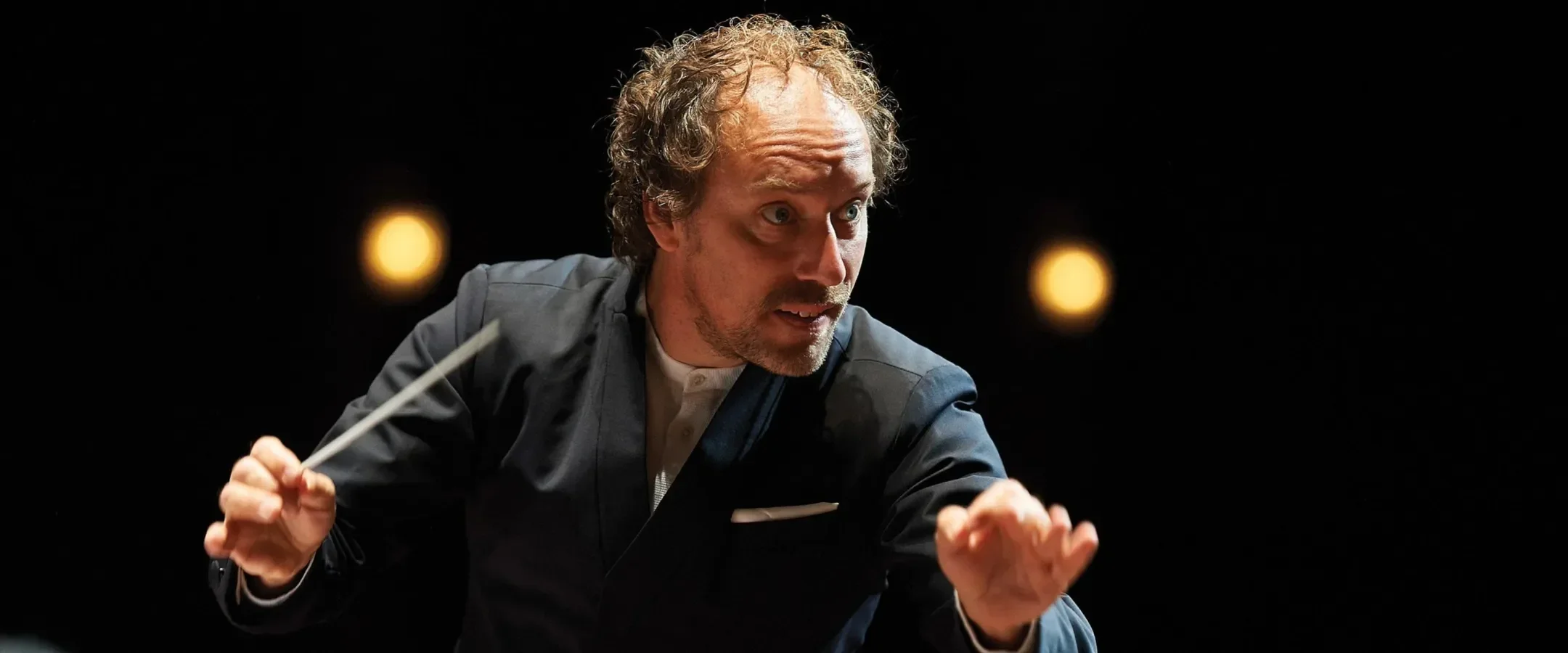
Belgian National Orchestra & Otto Tausk
Beethoven's Legacy
Where Is Home?
Coming home in music
A man steps onto the stage, cello in hand. He looks out into the concert hall, spreads his arms and says, ‘Welcome. Tonight, you are not listeners, but participants. Our meeting is an exchange.’ Then he begins to sing and play, and everything becomes clear. He absorbs the audience’s energy like a human antenna and returns it tenfold. The concert hall shifts into an intimate living room. Everyone who witnessed it walks away transformed.
This is essentially how a concert by Abel Selaocoe unfolds. Together with this charismatic cellist, singer and composer, we warmly welcome you to the 21st Klarafestival. As a festival artist, Selaocoe will play three concerts spanning the full spectrum of his musical world. From traditional music from his native South Africa to baroque, jazz, contemporary classical and improvisation: he melds all these influences into a unique body of work, centred on identity and cultural exchange.
The theme of this year's festival is taken from the debut album of Selaocoe’s own Bantu Ensemble: Where Is Home? It is an open question with endless answers – especially in the super-diverse city of Brussels, home to 180 nationalities and 100 languages. Our capital is a crossroads, a refuge, a temporary or permanent home for countless individuals, each carrying their own story. Every day, we feel privileged that our festival can take root in such fertile soil.
Klarafestival 2026 is an ode to the city we call home. During Muziekberg/Mont des Musiques, Brussels musicians will take over the Kunstberg (Mont des Arts) for a day, from the Musical Instruments Museum to Bozar, from the Ravenstein Gallery to the Royal Museums of Fine Arts. And both Radio Lomax and the choir Les Invisibles (La Voix des Femmes Sans Papiers) will perform Brussels songs with diverse roots.
Our mission is to show as wide an audience as possible that classical music is alive and kicking. Even the most familiar works take on fresh life in the hands of the adventurous musicians we surround ourselves with. Prepare to be captivated by Bach's St John Passion as conducted by Maxim Emelyanychev. Marvel at Beethoven and Strauss with the Orchestre Philharmonique du Luxembourg. Rediscover Chopin and Scriabin in a performance by Alexandre Kantorow. Or encounter keyboard phenomenon Anthony Romaniuk: like Abel Selaocoe, he intertwines his own compositions with the established repertoire, from Bach to Björk.
This festival programme features many more musical kindred spirits. Annelies Van Parys completed the 8th symphony of her former teacher Luc Brewaeys. Pianists Kris Defoort and Stephane Ginsburgh pay tribute to their friend Philippe Boesmans, who would have turned 90 in 2026. Abel Selaocoe, in turn, improvises with like-minded souls, both old and new, and performs a brand-new cello concerto by American composer Jessie Montgomery.
None of this would be possible without the support of our partners in Brussels and beyond. Bozar, Flagey, De Munt, Ancienne Belgique, Brussels Philharmonic, Belgian National Orchestra, Passa Porta, BNA-BBOT and the Luc Brewaeys Foundation all contribute to Klarafestival’s unique DNA. Our indispensable private partners include KPMG Belgium, Proximus, Brugse Zot, Gimv/WorxInvest and Interparking. We are grateful for the support of the Flemish Community, the Flemish Community Commission, the Brussels-Capital Region and the National Lottery. Our collaboration with VRT and Klara, meanwhile, is the secret to our success as a broadcasting festival. Above all, we thank our enthusiastic audience who follow us both in the concert hall and at home on the radio and VRT MAX.
For Abel Selaocoe, ‘home’ is much more than a building or a place. 'It can be a spiritual space. It can be people. (...) It can be something you find along your travels.’ For seven years, Klarafestival has been ‘home’ for festival director Joost Fonteyne. His sense of adventure and social connection is more evident than ever in this festival programme. In April 2026, he will continue his journey and pass the torch to Jan Van den Borre. Many thanks, Joost, for the wonderful years!
The Klarafestival Team
Joost Fonteyne, intendant
Jan Raes, chairman
Chantal Pattyn, network manager Klara
Belgian National Orchestra
Otto Tausk – musical direction
Coproduction: Bozar, Klarafestival, Belgian National Orchestra
In the context of Fasten Seat Belts! Celebrating Luc Brewaeys 2025-2026
The work of Annelies Van Parys was made possible thanks to vzw Vlaamse Muziek en Musicus.
Jonathan Harvey (1939-2012)
80 Breaths for Tokyo
Ludwig van Beethoven (1770-1827)
Symphony No. 8 in F Major, Op. 93
- Allegro vivace e con brio
- Allegretto scherzando
- Tempo di menuetto
- Allegro vivace
interval
Luc Brewaeys (1959-2015) / Annelies Van Parys (1975)
Symphony No. 8 (world premiere)
When extremes meet
No, you couldn’t accuse Luc Brewaeys (1959-2015) of false modesty. Even as a teenager, he was absolutely certain he was going to be a composer. And a good one at that! Le Sacre du Printemps by Igor Stravinsky was his touchstone. He pored over it until he knew it inside out. His own music was going to be as least as good as that, and preferably better. And he’d write symphonies, lots of symphonies, like Joseph Haydn did. Yes, you guessed it: Luc Brewaeys loved the symphonic orchestra with its endless tints and hues, layer upon layer of sound and enormous energy. The idea that there was nothing original left for today’s composers to do with an orchestra was nonsense, as far as he was concerned. It seems he tried to prove that point in every single one of his symphonies, almost eight of them in total. All the same, tradition was a weight on his shoulders. ‘I want to do something new,’ he once wrote, ‘but even Pierre Boulez says that history is there.’
For composers attempting a symphony, there is one name from the past that resounds just that little bit louder than the others: Ludwig van Beethoven (1770-1827). Many find his work an intimidating legacy. If Brewaeys felt the same, he never let it show. His fifth symphony was a nod in the direction of his colleague from two centuries earlier, and in the Canvas documentary Luc Brewaeys. Straight in 2011, he recalls how Beethoven’s eighth symphony inspired his own. Whereas Beethoven had intended his symphony to be a lively piece, Brewaeys’ would be an ode to sound and the pleasure of making music.
At first glance, Beethoven’s Eighth (1812) sounds fairly classical, but upon closer listening, the ear is drawn towards striking details. For example, new ideas seem to be emerging constantly in the first movement, but all of them turn out to be pieces of a single puzzle. Sudden silences and brusque contrasts often wrong-foot the listener, but the composer always lands on both feet. It is as if Beethoven wants to show that he can fill a single piece of music with apparent contradictions without difficulty: he is generous, funny and ingenious all at once.
Rather than creating melodies, Luc Brewaeys uses the orchestra to produce big, moving masses of sound. The basis of his compositional technique is spectralism, a method based on the analysis of specific sound colours. It is a bit like the way the design of the Atomium is based on the shape of an iron atom. This approach creates a feeling of great coherence and an immense wealth of sound colours. Although much spectral music is fairly static, Brewaeys adds speed, energy and a strong sense of direction. On several occasions he also smuggles unusual instruments onto the stage, in this symphony and elsewhere. As far as Brewaeys is from Beethoven in time and language, their relationship cannot be ignored when it comes to their virtuoso use of the orchestra, richness of colour, strong internal coherence and the exuberant forward motion of their music.
Annelies Van Parys (°1975) explains that when Brewaeys taught her, he made her listen to enormous amounts of music (with the score at hand, of course). Clearly a close study of other composers’ work teaches you compositional techniques, but you also gain a deeper knowledge of your musical roots. This can also be meaningful for the listener: those who are familiar with Beethoven and the symphonic tradition will bring this knowledge to their understanding of Brewaeys. But can Brewaeys also give us new ears to listen to Beethoven? Can we see his love for this repertoire as an invitation to appreciate Beethoven in new ways? To hear the colours of the orchestra more vividly than usual? To go beyond hearing something comfortably familiar and perceive what was new, daring and disruptive at the time? To listen beyond the label of a classical masterpiece in order to hear its contradictions and paradoxes, its humour, imagination, courage, energy, pure musicality and the grand craftsmanship of a human being of flesh and blood?
The first two movements of Luc Brewaeys’ Symphony No. 8 premiered in 2004. Six years later, the third movement was also performed, but not the promised finale. ‘I really need to get this finished’, the composer remarked at the time. But time caught up with him, and the paper on his desk remained almost entirely blank. He only wrote out the first four bars, and a large portion of the flute and trumpet parts. That scarce material was what Annelies Van Parys had to work with when she accepted the task of composing a finale for Brewaeys’ unfinished symphony, to be performed at Fasten Seat Belts! It was an immense challenge, because it soon turned out to be impossible to trace how Brewaeys himself would have wanted to complete the piece. There had never been any drafts, now or in the past. And it was impossible to discern a consistently applied system that she could build upon. On the other hand, she didn’t want to make too much of her own mark on the piece. Bar by bar, she pieced together a possible structure around the fragments of Brewaeys’ work. She used material and techniques that belonged to Luc himself, from both the preceding movements of the Eighth and other works. Unlike Brewaeys, she made the texture less full and dense, ‘to let the original material breathe.’
What about Jonathan Harvey (1931-2012)? Brewaeys described him as a second father, both musically and personally, and the two composers cherished a lifelong friendship. In the documentary mentioned above, Brewaeys says that Harvey was the one who taught him to meditate. That was a considerable achievement, because Brewaeys claims to have been ‘quite a bundle of nerves.’ Like Brewaeys, Harvey was fascinated by the essence of sound, and his own writing is based on spectralism and a vertiginous mastery of sound colour. Harvey also had a strong affinity with Buddhist traditions, which pervade many of his compositions, as does his sense of spirituality. The orchestral work 80 Breaths for Tokyo (2010) is a prime example. In this piece, he refers both to the Zen practice of breathing and to the impact of slow music on the body and mind. ‘The breath’, he writes, ‘is behind all music in some form or another. Students of yoga use it to control the body, Buddhists to control the mind. (...) In a sense, the orchestra reflects the endlessly changing, endlessly subtle and many-coloured complexity of the breath.’
Jonathan Harvey’s music, with its characteristic radiant calm, sounds very different to Brewaeys’. In this concert programme, 80 Breaths for Tokyo thus offers a contrasting overture, the calm before the storm. Deep down, however, there is a strong resemblance between the two composers. Besides the musical ‘grammar’ of spectralism, they also share a predilection for the particular timbre of bells, a sound that both composers incorporate here and there into their work. Or, as Harvey so poetically put it: ‘I think Luc liked to live inside bells, that strange world, a universe in itself, a magical new planet where sound is made to change.’
Rebecca Diependaele
Translation: Helen White
Listening tips
1. Beethoven’s Symphony No. 8 has hardly started when Beethoven brings the orchestra to an abrupt halt. At that point, the strings begin a tick-tock motif that is picked up by the bassoon. Further on in the piece, more ‘ticking clocks’ appear, especially in the second movement.
2. At the end of the first movement, the orchestra thunders fortissimo towards the final note, but suddenly Beethoven swerves off course. Now the strings and wind instruments toss three notes gently back and forth. Even when the wind instruments arrive pianissimo at the final chord, the strings play the theme one last time.
3. In his own Symphony No. 8, Luc Brewaeys extends the orchestra to include a host of glass bottles, which are used as a ‘bottle organ’ to create an unusual sound. Incidentally, this is far from the most exotic extension he devises for the orchestra: in the Symphony No. 2, there is a heating oil tank in the percussion section.
Belgian National Orchestra
The Belgian National Orchestra has long been based at the Centre for Fine Arts (Bozar). Through its ongoing partnerships with the Festival of Flanders and the Festival de Wallonie, it also performs regularly in provincial capitals across the country. Internationally, BNO maintains a strong reputation through overseas tours and by providing accompaniment for the Queen Elisabeth Competition. Alongside the symphonic repertoire, the BNO presents film music, collaborations with pop artists such as Ozark Henry and Stromae, and contemporary works by composers including Annelies Van Parys, Michael Daugherty and Andrew Norman. Since 2022, the BNO has been led by Dutch chief conductor Antony Hermus, in addition to frequently hosting international guest conductors.
Otto Tausk
The Dutch conductor Otto Tausk performs worldwide with leading orchestras and opera houses, with a versatile repertoire ranging from the classical canon to contemporary works. Between 2012 and 2018 he served as Music Director of Sinfonieorchester & Theater St. Gallen, where he conducted productions including Don Giovanni, Lohengrin, Yevgeny Onegin and West Side Story. Since 2018 he has been Music Director of the Vancouver Symphony Orchestra, where he has collaborated with soloists such as Yo-Yo Ma, Renée Fleming, Itzhak Perlman, Hilary Hahn and Hélène Grimaud. As a guest conductor, he has also led orchestras including the Royal Concertgebouw Orchestra, the Stuttgart Philharmonic, the Los Angeles Philharmonic and the San Diego Symphony.
Before or after the concert, you can visit the free mini-exhibition Musical Thoughts of Luc Brewaeys and dive into his fascinating scores and colourful musical language.
Structural partners
Klara, KPMG
Event partners
Brouwerij Halve Maan, Gimv | Worxinvest, Interparking, Proximus
Cultural partners
Ancienne Belgique, Belgian National Orchestra, Bozar, Brussels Philharmonic, De Munt | La Monnaie, Flagey, Muntpunt, Museum of Musical Instruments, Passa Porta
Public funding
Nationale Bank, Nationale Loterij meer dan spelen, Stad Brussel, Visit Brussels, Vlaamse Gemeenschap
Media partners
BRUZZ, De Standaard, La Première, La Trois, Le Soir, Musiq3, Radio 1, Ring TV, VRT Eén, VRT Canvas, VRT Max
Festival suppliers
Daniel Ost, Drukkerij VD, Maison Dandoy