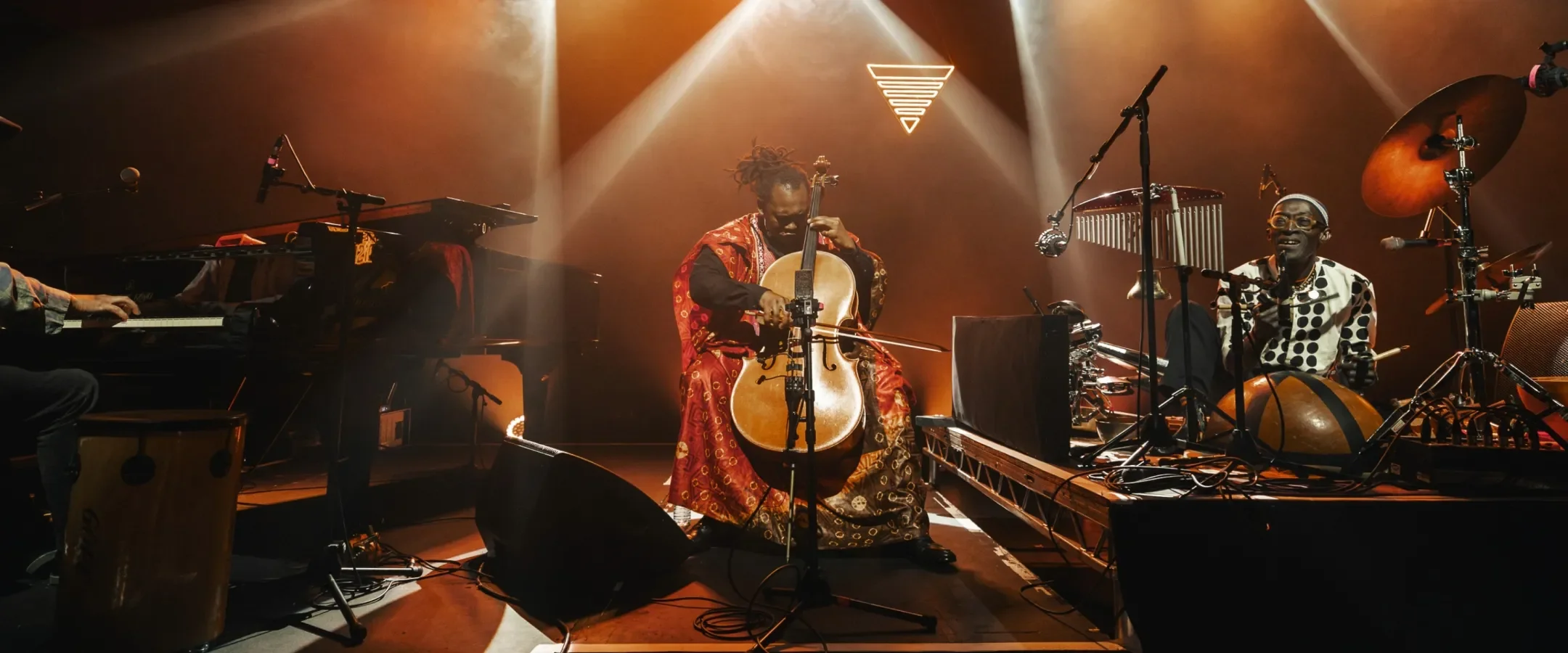
Abel Selaocoe & Bantu Ensemble
Hymns
Where Is Home?
Coming home in music
A man steps onto the stage, cello in hand. He looks out into the concert hall, spreads his arms and says, ‘Welcome. Tonight, you are not listeners, but participants. Our meeting is an exchange.’ Then he begins to sing and play, and everything becomes clear. He absorbs the audience’s energy like a human antenna and returns it tenfold. The concert hall shifts into an intimate living room. Everyone who witnessed it walks away transformed.
This is essentially how a concert by Abel Selaocoe unfolds. Together with this charismatic cellist, singer and composer, we warmly welcome you to the 21st Klarafestival. As a festival artist, Selaocoe will play three concerts spanning the full spectrum of his musical world. From traditional music from his native South Africa to baroque, jazz, contemporary classical and improvisation: he melds all these influences into a unique body of work, centred on identity and cultural exchange.
The theme of this year's festival is taken from the debut album of Selaocoe’s own Bantu Ensemble: Where Is Home? It is an open question with endless answers – especially in the super-diverse city of Brussels, home to 180 nationalities and 100 languages. Our capital is a crossroads, a refuge, a temporary or permanent home for countless individuals, each carrying their own story. Every day, we feel privileged that our festival can take root in such fertile soil.
Klarafestival 2026 is an ode to the city we call home. During Muziekberg/Mont des Musiques, Brussels musicians will take over the Kunstberg (Mont des Arts) for a day, from the Musical Instruments Museum to Bozar, from the Ravenstein Gallery to the Royal Museums of Fine Arts. And both Radio Lomax and the choir Les Invisibles (La Voix des Femmes Sans Papiers) will perform Brussels songs with diverse roots.
Our mission is to show as wide an audience as possible that classical music is alive and kicking. Even the most familiar works take on fresh life in the hands of the adventurous musicians we surround ourselves with. Prepare to be captivated by Bach's St John Passion as conducted by Maxim Emelyanychev. Marvel at Beethoven and Strauss with the Orchestre Philharmonique du Luxembourg. Rediscover Chopin and Scriabin in a performance by Alexandre Kantorow. Or encounter keyboard phenomenon Anthony Romaniuk: like Abel Selaocoe, he intertwines his own compositions with the established repertoire, from Bach to Björk.
This festival programme features many more musical kindred spirits. Annelies Van Parys completed the 8th symphony of her former teacher Luc Brewaeys. Pianists Kris Defoort and Stephane Ginsburgh pay tribute to their friend Philippe Boesmans, who would have turned 90 in 2026. Abel Selaocoe, in turn, improvises with like-minded souls, both old and new, and performs a brand-new cello concerto by American composer Jessie Montgomery.
None of this would be possible without the support of our partners in Brussels and beyond. Bozar, Flagey, De Munt, Ancienne Belgique, Brussels Philharmonic, Belgian National Orchestra, Passa Porta, BNA-BBOT and the Luc Brewaeys Foundation all contribute to Klarafestival’s unique DNA. Our indispensable private partners include KPMG Belgium, Proximus, Brugse Zot, Gimv/WorxInvest and Interparking. We are grateful for the support of the Flemish Community, the Flemish Community Commission, the Brussels-Capital Region and the National Lottery. Our collaboration with VRT and Klara, meanwhile, is the secret to our success as a broadcasting festival. Above all, we thank our enthusiastic audience who follow us both in the concert hall and at home on the radio and VRT MAX.
For Abel Selaocoe, ‘home’ is much more than a building or a place. 'It can be a spiritual space. It can be people. (...) It can be something you find along your travels.’ For seven years, Klarafestival has been ‘home’ for festival director Joost Fonteyne. His sense of adventure and social connection is more evident than ever in this festival programme. In April 2026, he will continue his journey and pass the torch to Jan Van den Borre. Many thanks, Joost, for the wonderful years!
The Klarafestival Team
Joost Fonteyne, intendant
Jan Raes, chairman
Chantal Pattyn, network manager Klara
Abel Selaocoe – cello, vocals
Alan Keary – bass, vocals
Fred Thomas – piano, vocals
Dudù Kouaté – percussion, vocals
Coproduction: Bozar, Klarafestival
Music from the repertory of Bantu Ensemble
‘There is a thread running through history that binds us all together’
– Katherina Lindekens in conversation with Abel Selaocoe
A man steps onto the stage, cello in hand. He looks out into the concert hall, spreads his arms and says, ‘Welcome. Tonight, you are not listeners, but participants. Our meeting is an exchange.’ Then he begins to sing and play, and everything becomes clear. He absorbs the audience’s energy like a human antenna and returns it tenfold. The concert hall shifts into an intimate living room, and everyone who witnessed it walks away transformed.
This is essentially how a concert by cellist, singer and composer Abel Selaocoe (pronounced See-lau-twee) unfolds. As the central artist at Klarafestival 2026, he will play three concerts spanning the full spectrum of his musical world. From traditional music from his native South Africa to baroque, jazz, contemporary classical and improvisation: he melds all these influences into a unique body of work, centred on identity and cultural exchange. A few months before the festival, we looked ahead with him.
The theme of Klarafestival 2026 is inspired by your debut album with Bantu Ensemble: Where Is Home. What does the word ‘home’ mean to you?
Home... It's comforting, isn't it? Home is empowering. I think home is never just a geographical space. It’s full of nostalgia, full of memories, things that make you who you are. Home can also be something unconscious: the things you tend to do without thinking, the people you go to for refuge. If you have a place of refuge, you have a place to build.
When did you first realise that music could be a home for you?
That feeling has always been there, for as long as I can remember. Music was such a powerful presence in our house: my mother, my brother, everybody was constantly singing. That's something essential to how people come together in South Africa. It's connected to religion, but also to a spiritual belief in our ancestors. For me, singing is the most natural thing in the world, like a mother tongue.
How did the cello come into the picture?
My brother was very curious and saw music as a key that could take us anywhere. He took me to an outreach programme in Soweto, where he played the bassoon. He chose the cello for me and said, ‘That’s where you're going.’ So that's how that happened. (laughs) At first, I found my own way around the instrument: I plucked, pushed and turned it around. It was pure play, amazing. Thanks to that school in Soweto, I later discovered Bach and Beethoven and was able to refine my technique.
All kinds of influences resonate in the musical world you are building today. Can you give us a tour?
In the township where I grew up, all the doors were open. As a child, you walk around and hear jazz coming from a boombox. You hear the neighbours praying and drumming for a ceremony. You hear activist songs, football songs... a cacophony of noises. Some of them reflect each other across colonial boundaries. Take the hymns from my childhood, for example: they connect South African church music with Bach's chorales and even with protest songs. I am the product of all those influences. The art is in working with them and finding the truth for yourself. That idea is the culmination of my sound world.
It's striking how freely you deal with the musical past. How do you view repertoire?
I mainly try to tell a story. We stand on the shoulders of so many. The reason that you are here, how you speak, how you move: there’s a whole history behind you, of people that worked so hard for you to be in that position. So: look back, search for stories that are unique. And take the influences of your peers, tell a story about what is happening right now. There is a thread running through history that binds us all together.
You often speak about improvisation as a key to the imagination. What happens inside of you when you improvise?
As a child, I had a friend in South Africa who was a great trumpet player. He compared improvising to the feeling you get when you fall down a hill. You're scratching the ground and you're trying to hold on and trying to find your balance. Improvisation is a total sensory experience, an exploration of your mind, body and creativity. It is being lost and not being lost all at once. You look for solutions in the moment and travel from one story to the next, without having to follow a logical route. Improvisation sets us free.
Is taking that leap also what you offer your listeners when you invite them to sing with you?
Certainly, although that also has to do with a South African – or rather, universal – foundation that I grew up with. When someone stands in front of a group of people, I don't believe that the crowd is only receiving. Important information is transferred in both directions. When people come to a concert, it's not to listen passively. In the space we share, there's going to be an energy that we are responsible for as a group.
How do you stay at home within yourself when you're on stage?
Through genuine honesty. You stand in front of people and you begin to create something out of thin air. That's incredible! It would be unfair to impose perfection on that. Anything can happen at any time. I think that spontaneity is exactly what people are looking for in a concert. That realisation helps me to ground myself. I'm not here for your perfection. I'm here to give you a sense of creativity, a reflection of yourself.
A moment of community too?
Absolutely. No matter how different our lives are, we sit together in a room for a few hours and are connected with each other for a moment. That's magical. When we go back out into the world afterwards, we feel like we belong somewhere, like we're part of a community. We don't even need to know each other's names, it's enough to understand what it means to be human.
In the liner notes of the album Where Is Home, you ask yourself: ‘If I say “heal” as many times as I can, will the world heal?’ Do you believe that music can heal?
Certainly. It's important to look at the small things sometimes, because the big things can be quite overwhelming. And it's good to forget yourself every now and then. I think music can help with that. Music can heal in so many ways. It can dissolve tensions between people, clear up misunderstandings. Words and body language are often misunderstood, but in music, people understand each other. Today, we all have playlists on our phones with music from different cultures. We can imagine ourselves in so many places at once and learn to understand so many different people.
At Klarafestival, you will be playing three concerts, the first of which will be with your own Bantu Ensemble. What does this group mean to you?
Bantu Ensemble is my musical home base. Our work is about friendship, identity and community, but also about delving deeply into the unknown, playing without thinking. As a quartet, we bring together a range of sounds. Our pianist, Fred Thomas, is an incredible baroque musician, so we play Bach and weave other styles into it. Percussionist Dudù Kouaté creates cosmic sounds with a huge arsenal of African percussion instruments. He opens up a world that touches on improvisation and free jazz. Bass guitarist Alan Keary has an amazing groove, which makes us want to dance. All these elements are part of our language.
What made you create the ensemble?
I think I wanted to blur the boundaries between classical music and my own work even further. These musicians are so creative that I don't even have to tell them when to play classical music or when to take a different path. Our exchange feels very natural.
For your second concert, ‘Kindred Spirits’, you put together an adventurous quartet.
That project also brings different worlds together. Soprano Héloïse Werner is mainly involved in contemporary music and therefore uses her voice very differently from me. I thought it would be interesting to have a dialogue between two singers who do such different things, both vocally and culturally. Percussionist Bernhard Schimpelsberger specialises in Indian classical music; he also brings a battery of instruments with him. And then there’s jazz pianist Fabian Fiorini, who effortlessly combines tradition and improvisation in his work. Each of us four will present musical material to the group, as a kind of gift. Based on those contributions, we will improvise together. I’m curious to see where we will end up!
Finally, you will perform as a soloist with Brussels Philharmonic, in a brand-new cello concerto by the American composer Jessie Montgomery.
It will be the Belgian premiere of that work, which is very exciting. Jessie and I have different African backgrounds: she comes from the United States, I come from South Africa. Yet we tell stories that seem to connect somehow. So we started thinking about our mothers: how did they live and think, what were they like? Did they do similar things? Inspired by those questions, Jessie started writing. She is such a creative force; I can't wait to discover her concerto.
Translation: Catherine Grady
Abel Selaocoe
South African cellist, singer and composer Abel Selaocoe is one of the most important voices in the music world today. Freely interweaving and redefining repertoires, he effortlessly meanders between styles and genres, in programmes that connect Western and non-Western musical traditions. In doing so, he combines his virtuosity on the cello with improvisation, singing and body percussion. His open-minded spirit has led to collaborations with numerous musicians from different genres, including Bernhard Schimpelsberger, Seckou Keita, Giovanni Sollima and Dudù Kouaté. Selaocoe is the founder of the trio Chesaba, which focuses on African music, and the Bantu Ensemble, with which Selaocoe uniquely brings together African and classical influences.
Bantu Ensemble
The Bantu Ensemble, founded in 2022 by Abel Selaocoe, approaches classical music with utter freedom and openness. The four musicians – Selaocoe, bassist Alan Keary, pianist Fred Thomas and percussionist Dudù Kouaté – create innovative hybrids of traditional music and jazz. Their programmes are invariably built around compositions by Selaocoe, alongside those by composers who inspire him, such as Johann Sebastian Bach and Giovanni Battista Platti. In 2022, they released their debut album Hae Ke Kae (Where is Home), which they performed at venues including the Concertgebouw Amsterdam, Southbank Centre London and the Berliner Philharmonie. The 2024-2025 season saw the release of Hymns of Bantu and a first tour of the United States, including a debut at Carnegie Hall.
Structural partners
Klara, KPMG
Event partners
Brouwerij Halve Maan, Gimv | Worxinvest, Interparking, Proximus
Cultural partners
Ancienne Belgique, Belgian National Orchestra, Bozar, Brussels Philharmonic, De Munt | La Monnaie, Flagey, Muntpunt, Museum of Musical Instruments, Passa Porta
Public funding
Nationale Bank, Nationale Loterij meer dan spelen, Stad Brussel, Visit Brussels, Vlaamse Gemeenschap
Media partners
BRUZZ, De Standaard, La Première, La Trois, Le Soir, Musiq3, Radio 1, Ring TV, VRT Eén, VRT Canvas, VRT Max
Festival suppliers
Daniel Ost, Drukkerij VD, Maison Dandoy