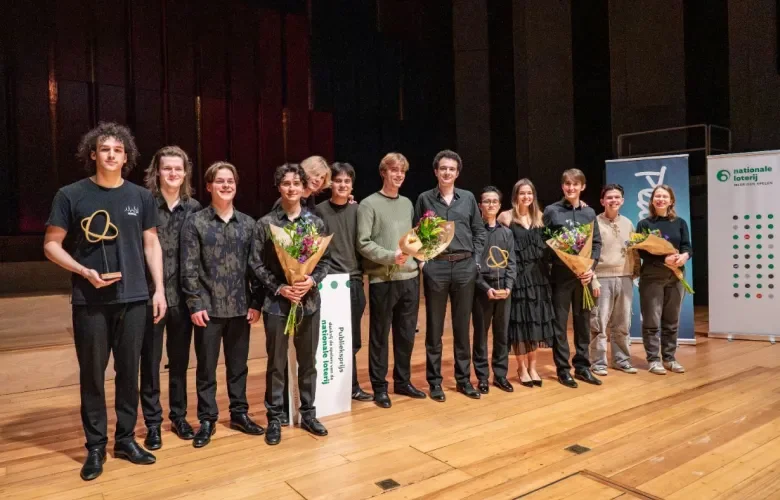
Laureates of the Queen Elisabeth Competition
Queen's Delight (part I)
Queen’s Delight: a musical promenade in homage to Queen Elisabeth
One hundred and fifty years ago, Queen Elisabeth was born. A passionate violinist and patron of the arts, she played a major role in Belgian and international musical life. Her name remains inextricably linked to the Queen Elisabeth Competition, which for decades has launched young artists onto the international stage. Wishing to honour the memory of the Queen in a manner worthy of her legacy, Flagey has devised a day of concerts. Entitled Queen’s Delight, the project transcends the framework of the Competition itself. Ten iconic laureates will gather to share with the audience an intense day devoted to music, encounters and exchanges.
How did this project come into being? Why did we choose such a wide range of musicians? From the outset, we placed a particular emphasis repertoire, collaboration and the audience’s experience.
A personal devotion to music
The idea emerged more than two years ago, as we were reflecting on the 150th anniversary of the birth of Queen Elisabeth. She was not only our sovereign but also a passionate musician: a violinist, deeply devoted to the arts and closely associated with Eugène Ysaÿe, alongside whom she founded the Competition that bears her name. We sought to place this personal relationship to music and musicians at the very heart of Queen’s Delight, conceived as a musical journey, a kind of promenade encompassing around ten concerts.
Diversity of talent and unprecedented formats
From this starting point, we asked ourselves how this tribute could be anchored in the present day and illuminate the full scope of the Queen’s exceptional commitment to music. Inviting a single artist did not seem sufficient. The richness of her legacy calls for multiple voices. We therefore set out to bring together several generations of laureates - pianists, string players and singers - among them Alexander Melnikov, Timothy Chooi and Eva Zaïcik.
But how could the most suitable selection be made? Our approach was at once pragmatic and deeply personal. Surveying the list of laureates of the Competition from the 1970s to the present, we asked ourselves one single question: with whom would we be happy to work today, regardless of ranking or prize obtained?
We undertook this reflection together with both the Competition and the Klarafestival. We aimed for First Prize winners to share the stage with other laureates in a natural way during the concerts. This approach embodies the philosophy of Flagey: we seek to accompany exceptional talents over the long term, to support them, to welcome them back and to foster the full potential of their musical personalities.
Moreover, we encouraged all the musicians not to confine themselves to solo performances, but also to take part in chamber music projects within newly formed ensembles. The emphasis will be on musical sharing. The audience will be invited to discover new configurations. With concerts taking place throughout the Flagey building, in all our studios, the concept constitutes a journey of musical discovery.
Artists within their own universe
Through this approach, we also hope to move beyond the momentary snapshot of a competition. Returning to Flagey certainly entails rediscovering memories and the experience of the Competition, but also everything that unfolds beyond the stage: encounters between musicians, working together, listening to one another, exchanges during rehearsals, shared meals. These connections most often remain invisible to the audience.
Queen’s Delight seeks precisely to render this dimension both visible and audible, operating on two levels. On the one hand, it does so by bringing the laureates together within new chamber music formations, in solo, duo or trio settings. On the other, it offers the audience the opportunity to rediscover them through new dialogues, renewed musical relationships and a shared musical experience that reaches far beyond the Competition.
To this end, we collaborated closely with the musicians. Rehearsal time is precious and schedules are complicated. Our first step was to look at those laureates who already knew one another and had previously performed together. At the same time, we wanted to encourage new encounters. The pianist Jonathan Fournel confided that he feels particularly at home in chamber music and prefers chamber music to solo performances. By contrast, pianist Alexander Melnikov also wanted to retain space for the solo repertoire, where his personal voice can be fully expressed. This combination renders the day both rich and vibrant.
We also aimed to foster intergenerational exchange among the musicians. Young talents and more established artists share the stage on equal terms. This how music lives today: tradition and renewal always coexist.
Unexpected choices
Of course, selecting the programme was of central importance. It includes key works from the solo and chamber repertoire, yet we also wanted to highlight less predictable parts of the repertoire. The music of the Belgian violinist Eugène Ysaÿe provides a pertinent example. His connection with Brussels and with Queen Elisabeth is self-evident, yet his oeuvre remains underestimated.
Alongside these appear works regarded as landmarks for each instrument, combined with highly personal choices by the musicians themselves. Violinist Sylvia Huang moves with ease between the great classical repertoire and the less frequently performed music of Rebecca Clarke, which she brings to the fore. Mezzo-soprano Eva Zaïcik explores the Lied repertoire of Richard Wagner in an intimate setting for voice and piano, alongside the pianist Severin von Eckardstein, who brings extensive experience as an accompanist. Such choices arise from dialogue rather than from an imposed concept.
In this way, we hope both to surprise and to delight our audience. Those who follow the entire musical journey will discover the laureates in a different light: no longer as soloists in competition, but as musicians in relation to one another. Familiar names appear in unexpected formations, and chamber music becomes a space of listening, response and shared breathing.
We hope to invite our audience to adopt a broader perspective on the laureates of the Queen Elisabeth Competition; to view it not as an endpoint, but as the starting point of an artistic journey. Was this not, after all, Queen Elisabeth’s own profound ambition?
Gilles Ledure, general manager of Flagey
Timothy Chooi - violin
Tobias Feldmann - violin
Sylvia Huang - violin
Santiago Cañón-Valencia - cello
Aleksey Shadrin - cello
Jonathan Fournel - piano
Severin von Eckardstein - piano
Coproduction: Flagey, Klarafestival, DE SINGEL, Queen Elisabeth Competition, Festivals de Wallonie
Timothy Chooi & Santiago Cañón-Valencia
Maurice Ravel (1875-1937)
Sonata for Violin and Cello, M. 73
Sylvia Huang & Jonathan Fournel
Rebecca Clarke (1868-1979)
Lullaby
Eugène Ysaÿe (1858-1931)
Poème élégiaque, Op. 12
Severin von Eckardstein, Tobias Feldmann & Aleksey Shadrin
Sergei Rachmaninoff (1873-1943)
Trio élégiaque No. 1 in G Minor
One glance at the impressive list of laureates and participants of the Queen Elisabeth Competition says it all: this will be an All-Star concert. The musicians curated the programme themselves, with special attention to Eugène Ysaÿe, founder of the competition and an icon of the Belgian violin tradition. His music appears alongside Rebecca Clarke’s lyrical Lullaby, Rachmaninov’s moving Trio élégiaque No. 1 and Ravel’s Cello Sonata, a tribute to Debussy.
Queen Elisabeth was born 150 years ago, a monarch with a warm heart for music and culture. Her name lives on in the prestigious Queen Elisabeth Competition, which has been launching leading musical talents for decades. We are celebrating this anniversary with a reunion that is already historic: ten of the most iconic laureates are gathering for one day at Flagey. They will fill the building with violin, cello, piano and singing, in various constellations.
Timothy Chooi
Canadian violinist Timothy Chooi studied at the Curtis Institute of Music in Philadelphia and the Juilliard School in New York. He garnered international attention with awards such as First Prize at the Joseph Joachim International Violin Competition Hannover 2018, the Prix Yves Paternot at the Verbier Festival in 2018 and Second Prize at the Queen Elisabeth Competition 2019. Chooi has performed as a soloist with the Deutsches Symphonie-Orchester Berlin, NHK Symphony Orchestra and Toronto Symphony Orchestra, among others. He is also a professor of violin at the University of Ottawa, where he received a research award for his work on classical music as a cultural connector.
Tobias Feldmann
German violinist Tobias Feldmann stands out for his stylistic versatility and emotional depth. He won Third Prize at the Joseph Joachim International Violin Competition Hannover 2012 and Fourth Prize at the Queen Elisabeth Competition 2015. As a soloist, he has shared the stage with orchestras such as the Konzerthausorchester Berlin, Orquestra Simfónica de Barcelona, Minnesota Orchestra and BBC Philharmonic, and conductors such as Nathalie Stutzmann, Reinhard Goebel and Marin Alsop. He has also performed as a chamber musician at venues including the Wiener Konzerthaus, Concertgebouw Amsterdam and the Rheingau Musik Festival with musical partners such as Martin Helmchen, Jean-Guihen Queyras and Tabea Zimmermann.
Sylvia Huang
Belgian violinist Sylvia Huang is a laureate of the Queen Elisabeth Competition 2019, where she also received the Prix Musiq3 du Public and the Canvas-Klara Prize. Since then, she has collaborated with orchestras such as the Belgian National Orchestra, the Flanders Symphony Orchestra and the Brussels Philharmonic. From 2014 to 2022, she played first violin with the Concertgebouw Orchestra Amsterdam, where she also made her debut as a soloist in 2021. Together with three other members of the Concertgebouw Orchestra, she also founded the GoYa Quartet in 2014. Since 2023, Huang has been concertmaster of the Symphony Orchestra of La Monnaie. She has released CDs with pianists Eliane Reyes (Lointain passé, 2021) and Boris Kusnezow (Ode to Mother Nature, 2025).
Santiago Cañon-Valencia
Colombian cellist and composer Santiago Cañón-Valencia made his debut as a soloist with the Orquesta Filarmónica de Bogotá at the age of six. He won Third Prize at the Queen Elisabeth Competition in 2017 and the Silver Medal at the International Tchaikovsky Competition in 2019. As a soloist, he has collaborated with orchestras such as the Kansas City Symphony, SWR Symphonieorchester, hr-Sinfonieorchester, BBC Symphony Orchestra and Seoul Philharmonic Orchestra. He has also premiered works by contemporary composers such as Amparo Ángel, Jorge Pinzón, Carlos Izcaray and Tobias Picker. In 2022, he was named BBC Next Generation Artist, which earned him his debut at London's Wigmore Hall.
Aleksey Shadrin
Ukrainian cellist Aleksey Shadrin studied at the Hochschule für Musik, Theater und Medien Hannover with Leonid Gorokhov and perfected his skills at the Kronberg Academy with Frans Helmerson and the Queen Elisabeth Music Chapel with Gary Hoffman. He won First Prize at the Mykola Lysenko International Music Competition in 2012, Third Prize at the Prague Spring Competition in 2018 and Fourth Prize at the Queen Elisabeth Competition in 2022. As a soloist, Shadrin has performed with orchestras such as the National Philharmonic Orchestra of Ukraine, the Opéra Orchestre national Montpellier, the Belgian National Orchestra, the NDR Radiophilharmonie and the Berliner Philharmoniker.
Jonathan Fournel
French pianist Jonathan Fournel studied at the Hochschule für Musik Saarbrücken and the Conservatoire national supérieur de musique et de danse de Paris. In 2021, he won First Prize at the Queen Elisabeth Competition, following earlier prizes at the Scottish International Piano Competition and the Viotti International Music Competition. Since then, Fournel has appeared on the stages of the Concertgebouw Amsterdam, the Wiener Konzerthaus, the Théâtre des Champs-Élysées, the Rheingau Musik Festival and the Verbier Festival. As a chamber musician, Fournel's regular partners include Gautier Capuçon, Augustin Dumay, Lorenzo Gatto and Victor Julien-Laferrière.
Structural partners
Klara, KPMG
Event partners
Brouwerij Halve Maan, Gimv | Worxinvest, Interparking, Proximus
Cultural partners
Ancienne Belgique, Belgian National Orchestra, Bozar, Brussels Philharmonic, De Munt | La Monnaie, Flagey, Muntpunt, Museum of Musical Instruments, Passa Porta
Public funding
Nationale Bank, Nationale Loterij meer dan spelen, Stad Brussel, Visit Brussels, Vlaamse Gemeenschap
Media partners
BRUZZ, De Standaard, La Première, La Trois, Le Soir, Musiq3, Radio 1, Ring TV, VRT Eén, VRT Canvas, VRT Max
Festival suppliers
Daniel Ost, Drukkerij VD, Maison Dandoy