Ictus, Contrechamps, Tarek Halaby & Nina Guo
Liquid Room X: Robert Ashley
Welcome to the 19th edition of Klarafestival! The theme Crossroads - Come Together keenly evokes the convergence of the audience, the artists and their inspiring concerts. A meeting place where the leading lights of international classical music enter into dialogue with challenging creations and young talent.
The inspiration for this edition comes from festival artist Claron McFadden. As she told us in an interview, “I stand at a crossroads where styles and generations cross, meet, and collide”. This notion forms the core of the programme. We hope you will enjoy Klarafestival as a sanctuary of hope, polyphony and beauty in all its forms. As a place where the familiar takes on new meaning and where new experiences take you by surprise.
Jan Raes, chairman
Joost Fonteyne, intendant
Chantal Pattyn, manager Klara
Ictus – ensemble
Contrechamps – ensemble
Nina Guo – voice
Tarek Halaby – voice
Coproductie: Klarafestival, Ictus, Kaaitheater
In collaboration with: Maison de la Poste
With the support of: The Swiss Arts Council Pro Helvetia
–
Robert Ashley (1930-2014)
Tap Dancing in the Sand
Excerpt from Perfect Lives:
– Act 3: The Bank (Victimless Crime)
Excerpt from The Improvement:
– The Indifference Text
Sarah Nemtsov (1980)
Implicated Amplification
Jessie Cox (1995)
New work, commissioned by Contrechamps & Ictus
Laurie Anderson (1947)
O Superman
Tom Johnson (1939)
Rational Melodies X & XV
Jennifer Walshe (1974)
Tri Amhrán (Three Songs)
Bryn Harrison (1969)
Five Miniatures in three parts
Liquid Room
… our pride and joy
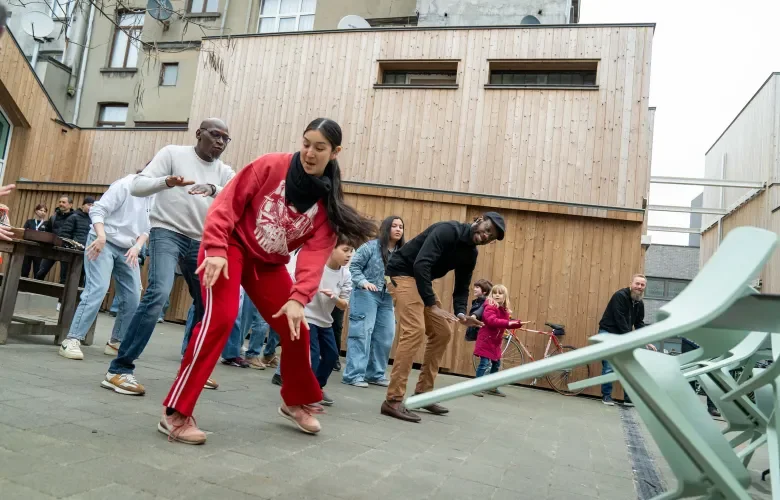
These multistage and polystylistic events have been organised across Europe since 2009. In these festival-like events, audiences are encouraged to roam freely, come and go, sit on small cardboard stools or remain standing; they can switch from one stage to the next, alternating between different kinds of music and listening moods.
Robert Ashley
… little-known, yet renowned
As you may recall, in 1983, Peter Greenaway made a prominent four-segment documentary called Four American Composers. In addition to Philip Glass and John Cage, both eminent composers at the time, Greenaway’s subjective gaze also shed light on the importance of Meredith Monk and Robert Ashley in the development of American music. Today, we will particularly focus on Ashley’s oeuvre: elusive and, in literary terms, undoubtedly the most ambitious of them all.
In the 1960s in Michigan, Ashley organised the renowned ONCE festival, a platform that presented and juxtaposed Fluxus style pieces, performances (Lucinda Childs, Steve Paxton), contemporary chamber music and punk (the festival saw the emergence of Iggy Pop and the Stooges). Ashley described his own style as ‘Music with Roots in the Aether’, before it came to be known as ‘minimalist’. Resulting from collective work, his oeuvre is a manifest of great creative freedom, and a far cry from the practices of classical-modernist opera.
Daydream
… or a waking dream
Ashley’s oeuvre in the 1980s is a prime stylistic example of what came to be known as the ‘postmodern moment’. ‘I don’t think there’s any heroism anymore’, said Ashley, resembling Andy Warhol in this respect. Case in point: Ashley’s paradoxical ‘operas’ did not have heroes but were instead based on individual narratives and populated by myriad characters from an archetypal Middle America.
Ashley suffered from a mild form of Tourette’s syndrome, which inspired him to produce an overabundance of involuntary sounds with varying degrees of significance. Based on this minor literature, he empirically established the three features of his inimitable style: the use of a microphone to capture highly subtle spoken intonations; a fascination with speed (‘English doesn’t sound right when it’s slowed down’); and the aloofness of the perfect dandy.
The miracle was hence produced: the prose of non-heroic lives became Aethereal Music, altered states of consciousness. ‘I'm in a kind of daydream where I can hear words with music’, Robert Ashley declared.
Re-creation
It now seems like the right time to delve into Ashley’s enigmatic oeuvre: a bubbling hotchpotch of verbal content, literary excerpts, tape recordings, video cassettes, a progression of chords, and musical notation. To properly grasp the spirit of Ashley’s work requires great personal commitment, a strong sense of the meaning of ‘interpretation’, and an earnest collective effort at re-creation. The musicality of spoken words, however, can indisputably serve as a compass. We have hence invited two remarkable artists: American soprano, reporter and radio performer Nina Guo, based in Berlin; and Palestinian-American dancer and performer Tarek Halaby, based in Brussels.
A Theatre of Voices
To leap into the heart of the matter, we have chosen to examine the most bountiful and enigmatic material Robert Ashley has ever produced: Perfect Lives, the 1983 seven-episode television opera directed by John Sanborn. Described as a journey through several quintessential places in the mental landscape of America — The Park, The Supermarket, The Church, The Bank — and the ordinary lives of those who inhabit them, the series, told in a distinctly American vernacular, puts great emphasis on video experimentation, and is generally considered a precursor of television productions ten years later.
Presented much in the same fashion as our novel version of Philip Glass’ opera Einstein on the Beach — focused solely on the musicians at work — we will approach Ashley’s Perfect Lives from a strictly musical and performative angle. We are directing our attention on the ‘theatre of voices’ as it creates new acoustic images of the body.
Partners in crime
With Perfect Lives as a backdrop, we also present a new take on Tap Dancing in The Sand, a more recent work by Robert Ashley, performed by the Swiss ensemble Contrechamps – our guests of honour for this new Liquid Room edition.
About Jessie Cox
Jessie Cox is a Black Swiss drummer, composer and researcher. He is currently completing a doctorate at Columbia University. He has worked with the Sun Ra Arkestra, Ensemble Modern and the JACK Quartet among others. His triptych that was specifically commissioned for this concert, is in its own way a part of our Theatre of Voices. It brings together two actors with paradoxical modes of existence: the songs of extinct species of birds and the so-called talking drum.
Jessie Cox: ‘The Drum is a Tree and Re(mnants): of Woods and Skins are two pieces that engage the interrelated crises of the climate and of anti blackness through music as an opening for new possibilities towards unthought, and impossible, futures. The drum serves as a leading example and metaphor towards this possible refiguring of our futures. In its material constitution it is made of woods from trees and the skins of either cattle or wild animals. The devaluing and banning of drums, that accompanies forms of extinction such as colonialism, slavery, and capitalist exploitation, is reflected also in the destruction of the environments and lives – human and otherwise – that meet as/within/around the drums. The drum is also a sound, and like all those lives, life-forms, ways of living, ways of sounding, that get destroyed in these crises, its sound is in jeopardy. But what might happen, when we music; when the sound of drums is valued again, and is changing how we come to value? Here, as those who are inheritors of survivors of multiple extinction events, we may rethink not only how we live in and with the world, but also what “we” may be.’
About Jennifer Walshe
In 2016, an international and informal network of composers published a series of short manifestos around the appellation New Discipline. These artists (James Saunders, David Helbich, Matthew Shlomowitz, Neele Hülcker, François Sarhan, Jessie Marino, Steven Takasugi, Natacha Diels, Jennifer Walshe, among others) described a series of traits in which a new generation of musical artists could be found: emphasising the conceptual art way of thinking, focusing on ecological, decolonial and queer themes, shifting from ‘computer excellence’ to all the popular forms of digital life as well as depending on temperament, humour, kitsch and ‘do-it-yourself’ aesthetics. With Three Songs, the Irish composer Jennifer Walshe pursues the somewhat Borgesian project of an imaginary encyclopaedia of Irish culture. Let's recall her fake documentaries on the great Irish Dada movement (that was completely imaginary). In Three Songs, she uses Artificial Intelligence to recreate synthetic folklore from scratch.
About Tom Johnson
A privileged witness to the American avant-garde of the 1970s thanks to his columns in The Village Voice – and thus co-responsible, with Michael Nyman, for the now-contested term ‘minimalism’ – Johnson is also a composer with a very singular voice. Without ever using a machine, he has developed a ‘handmade’ algorithmic music that is radically elegant. Each of his pieces is a musical response to a logical, mathematical or topological problem. Rational Melody X is a combinatorial system on 3 X 3 notes, and has the air of perfection similar to a Bach prelude. The even more ambitious Rational Melody XV constructs a fractal melody – read it as it is, or take only one note out of two, or four, or eight or sixteen: it will always be the same melody.
About Bryn Harrison
At a time when ‘minimalist style’ is returning as the neo-hype art of our time, nothing is more refreshing than to delve into Bryn Harrison's strange repetitive systems. They have remained connected to the most powerful intuitions of the American avant-garde: transfiguring perception through the disorientation of memory.
Bryn Harrison: ‘Exact repetition changes nothing in the object itself but does change something in the mind that contemplates it. These works deal explicitly with aspects of duration and memory through which near and exact repetition operate in close proximity throughout and provide points of orientation and disorientation for the listener.’
About Sarah Nemtsov
Born in 1980, Sarah Nemtsov has developed an abundant and violent body of work (over 150 compositions!), in which electronics embody a restless dreamlike quality. She once wrote the following words about another work, which also perfectly describes the one heard today: ‘I wanted an earthy sound, with dust and dirt, mud, stones, organic matter from a soil other than the one we live on.’
About Laurie Anderson
O Superman is a part of the great multimedia cycle United States. This eight-hour show, composed and performed by Laurie Anderson, premiered in Brooklyn forty years ago, in 1983. It was a landmark of its time: at once monumental and ostensibly ‘bricolage’, it is composed of video and still images, avant-garde and pop music, spoken text, gestural performance and playful electronics. The film of the show is now projected in a loop as part of the permanent collection at MoMA in New York.
O Superman is based on a subtle, poisonous poem that alternates between false leads and reversals. It opens with a delightful sense of humour: it seems that Superman's mother wants to check in and leave a message on her hero son's answering machine. Superman has to deal with a mother hen: what a romp! But ‘Mom's’ voice soon changes its nature. It soon becomes The voice of all; The Voice – a disturbing figure of the Other, at once gentle, insinuating and anonymous: ‘Well, you don't know me, but I know you’. On Superman's answering machine, The Voice then insists on leaving a very specific message: ‘So you better get ready, ready to go | Here come the planes | They're American planes, made in America’. The listener then understands that Mom's voice may be nothing more than the voice of America itself, the vague patriotism that remains ‘when justice is gone’: ‘So hold me, Mom, in your long arms, in your automatic arms, your electronic arms, your petrochemical arms, your military arms.’
Greetings
Thank you for coming to the Theatre of Voices! Come and talk to us at the end of the show, if you like, and don't take our precious stools with you!
Ictus & Contrechamps
Ictus
The Brussels ensemble for contemporary music Ictus was founded in 1994 as the permanent musical partner of the dance company Rosas. Ictus has a variable roster of soloists specialised in experimental music, and structurally collaborates with larger ensembles such as the Brussels Philharmonic and Collegium Vocale Gent. The ensemble always connects modernist, experimental and alternative music and is known for unconventional concert forms in which music, theatre and dance come together. Past collaborations have included with choreographers such as Anne Teresa De Keersmaeker, Wim Vandekeybus, Fumiyo Ikeda and Eleanor Bauer and with composers such as Toshio Hosokawa, Steve Reich and Gavin Bryars.
Contrechamps
The Swiss ensemble Contrechamps specialises in the performance and development of contemporary music and is committed to reaching a wide audience with that music. It does this, among other things, by searching for new concert forms, such as installations, interactive concerts or radio concerts, and by publishing magazines and monographs about individual composers or works. Contrechamps has already performed premieres by several renowned composers, such as György Kurtág, Heinz Holliger, Isabel Mundry and Rebecca Saunders and has played at many international festivals, including Festival d'automne à Paris, the Salzburg Festival, Lucerne Festival and the Venice Biennale.
Nina Guo
Soprano Nina Guo focuses on contemporary music, improvisation and interdisciplinary projects. She has collaborated with Ensemble Ascolta, Ensemble Modern and Decoder Ensemble, among others, and is part of the music theatre ensemble Opera Lab Berlin. Guo also enjoys working in duos: she forms an improvisation duo with Auguste Vickunaite (electronics), and the Departure Duo for contemporary repertoire with Edward Kass (double bass). She also collaborates with installation artist Leonie Brander, for example for the 'installation opera' MOSSOPERA. Humour and radio play a major role in Guo's work, for example in her radio programme The Entertainment, a musical comedy variety show on Cashmere Radio.
Tarek Halaby
Tarek Halaby is a Palestinian-American dancer, performer and choreographer. He studied dance at the University of Iowa, started his career in the New York dance scene and then completed his training at P.A.R.T.S. in Brussels. Halaby has contributed to various dance, theatre, television and film projects and has collaborated with choreographers Miguel Gutierrez, Martin Zimmerman and Anne Teresa De Keersmaeker and director Manu Riche, among others. In his own work, with which he has done various international tours, Halaby combines movement with text and song in performances in which (artistic) identity in relation to the political situation is often central.
Robert Ashley
The American composer Robert Ashley (1930-2014) is known worldwide for his multidisciplinary opera and music theatre projects. In the 1960s and 1970s, he was one of the most influential figures in experimental music groups such as the ONCE Group and Sonic Arts Union. He wrote music for the dance troupes of Merce Cunningham, Trisha Brown and Steve Paxton, among others. However, Ashley is best known as a pioneer of television opera, the most prominent example being Perfect Lives (1984), consisting of seven half-hour parts. The absurd, multi-layered storylines, the typical American themes and the interplay of music, images and spoken word give his operas an incomparable style of their own.
Jessie Cox
Jessie Cox is a Swiss composer and drummer who combines influences from contemporary classical music, experimental jazz and sound art. Inspired by Afrofuturism, he continually tries to discover new sound worlds in his work, which is described as 'musical science fiction'. As a composer and drummer, he has collaborated with ensembles such as the Sun Ra Arkestra, the Los Angeles Philharmonic, Ensemble Modern and JACK Quartet. His work has been performed on diverse international stages, including the Lucerne Festival, MaerzMusik and Opera Omaha. As a composer, Cox has received commissions and support from, among others, Fromm Music Foundation, Ernst von Siemens Musikstiftung and New Music USA.
Jennifer Walshe
Irish composer and singer Jennifer Walshe is one of the most original voices in contemporary music. Her compositions are performed worldwide by orchestras and ensembles such as the Arditti Quartet, Klangforum Wien, Nadar Ensemble, Ensemble Resonanz, the BBC Scottish Symphony Orchestra and the National Symphony Orchestra of Ireland. The voice often plays a central role in her work and as a performer she searches for new sound possibilities in combination with other instruments. She also often works with artificial intelligence, for example in ULTRACHUNK (2018), which contains an AI-generated version of Walshe. Walshe currently teaches composition at the University of Oxford.
Bryn Harrison
The work of British composer Bryn Harrison is entirely dedicated to his fascination with time. This has led to several lengthy compositions with repeating and cyclical structures that provide a unique listening experience, such as the ensemble work Surface Forms (repeating) (2009), in which speed and density force the listener to experience time differently. In his more recent work, the relationship between music and memory is central, for example in his Piano Quintet (2017), in which motifs slowly fade and reappear. Harrison's compositions have been performed by, among others, Ensemble Recherche, Klangforum Wien, ELISION, London Sinfonietta and the London Symphony Orchestra.
Sarah Nemtsov
The German composer Sarah Nemtsov studied oboe and composition at the Hochschule für Musik Hannover and specialised as a composer at the University of the Arts Berlin with Walter Zimmermann. Her catalogue of works includes more than 150 compositions, including orchestral works, operas, electronic music and film scores. In her compositions, Nemtsov combines various influences, from Renaissance and Baroque music to jazz and rock, and often connects music with other art forms. Her work has been performed by, among others, hr-Sinfonieorchester, Basel Sinfonietta, Ensemble Musikfabrik, Ensemble Intercontemporain and the Arditti Quartet. Since 2022 she has taught composition at the Universität Mozarteum Salzburg.
Tom Johnson
Tom Johnson is an American composer. After studying at Yale University, he moved to New York to take private lessons with Morton Feldman. While taking his first steps as a composer in the 1970s, he was also active as a music critic for The Village Voice. In this capacity he was the first to use the term 'minimalist music', which he would later also apply to his own compositions. Typical of his work is the structure through logical and mathematical processes that are often explicitly explained by the spoken or sung text. His extensive oeuvre includes compositions for various solo instruments, chamber music and several operas.
Laurie Anderson
Laurie Anderson is active as a composer, performer, author, director, and visual artist and is considered one of the most innovative American artists. She is known for her multimedia projects, her inventive use of technology and experimental instruments. She gained widespread recognition with the single O Superman (1981), which was followed by seven more studio albums. Anderson has presented her work virtually all over the world on various international tours and has received numerous nominations and awards for both her films and albums, including several career awards and a Grammy for Landfall (2018), a collaboration with the Kronos Quartet.
presenting partners
Klara, KPMG
event partners
Belfius, BMW, Proximus, Brouwerij Omer Vander Ghinste, Interparking
public funding
Brussels Hoofdstedelijk Gewest, Nationale Bank, Nationale Loterij-meer dan spelen, Vlaamse Gemeenschap, Vlaamse Gemeenschapscommissie
cultural partners
Bozar, Flagey, Ancienne Belgique, Kaaitheater, Muntpunt
festival suppliers
Maison De La Poste, Fruit at Work, Levi Party Rental, Drukkerij Bosmans, Café Victor, Brussels Booking Desk, Ray & Jules, Maison Dandoy
media partners
VRT 1, VRT Canvas, Radio 1, Bruzz, De Standaard, Knack / Le Vif, La Libre, Musiq3, La Première, La Trois, Ring TV, visit.brussels