[last tickets] Dionysos Now!
Passion for.by Willaert
Welcome to the 19th edition of Klarafestival! The theme Crossroads - Come Together keenly evokes the convergence of the audience, the artists and their inspiring concerts. A meeting place where the leading lights of international classical music enter into dialogue with challenging creations and young talent.
The inspiration for this edition comes from festival artist Claron McFadden. As she told us in an interview, “I stand at a crossroads where styles and generations cross, meet, and collide”. This notion forms the core of the programme. We hope you will enjoy Klarafestival as a sanctuary of hope, polyphony and beauty in all its forms. As a place where the familiar takes on new meaning and where new experiences take you by surprise.
Jan Raes, chairman
Joost Fonteyne, intendant
Chantal Pattyn, manager Klara
Dionysos Now! – ensemble
Tore Tom Denys – musical direction, tenor
Franz Vitzthum – countertenor
Bernd Oliver Fröhlich – tenor
Julian Podger – tenor
Tim Scott Whiteley – bass-baritone
Joachim Höchbauer – bass
Catalina Vicens – harpsichord
Coproduction: Klarafestival, Bozar
–
György Ligeti (1923-2006)
Hungarian Rock
Adriaan Willaert (1490-1562)
Passio Domini Jesu Christi secundum Joannem –
György Ligeti
Continuum
Adriaan Willaert
Passio Domini Jesu Christi secundum Joannem (sequel)
Enríquez de Valderrábano (ca. 1500-after 1557) after Adriaan Willaert
Pater Noster
Many people will immediately associate the St John Passion with the masterpiece of that name written by Johann Sebastian Bach in 1724. However, many other composers both before and after Bach have set the story of Jesus’ passion as told by the Apostle John to music. It is clear from early mediaeval manuscripts that the St John Passion was sung as early as the ninth century during the Good Friday mass. A millennium later, the text continues to inspire composers. Arvo Pärt and Herbert Collum are among those who have set it to music. The St John Passion on the programme this evening dates from the 1550s. A debate raged among musicologists for many years over who composed this piece, since the surviving 16th-century sources ascribe it to both Adrian Willaert and Cipriano de Rore. Today, however, musicologists seem to be reaching a growing consensus that Willaert composed this Passion.
In all probability, Adrian Willaert was born around 1490 in Bruges. As is often the case among composers of the time, little is known with any certainty about his musical training. Before he dedicated himself entirely to music, Willaert is rumoured to have begun studying law at Paris University. After about ten years working as a singer at the courts of Cardinal Ippolito d’Este and Duke Alfonso d’Este, Willaert was appointed maestro di cappella at the famous St Mark’s Basilica in Venice in 1527. As the maestro di cappella, he led the choir during the religious services held in the basilica. Willaert most likely composed much of his religious music specifically for those services at St Mark’s. He must have been a fantastic teacher as well, since many of his students went on to become famous composers on the Italian peninsula. Willaert died in 1562 in Venice, after years of physical troubles and illnesses.
He left a considerable musical legacy behind, including works in many of the 16th-century sacred and secular vocal genres: Latin masses and motets, French songs and Italian madrigals. Although Willaert composed almost exclusively vocal music, he is also considered to be a key figure in the development of 16th-century instrumental music. In general, Willaert’s music is characterised by a serious, profound tone. This musical character is shaped partly by a preference for complex polyphony, in which each voice is given its own melodic and rhythmic identity. However, he also composed vocal works in which he distances himself from this complex polyphony in favour of monody. Here, the individual voices generally follow the same rhythm and move synchronously. His St John Passion is an excellent example.
The text of Willaert’s St John Passion comes from Chapters 18 and 19 of the Gospel according to John. The story begins in the garden where Judas and a throng of Roman soldiers and furious high priests find Jesus and arrest him. Once the high priests have questioned him, Jesus is brought before Pontius Pilate, the Roman governor of the Jewish province, who has sole authority to condemn Jesus to death. Although Pilates does not see any guilt in Jesus, the Jews ask for the release of the criminal Barabbas and demand that Jesus be crucified. Willaert’s St John Passion ends with the image of Jesus’ lifeless body hanging on the cross. Blood and water are leaking from the wound made by a Roman spear.
Willaert uses an a cappella ensemble consisting of a soprano, two altos, two tenors and a bass for the musical performance of this story. To reflect the drama of the episode in music, Willaert associates the different characters with specific combinations of voices. The tenor and bass play the role of Jesus, whereas the soprano and alto fulfil the roles of Pontius Pilate, the disciple Peter and others. The entire ensemble plays various groups of people. The most prevalent combination is the four-part choir, consisting of the soprano, alto, tenor and bass, which performs the narrative voice.
As we have said, Willaert mainly opts for a monodic musical fabric in his St John Passion. The rare moments when he writes in a more complex, polyphonic style are closely linked to the dramatic arc and content of the text. Specifically, Willaert often announces the end of a sentence or a section of text with a short passage of polyphony. This technique enables Willaert to create a musical imitation of spoken language, as it were, in which intonation makes the sentence structure clear to the ear. The contrast between monodic and polyphonic passages may also serve an expressive purpose. Willaert’s swirling polyphony on the word crucifige, which the crowd call out when they want to see Jesus crucified, is an excellent example of this. It is a highly pertinent reflection of the crowd’s bloodthirsty rage.
Willaert’s complex polyphony is also revealed at its best in his Pater Noster. Although this piece was originally composed for a six-part vocal ensemble, the harpsichordist Catalina Vicens will present an instrumental solo version, arranged by the 16th-century Spanish composer Enríquez de Valderrábano (c. 1500 - c. 1557).
The influence of the 16th century is also present in the work of the 20th-century Hungarian composer György Ligeti (1923-2006). In his 1978 piece for the harpsichord, Hungarian Rock, the composer uses a chaconne, a continuously repeating pattern in the bass. The chaconne was a popular dance in the 16th and 17th centuries, although it was also seen as immoral. Incidentally, rock music was forbidden in Hungary from the 1960s onwards. Might Ligeti’s Hungarian Rock be a symbol of protest against the ban on certain art forms?
Ligeti’s Continuum from 1968, finally, is a musical trompe-l'oeil. In this piece, the composer illustrates how extreme speed and constant motion can be perceived as stillness under certain conditions. Ligeti’s virtuoso musical illusion has found a dream of a performer in Vicens.
Lothar Peirsman, translated by Helen White
ENG
Dionysos Now!
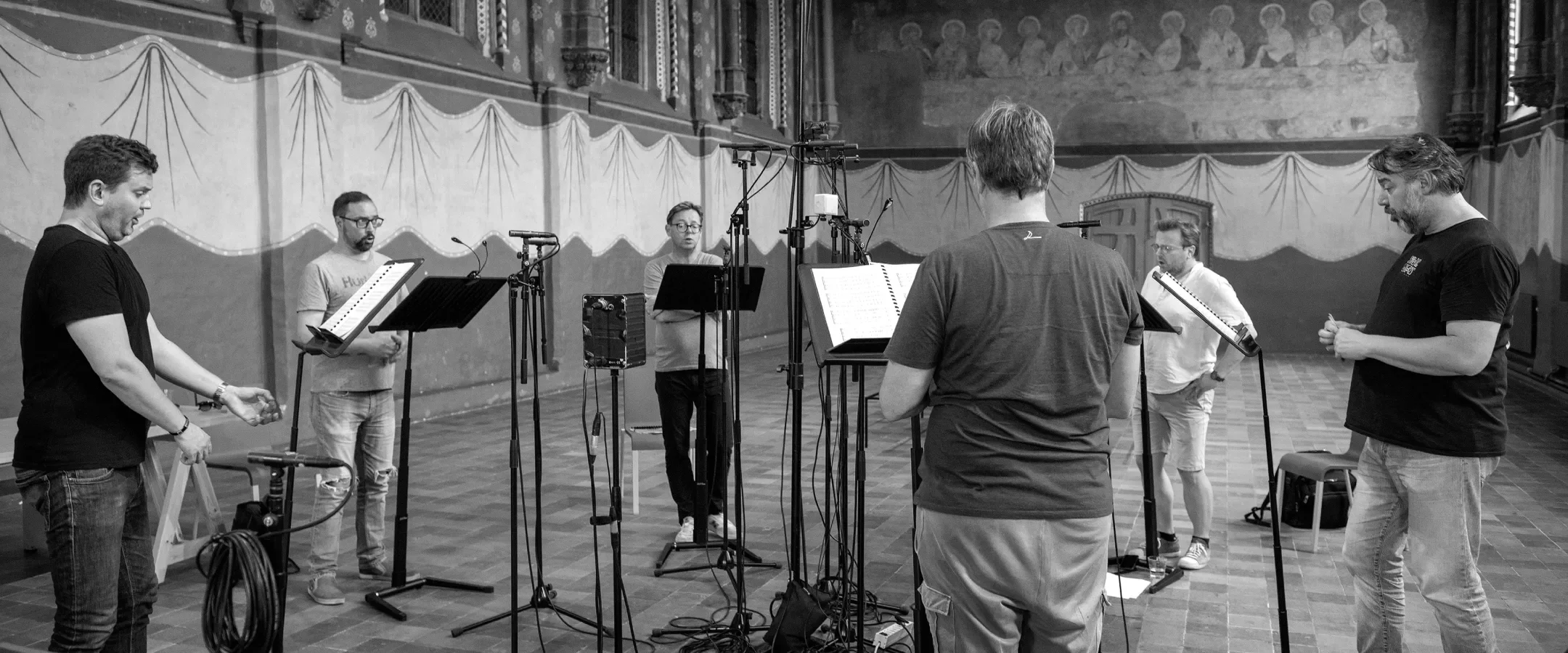
The vocal ensemble Dionysos Now! was founded in 2020 by tenor and artistic director Tore Tom Denys. This flexible ensemble consists of a core of six singers with experience at the international top of polyphony, but also works structurally together with other vocal and instrumental ensembles, such as recently with Spectra Ensemble for the musical theatre project THOU! Dionysus Now! focuses mainly on the work of the 16th-century composer Adriaan Willaert, one of the most highly regarded composers of his time, who is little known today. Through performances and recordings, the ensemble aims to bring his music back to the attention of a wider audience.
Catalina Vicens
Catalina Vicens is internationally esteemed as a researcher and player of historical keyboard instruments. She studied modern piano, harpsichord, medieval keyboards and contemporary music performance at various conservatories in Chile, the US and Europe. Since 2021, she has been director and curator of the Tagliavini Collection in Bologna, one of the largest collections of historical keyboard instruments in Europe. In 2013, Vicens founded the ensemble Servir Antico, which aims to share the intellectual and musical legacy of the Renaissance with a contemporary audience. She has been a guest harpsichord teacher and researcher at numerous conservatories, including the Royal Conservatory of Brussels.
presenting partners
Klara, KPMG
event partners
Belfius, BMW, Proximus, Brouwerij Omer Vander Ghinste, Interparking
public funding
Brussels Hoofdstedelijk Gewest, Nationale Bank, Nationale Loterij-meer dan spelen, Vlaamse Gemeenschap, Vlaamse Gemeenschapscommissie
cultural partners
Bozar, Flagey, Ancienne Belgique, Kaaitheater, Muntpunt
festival suppliers
Maison De La Poste, Fruit at Work, Levi Party Rental, Drukkerij Bosmans, Café Victor, Brussels Booking Desk, Ray & Jules, Maison Dandoy
media partners
VRT 1, VRT Canvas, Radio 1, Bruzz, De Standaard, Knack / Le Vif, La Libre, Musiq3, La Première, La Trois, Ring TV, visit.brussels