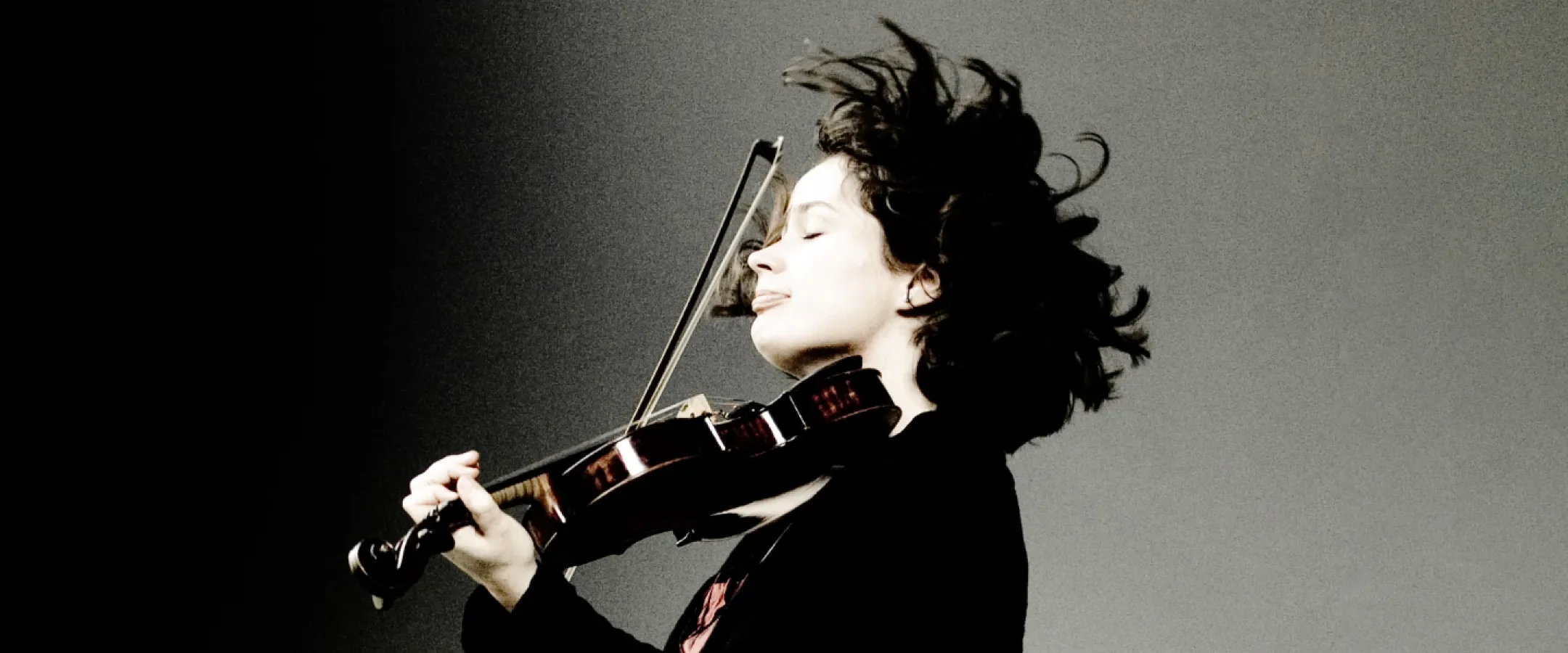
Brussels Philharmonic & Patrick Hahn
An Evening with Patricia Kopatchinskaja
Welcome to the 20th Klarafestival!
Under the title We Are Now, this special anniversary edition pays tribute to the here and now. No one embraces the magic of the moment more fearlessly than festival artist Patricia Kopatchinskaja. Wherever and whatever she plays, this Moldovan violinist and composer sets the stage alight. For her, every concert is a new beginning, a full moment in which anything can happen. Klarafestival 2025 paints a multifaceted portrait of Patricia Kopatchinskaja as a violinist, composer and inspiring presence.
In honour of our 20th anniversary, we are launching a new tradition: for one day, Mont des Arts will be transformed into the Muziekberg /Mont des Musiques. Alongside concerts and performances at various venues, a new ensemble will also see the light. Sound of Brussels Orchestra goes in search of the exceptional sound of our capital.
We live in challenging times, and some of the festival projects reflect on this. At the same time, they demonstrate how much hope can lurk between the notes of a Stabat Mater or a Dies Irae. How music can move and inspire us. For Patricia Kopatchinskaja, music is no abstract matter: ‘Music is there for us to do something with it. Even when it has no concrete message or function, it appeals to us. It wants to be heard. I don't believe in absolute music. Not really.'
Let the celebration begin!
Joost Fonteyne, intendant
Jan Raes, chairman
Chantal Pattyn, network manager
19:15 - Studio 1 *
Johanna Beyer (1888-1944)
Percussion Suite
I.
II.
III.
Edgard Varèse (1883-1965)
Ionisation
credits
Gert François, Bart Quartier – general direction
Bart Bouckaert – musical direction (Ionisation)
Laura Oliver López, Hui Chi Li, Rémy Gouraud, Silas Van den Spiegel, Gideon Van Canneyt, Xiaotong Wu, Luis Ramos Guëmes, Alejandro Rey Mendoza, Kalina Hristova, Pierre Bezard, Stijn Decuypere, Lou Nickels, Mathijs Lanckriet – percussion (Students from Koninklijk Conservatorium Brussel / Erasmus Hogeschool Brussel)
* free upon presentation of a ticket for the concert at 20:00 - limited capacity
20:00 - Studio 4
Igor Stravinsky (1882-1971)
Violin Concerto in D Major, W. 61
-
Toccata
-
Aria I
-
Aria II
-
Capriccio
Johann Sebastian Bach (1785-1750)
Sarabande from Cello Suite No. 5 in C Minor, BWV 1011
Olivier Messiaen (1908-1992)
Les Offrandes oubliées. Méditation symphonique.
PatKop (1977)
A Play, for violin, cello and orchestra
-
Stacking the Deck
-
Kinderlied (für Mihaela Ursuleasa)
-
Tuning
-
Der Brunnen dort oben (...ein Glas klares reines Wasser für Peter Eötvös…)
-
Cadenza
credits
Brussels Philharmonic – orchestra
Patrick Hahn – musical direction
Patricia Kopatchinskaja – violin
Anastasia Kobekina – cello
21:45 - Studio 1 **
Film screening of Ursonate, after Kurt Schwitters
A Dadaist sound poem filmed with four non-actors, creating absurd imagery through nonsensical scenes
With musical interludes by Patricia Kopatchinskaja and Anthony Romaniuk:
Igor Stravinsky
Introduction from Suite Italianne for violin and piano
Giya Kancheli (1935-2019)
Rag-Gidon-Time
John Cage (1912-1992)
Nocturne for violin and piano
Bohuslav Martinů (1890-1959)
Jazz Etude for violin and piano
credits
Patricia Kopatchinskaja, Lucas Fierz, Reto Bieri – concept
Patricia Kopatchinskaja, Reto Bieri, Annekatrin Klein, Anthony Romaniuk – acting musicians
Hellerau, European Centre for the arts – coproduction
** Tickets € 10 / € 5 for ticket holders of the concert at 20:00
Time Travel with Patricia Kopatchinskaja
For an entire evening, festival artist Patricia Kopatchinskaja and the Brussels Philharmonic Orchestra take us to a special chapter in music history: the 1930’s. During that turbulent period, there was a dizzying amount to experience at an artistic level. We pass several of these milestones in a triptych of unique concerts. Location of the action: the stunning Flageygebouw, which was designed and inaugurated as one of the first broadcasting buildings in Europe.
Varèse meets Beyer
For the first stop of this concert evening, Brussels percussion students take us to the United States. In the 1920’s and ‘30’s, a movement of avant-garde composers surfaced, with Henry Cowell as its central figure. Along with composers such as Carl Ruggles, Ruth Crawford and Charles Seeger, Johanna Beyer was a member of this circle. Her work in the 1930’s was unusually inventive. The first woman to compose for electronic instruments, she also anticipated post-war developments such as minimal music and provided a ground-breaking contribution to the percussion repertoire. In her Percussion Suite, the understated, tranquil treatment of the instruments is particularly innovative. Where other composers employ percussion for its explosive sound, Beyer finds the most subtle nuances of tone and resonance from instruments such as bass drum, triangle and tom-tom.
Another member of Cowell’s circle was the French composer Edgard Varèse, who lived in the U.S. from 1945. Varèse was especially known for his radical innovations. He experimented widely with rhythm and timbre, giving percussion a central role and working with alternative instruments such as the ondes Martenot and the siren. Varèse didn’t even really speak of ‘music’; he chose the term ‘organised sound’ for his work. His pioneering spirit is clearly audible in Ionisation for 13 percussionists. The title refers to the chemical process of ionisation, by which an atom or molecule loses or gains an electron, and thereby becomes positively or negatively charged. Something similar occurs in Varèse’s music: we hear a number of rhythmic cells being continually extended, abbreviated and modified.
In the spirit of Stravinsky
For the central concert on this triple bill, Patricia Kopatchinskaja joins forces with the Brussels Philharmonic. Together they present a programme inspired by the Russian composer Igor Stravinsky. Before the First World War, Stravinsky had already made his name in Paris with innovative compositions for the Ballets Russes. From 1920 onwards, he returned to classical examples (with a modern twist) in the style known as ‘neoclassical’. In his Violin concerto in D, Stravinsky orientates towards baroque music, apparent in movement titles such as ‘Toccata’, ‘Aria’ and ‘Capriccio’ and the motoric rhythm that we hear especially in the first movement. His way of handling the instruments is also unequivocally modern. The violin soloist begins each movement with a chord that stretches across two octaves; Samuel Dushkin, for whom Stravinsky wrote the concerto, at first declared it unplayable. Nevertheless, Stravinsky was never looking for pure virtuosity in his concerto.
He investigated the violin’s tone possibilities in a variety of combinations with orchestral instruments, making the texture often more reminiscent of chamber music. Here again, Stravinsky took inspiration from the baroque, in particular from the Concerto for two Violins by Johann Sebastian Bach. To make this influence more appreciable to our ears, cellist Anastasia Kobekina plays the ‘Sarabande’ from Bach’s Cello Suite No.5 in C minor. This slow, stately dance in three-four time is considered one of the most exquisite movements of Bach’s cello suites. This contemplative movement again demonstrates Stravinsky’s affinity: the understated intensity reminds one of the third movement (‘Aria II’) of Stravinsky’s Violin Concerto.
We also find the young Olivier Messiaen in 1930’s France. His Les Offrandes oubliées (The Forgotten Offerings) is an early work, but already features seeds of the colourful soundscape and religious subject matter that would characterise his later work. However, the content of this ‘symphonic meditation’ has other emphases. Although he would later focus more closely on the salvation promised by Christian belief, here human wickedness stands central. The work is in three movements. A grieving evocation of Christ’s crucifixion is followed by a bombastic middle movement in which we hear, against incisive trumpet calls, mankind in a sinful race into the abyss. The particularly slow final movement for strings allows the music to completely relax, as if we have now entered the afterlife. Messiaen’s technique for orchestration is remarkable, influenced by his position as organist at the Église de la Sainte-Trinité in Paris. He often handles different groups of instruments as one single unit, switching them fully on or off like organ registers.
With A Play, a double concerto for violin, cello and orchestra by PatKop (Patricia Kopatchinskaja’s pseudonym as composer), we return to the present day. PatKop wrote the concerto for herself and cellist Sol Gabetta, a long-time close friend. She found her inspiration in the intimate world of their friendship. The quirky percussion references Gabetta’s son (PatKop’s godchild), who has been fascinated by percussion since childhood. Next, the last notes on a toy piano – a quote from George Enescu’s Third Violin Sonata – are a tribute to the deceased pianist and friend Mihaela Ursuleasa, with whom Kopatchinskaja frequently performed this sonata. In the five movements of A Play, PatKop evokes the most diverse images. The first movement, for example, introduces a mischievous spirit, and a circus in active preparation for a new performance. The second movement represents a fight between a monster and a mother preventing it from coming near her child. The fifth movement is a series of loose memories, as if we are waking up from a troubled dream.
Dada
Patricia Kopatchinskaja closes the evening with a musical presentation of Ursonate, the film she based on the similarly titled sound poem by German Dadaist Kurt Schwitters. At the beginning of the 20th century, art movements such as Italian Futurism, the Russian Zaum movement and especially Dadaism experimented with this kind of sound poetry. Like abstract painters at the time, who believed colour and form to be more important than content, poets uncoupled meaning from sound to achieve a phonetic sort of poetry. Schwitters, a central figure in Hannover’s Dada movement, wrote Ursonate, a nonsensical poem in which the sounds of abstract syllables are central and any referential meaning disappears.
The film Ursonate, after Kurt Schwitters breathes new life into Schwitter’s poem, which had somewhat lost its power over time. Kopatchinskaja distinguishes four parts to the poem, that were named by Schwitters himself. They correspond to four classic musical personalities: the first section is explosive and excitable, the second lyrical, the third militaristic and quick-tempered, and the fourth melancholic. The four characters are represented by as many protagonists in the film, played by Kopatchinskaja and three fellow musicians. There is a lively daughter, a stoic son, a morbid father and a melancholic mother. Over the course of the film, we see the family dynamic between the characters evolving, and how their dreams and illusions are finally thwarted. Between sections, Kopatchinskaja and pianist Anthony Romaniuk play music by Igor Stravinsky, Gia Kantsjeli, John Cage and Bohuslav Martinů, in the same experimental, playful spirit as Schwitter’s sound poem.
Robbe Beheydt
Translation: Patrick Goddard
[concert 1]
Bart Bouckaert
Bart Bouckaert studied at the Royal Conservatory of Brussels, where he earned Higher Diplomas in chamber music and percussion, as well as a master’s degree in orchestral conducting. His principal conducting teachers included Rob Casteels, Lucas Vis, Peter Eötvös, Arturo Tamayo, and Peter Gülke. He later obtained a PhD in the arts from the Vrije Universiteit Brussel. Bouckaert has conducted orchestras and ensembles such as the Asko Ensemble, Prometheus Ensemble, Het Collectief, Odysseia Ensemble, Belgian National Orchestra, Spoleto Festival Orchestra, and the National Orchestra of Lithuania. He is currently a professor of orchestral conducting and contemporary music at the Royal Conservatory of Brussels.
[concert 2]
Brussels Philharmonic
Brussels Philharmonic was founded in 1935 as the symphony orchestra of Belgium’s public broadcaster and has been an independent institution since 1998. Based at Flagey, the orchestra has been under the direction of music director Kazushi Ono since 2022. It is dedicated to sharing both the symphonic repertoire and contemporary music with a broad audience. Additionally, the orchestra has a strong affinity with film music, having recorded numerous soundtracks, including the Oscar-winning score for The Artist in 2012. Beyond Flanders and Brussels, Brussels Philharmonic has performed on renowned international stages, including Carnegie Hall in New York, Philharmonie de Paris, Wiener Musikverein, and the Großes Festspielhaus in Salzburg.
Patrick Hahn
Patrick Hahn is an Austrian conductor, pianist and composer. In recent years, he has made an international name for himself, conducting at some of the world’s most prestigious concert halls. He has collaborated with orchestras such as the Münchner Philharmoniker, Philharmonia Orchestra, London Philharmonic, Tonhalle-Orchester Zürich, Wiener Symphoniker, and the Concertgebouworkest. His opera engagements have included productions at the Dutch National Opera & Ballet, Bayerische Staatsoper, Semperoper Dresden, Opernhaus Zürich, and the New National Theatre Tokyo. He currently serves as music director of the Wuppertaler Bühnen und Sinfonieorchester and as principal guest conductor of the Symphonieorchester des Bayerischen Rundfunks and the Royal Scottish National Orchestra.
Patricia Kopatchinskaja
Moldovan violinist and composer Patricia Kopatchinskaja is known for her innovative concert programmes, often with a theatrical element. Her experimental spirit is expressed in original approaches to the traditional repertoire and a love of 20th and 21st century music. This has led to collaborations with contemporary composers such as Luca Francesconi, Michael Hersch and György Kurtág. Kopatchinskaja was previously artist in residence with, among others, the Berliner Philharmoniker, Orchestre philharmonique de Radio France and at the Barbican Centre London. She has made more than 30 CD recordings, including the album Death and the Maiden with the Saint Paul Chamber Orchestra, which won a Grammy in 2018.
Anastasia Kobekina
Russian cellist Anastasia Kobekina studied in Moscow, Berlin, Paris, and Frankfurt under teachers including Jérôme Pernoo and Kristin von der Goltz. In 2019, she won third prize at the International Tchaikovsky Competition. She also received the Leonard Bernstein Award at the Schleswig-Holstein Musik Festival in 2024, a prize supporting promising musicians. Kobekina has collaborated with orchestras such as the Konzerthausorchester Berlin, Wiener Symphoniker, Kremerata Baltica, and the BBC Philharmonic, working with conductors including Krzysztof Penderecki, Omer Meir Wellber, and Paavo Järvi, performing in major concert venues worldwide such as the Concertgebouw Amsterdam, Tonhalle Zürich, Wigmore Hall and Lincoln Center.
[concert 3]
Patricia Kopatchinskaja
Moldovan violinist and composer Patricia Kopatchinskaja is known for her innovative concert programmes, often with a theatrical element. Her experimental spirit is expressed in original approaches to the traditional repertoire and a love of 20th and 21st century music. This has led to collaborations with contemporary composers such as Luca Francesconi, Michael Hersch and György Kurtág. Kopatchinskaja was previously artist in residence with, among others, the Berliner Philharmoniker, Orchestre philharmonique de Radio France and at the Barbican Centre London. She has made more than 30 CD recordings, including the album Death and the Maiden with the Saint Paul Chamber Orchestra, which won a Grammy in 2018.
Anthony Romaniuk
The Australian keyboardist Anthony Romaniuk moves effortlessly across musical styles and genres. Beginning with a fascination for jazz, he later specialised in early music and has since expanded his practice to include improvisation, indie rock, and electronic music. Romaniuk is a core member of Vox Luminis and has collaborated with artists such as tenor Reinoud Van Mechelen, the Australian Chamber Orchestra, Camerata Bern, and the Danish indie rock band Efterklang. His two solo albums, Bells (2020) and Perpetuum (2023), each showcase a wide spectrum of composers, from Byrd and Bach to Beethoven and Schubert, as well as Ligeti and Crumb, alongside Romaniuk’s own compositions.
Structural partners
Klara, KPMG
Event partners
Belfius, Interparking, Proximus
Cultural partners
Ancienne Belgique, Belgian National Orchestra, Bozar, Brussels Philharmonic, Flagey, Kaaitheater, Muntpunt, Passa Porta
Public funding
Nationale Bank, Nationale Loterij meer dan spelen, Stad Brussel, Visit Brussels, Vlaamse Gemeenschap
Media partners
BRUZZ, De Standaard, Knack, La Première, La Trois, Le Soir, Musiq3, Radio 1, Ring TV, Le Vif, VRT Eén, VRT Canvas, VRT Max
Festival suppliers
Daniel Ost, Drukkerij VD, Fruit at Work, Tarteletto, Victor Bozar Cafe
Patrons
Wim Bossens, Alex Brabers, Tania Seynhaeve & Jan Raes, Sophie Rutten
