Patricia Kopatchinskaja, Aurora Orchestra, Vox Luminis & Anthony Romaniuk
Dies Irae
Welcome to the 20th Klarafestival!
Under the title We Are Now, this special anniversary edition pays tribute to the here and now. No one embraces the magic of the moment more fearlessly than festival artist Patricia Kopatchinskaja. Wherever and whatever she plays, this Moldovan violinist and composer sets the stage alight. For her, every concert is a new beginning, a full moment in which anything can happen. Klarafestival 2025 paints a multifaceted portrait of Patricia Kopatchinskaja as a violinist, composer and inspiring presence.
In honour of our 20th anniversary, we are launching a new tradition: for one day, Mont des Arts will be transformed into the Muziekberg /Mont des Musiques. Alongside concerts and performances at various venues, a new ensemble will also see the light. Sound of Brussels Orchestra goes in search of the exceptional sound of our capital.
We live in challenging times, and some of the festival projects reflect on this. At the same time, they demonstrate how much hope can lurk between the notes of a Stabat Mater or a Dies Irae. How music can move and inspire us. For Patricia Kopatchinskaja, music is no abstract matter: ‘Music is there for us to do something with it. Even when it has no concrete message or function, it appeals to us. It wants to be heard. I don't believe in absolute music. Not really.'
Let the celebration begin!
Joost Fonteyne, intendant
Jan Raes, chairman
Chantal Pattyn, network manager
Aurora Orchestra
Vox Luminis – vocal ensemble
Patricia Kopatchinskaja – violin, artistic direction
Anthony Romaniuk – piano
Roman Borkovsky, Arnau Chacun Alberta, Luca Faghel, Elias Meers, Guann-Tyng Ho, Akari Koizumi, Annika Küster – trombone (students of the Brussels Conservatories)
Coproduction: Klarafestival, Bozar, Koninklijk Conservatorium Brussel, Conservatoire royal de Bruxelles
With the support of: the Tax Shelter of the Belgian Federal Government
World premiere: 2 September 2017, Lucerne Festival
DIES IRAE – A Staged Concert
Giacinto Scelsi (1905-1988)
Okanagon (recording)
Heinrich Ignaz Franz Biber (1644-1704)
Battalia
George Crumb (1929-2022)
Black Angels (excerpts)
Jimi Hendrix
Visual recomposing by Jonas Link and sound design by Jorge Sánchez-Chiong
Antonio Lotti (1667-1740)
Crucifixus (choir a cappella)
Improvisation on a Byzantine chant (Psalm 140)
John Dowland (1563-1626)
Lachrimae antiquae novae
Galina Ustvolskaya (1919-2006)
Composition II – ‘Dies Irae’ for 8 double basses, percussion and piano
Gregorian Dies Irae (choir a cappella)
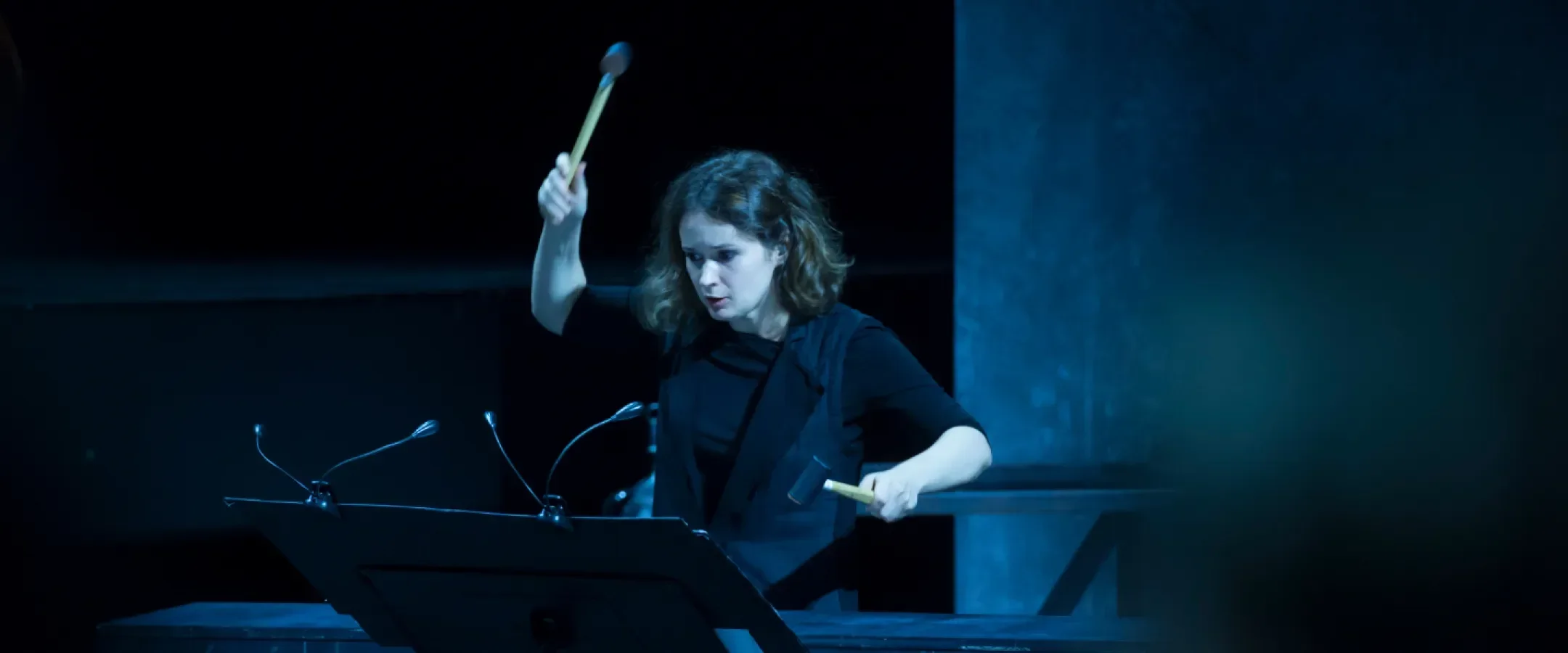
A woman attacks a wooden box with a hammer as stormy piano chords erupt beside her. Eight double basses echo the same intense phrase repeatedly. Galina Ustvolskaya’s Dies Irae marks the apotheosis of the eponymous performance that concludes Klarafestival 2025. This powerful scenic concert is the brainchild of festival artist Patricia Kopatchinskaja, exploring the question: what answer does classical music have for today’s urgent crises? How can musicians respond to war and climate change? Joined by Aurora Orchestra and Vox Luminis, Kopatchinskaja gallops through music history, from the Gregorian Dies Irae (‘Day of Wrath’) to Ustvolskaya’s modern reimagining. Along the way, Biber’s baroque Battalia and Lotti’s moving Crucifixus stand side by side with George Crumb’s Black Angels. Both a protest and a call to action, this production leaves the audience inspired and empowered as the musical dust settles.
This third and last project of our festival artist is the living proof of her creed: for violinist and composer Patricia Kopatchinskaja, music is no dry matter – it is nothing short of existential. When she steps onto the stage, barefoot or otherwise, expect an electric performance that changes how you see the world. Whether she’s performing early, contemporary or her own music, she reimagines each note, guided by the singular energy of the moment. Convention and perfection take a back seat to imagination and adventure. In the run-up to the festival, she spoke with intendant Joost Fonteyne and dramaturge Katherina Lindekens about her conception of music and the special ritual of a concert.
JF - In an interview, you once said that the rain was your first music teacher.
PK - Yes, I vividly remember my first impressions of rhythm and melody in nature. People always ask who your teacher was, but you can learn anywhere. Music is more than what’s written down in scores. In fact, Busoni said: ‘As soon as you write down music, you kill it.’ You literally capture it in a rigid form. So, in order to perform music, you have to take it off the paper and bring it back to life. A performance is a personal encounter. I interpret what happens between the work and myself – here and now, without the mediation of theories or traditions. I invite the audience to join me on that adventure. Sometimes things go wrong, and that's okay. I think it's important to embrace mistakes and imperfections. We’re human.
KL - You are both a violinist and a composer. How do those two identities relate to each other?
PK - I don't distinguish between creative processes. In fact, I don’t believe compositions are owned by anyone – not even the author. The material is all around us. As a creator, you are simply capturing something that is already there. It’s a privilege to be able to hear it, write it down and play it. The composer is not a god, with musicians as servants. No, we are all part of that creative process. The score is a stopover, where the material is preserved for a while. But then we have to bring it to our time and interpret it in a language that everyone understands. When I play early music, I am not in a distant past. Of course, I want it to sound as surprising and revolutionary as it did back then. But I am in the now. My listeners live in these times. They know what nuclear threat and climate change are; they know Spotify and A.I.
KL - So the audience is a crucial interlocutor?
PK - Absolutely. Without the audience, we don't exist. There is also no wall between player and spectator, although you might sometimes think there is. It seems as if the concert hall has taken the place of the church: the musicians are at a safe distance, and people are only allowed to applaud. I would like to desecrate that sacred setting. As far as I’m concerned, the stage can be a playground. Play with the music. Live it, over and over again. Move it! What is our duty as artists? First and foremost: not to bore our audience. Next, we have to be as authentic as possible. We stand onstage as our fragile, naked selves, but with a strong message.
JF - I also see artists as questioners, inviting us to reflect.
PK - Artists often see the world in a slightly different light. As a result, they also pull people out of their comfort zone. A concert hall is not a wellness centre. It’s a space for entertainment and beauty, sure, but also for fascination, confrontation, provocation. As an artist, you show a mirror of your soul. Only in this way can you uncover a fraction of the truth, which always has many layers. That's also why I don't think art can be apolitical. Politics is about us and art is about us. We’re not aliens. We’re here, we’re a community.
JF - Do we reduce art to beauty? After a concert, people often ask each other: ‘Did you like it? Did you enjoy it?'
PK - Yes, whereas the question should perhaps rather be what a concert did to you. That experience can be about beauty, but about so many other things as well. Beauty is an elastic and personal concept. Just think of Francis Bacon's agonised paintings, Munch' s The Scream or Hieronymus Bosch's hellscapes. Or take the faces of Frans Hals: if you look at them close up, they’re far from perfect. You need some distance to experience their power. A dissonance in Kurtág's music, that's beauty.
KL - Back to your call to embrace imperfection. Coming from such a phenomenal violinist, it sounds almost paradoxical.
PK - For me, it's mainly about integrating art into life and vice versa. I learnt a lot from the folk music I heard in my childhood, which was very functional. There was dance music, and music for funerals and other rituals. Invariably, it was structured in such a way that you couldn't help but dance or cry. That kind of directness is deeply rooted in me. Music is never really abstract. It’s there to do something with. Even when it has no concrete message or intention, it appeals to us. It wants to be heard. I don't believe in absolute music. Not really.
Katherina Lindekens
Patricia Kopatchinskaja
Moldovan violinist and composer Patricia Kopatchinskaja is known for her innovative concert programmes, often with a theatrical element. Her experimental spirit is expressed in original approaches to the traditional repertoire and a love of 20th and 21st century music. This has led to collaborations with contemporary composers such as Luca Francesconi, Michael Hersch and György Kurtág. Kopatchinskaja was previously artist in residence with, among others, the Berliner Philharmoniker, Orchestre philharmonique de Radio France and at the Barbican Centre London. She has made more than 30 CD recordings, including the album Death and the Maiden with the Saint Paul Chamber Orchestra, which won a Grammy in 2018.
Aurora Orchestra
The British Aurora Orchestra is known as an innovative and groundbreaking orchestra. It was founded in 2004 and has since grown into an established name on the international concert stages under chief conductor Nicholas Collon. It was one of the first orchestras in the world to make performances without sheet music a permanent part of its concerts. For its original and interdisciplinary concert formats, the orchestra has collaborated with artists such as tenor Ian Bostridge, visual artist Edmund de Waal, choreographer Wayne McGregor and singer Björk. Aurora Orchestra also strives to appeal to a wide audience through workshops and storytelling concerts for families, schools and children.
Vox Luminis
The Belgian early music ensemble Vox Luminis was founded in 2004 by bass and artistic director Lionel Meunier. The core of vocal soloists is supported by continuo, solo instruments or orchestra, depending on the repertoire. The ensemble focuses on English, Italian and German music from the 17th and early 18th centuries, from the essential repertoire to forgotten gems. Vox Luminis is a welcome guest on international concert stages such as Teatro Real Madrid, Wigmore Hall London, Lincoln Center New York, the Boston Early Music Festival, Bachfest Leipzig and the Salzburg Festival. Since 2021, Vox Luminis has been working regularly with the renowned Freiburger Barockorchester and Freiburger BarockConsort.
Anthony Romaniuk
Australian keyboard player Anthony Romaniuk moves effortlessly between different musical styles and genres. He started out with a fascination for jazz, went on to specialise in early music and has since expanded his practice to include improvisation, indie rock and electronic music. Romaniuk is a permanent member of Vox Luminis and has also worked with tenor Reinoud Van Mechelen, the Australian Chamber Orchestra, Camerata Bern and the Danish indie rock band Efterklang. His two solo albums, Bells (2020) and Perpetuum (2023), each feature a broad spectrum of composers, ranging from Byrd and Bach to Beethoven and Schubert to Ligeti and Crumb, alongside Romaniuk's own work.
I. Dies iræ, dies illa,
Solvet sæclum in favilla:
Teste David cum Sibylla.
II. Quantus tremor est futurus,
Quando iudex est venturus,
Cuncta stricte discussurus!
III. Tuba, mirum spargens sonum
Per sepulchra regionum,
Coget omnes ante thronum.
IV. Mors stupebit, et natura,
Cum resurget creatura,
Iudicanti responsura.
I. Day of wrath and doom impending!
David's word with Sibyl's blending,
Heaven and earth in ashes ending!
II. Oh, what fear man's bosom rendeth,
When from heaven the Judge descendeth,
On whose sentence all dependeth.
III. Wondrous sound the trumpet flingeth;
Through earth's sepulchres it ringeth;
All before the throne it bringeth.
IV. Death is struck, and nature quaking,
All creation is awaking,
To its Judge an answer making.
VOX LUMINIS
Soprano
Victoria Cassano
Zsuzsi Toth
Liga Zirina
Alto
Sophia Faltas
Anna Bachleitner
Tenor
Adriaan De Koster
Joao Moreira
Lisandro Nesis
Bass
Vincent Berger
Lionel Meunier
AURORA ORCHESTRA
Violin
Maia Cabeza
Viola
Alinka Rowe
Christine Anderson
Cello
Sébastien van Kuijk
Double bass
Ben Griffiths
Sam Rice
Alice Kent
Daniel Molloy
Lucia Polo Moreno
Tom Morgan
Phoebe Clarke
William Puhr
Theorbo/Lute
Kristiina Watt
Trombonist
Roman Borskovskiy
Luca Faghel
Ho Guann-Tyng
Elias Meers
Chacón Albero Arnau
Annika Elisabeth Küster
Akari Koizumi
Percussion
Julie Scheuren
Structural partners
Klara, KPMG
Event partners
Belfius, Interparking, Proximus
Cultural partners
Ancienne Belgique, Belgian National Orchestra, Bozar, Brussels Philharmonic, Flagey, Kaaitheater, Muntpunt, Passa Porta
Public funding
Nationale Bank, Nationale Loterij meer dan spelen, Stad Brussel, Visit Brussels, Vlaamse Gemeenschap
Media partners
BRUZZ, De Standaard, Knack, La Première, La Trois, Le Soir, Musiq3, Radio 1, Ring TV, Le Vif, VRT Eén, VRT Canvas, VRT Max
Festival suppliers
Daniel Ost, Drukkerij VD, Fruit at Work, Tarteletto, Victor Bozar Cafe
Patrons
Wim Bossens, Alex Brabers, Tania Seynhaeve & Jan Raes, Sophie Rutten
