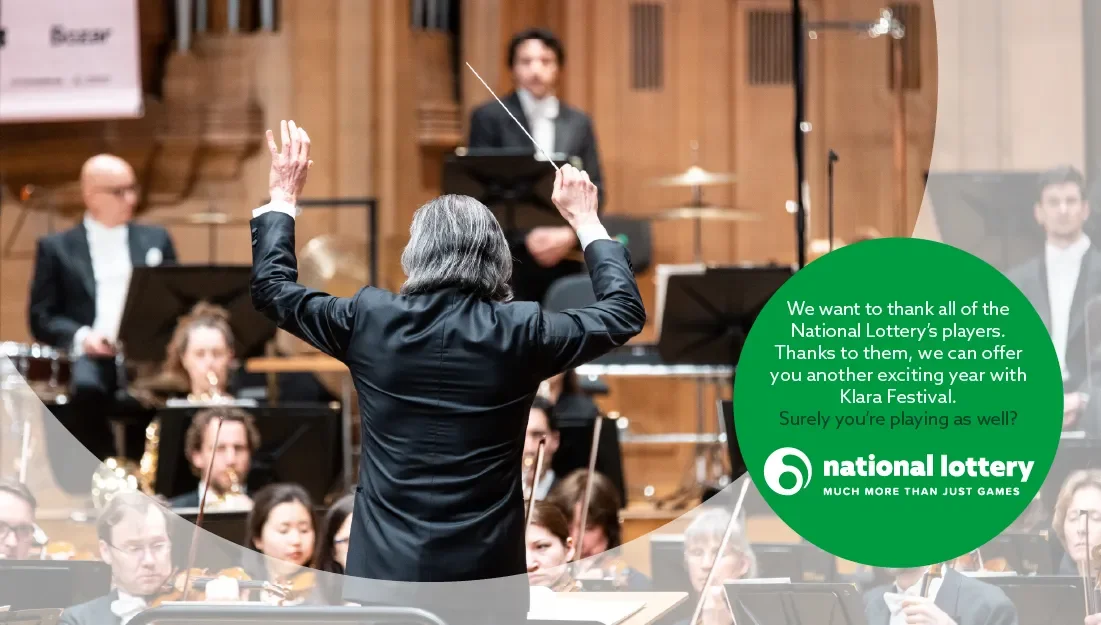
Belgian National Orchestra & Lorenzo Gatto
Arvo Pärt 90
Welcome to the 20th Klarafestival!
Under the title We Are Now, this special anniversary edition pays tribute to the here and now. No one embraces the magic of the moment more fearlessly than festival artist Patricia Kopatchinskaja. Wherever and whatever she plays, this Moldovan violinist and composer sets the stage alight. For her, every concert is a new beginning, a full moment in which anything can happen. Klarafestival 2025 paints a multifaceted portrait of Patricia Kopatchinskaja as a violinist, composer and inspiring presence.
In honour of our 20th anniversary, we are launching a new tradition: for one day, Mont des Arts will be transformed into the Muziekberg /Mont des Musiques. Alongside concerts and performances at various venues, a new ensemble will also see the light. Sound of Brussels Orchestra goes in search of the exceptional sound of our capital.
We live in challenging times, and some of the festival projects reflect on this. At the same time, they demonstrate how much hope can lurk between the notes of a Stabat Mater or a Dies Irae. How music can move and inspire us. For Patricia Kopatchinskaja, music is no abstract matter: ‘Music is there for us to do something with it. Even when it has no concrete message or function, it appeals to us. It wants to be heard. I don't believe in absolute music. Not really.'
Let the celebration begin!
Joost Fonteyne, intendant
Jan Raes, chairman
Chantal Pattyn, network manager
Belgian National Orchestra
Matthew Halls – musical direction
Lorenzo Gatto – violin
Coproduction: Klarafestival, Bozar, Belgian National Orchestra
With the support of: the Tax Shelter of the Belgian government via Casa Kafka Pictures
Arvo Pärt (1935)
Estländler
Spiegel im Spiegel
Fratres
‘Ludus’ from Tabula Rasa
Estländler
Mozart-Adagio
Arbos
Symphony No. 3
I.
II.
III.
Cantus in Memory of Benjamin Britten
Like almost all the composers in the former Soviet Union, Arvo Pärt (°1935) experienced his career as an arduous search for his own musical style. We see from his official list of works that Pärt began by experimenting with serial techniques but soon turned to freer forms and collage techniques. There were two turning points: one was his Credo (1968), which points towards the religious music that would become Pärt’s focus. The second was his Third Symphony (1971), which first reveals the clearly audible impact of his intensive study of early music (Machaut, Ockeghem, Josquin) in that period. In this symphony, Pärt sets aside his avant-garde leanings in favour of a polyphonic fabric of musical lines inspired by the Renaissance.
After two long periods of creative silence, Pärt returned in 1976-77 with an absolute eruption of works that established the style that would become so characteristic of his music. It was a style that would cause a global furore, albeit with a certain delay: his breakthrough only came when he left Estonia for the West with his family in 1980. The fact that one of those works was called Tabula Rasa (1976) indicates the strength of Pärt’s desire for a new start at that time – literally a ‘clean slate’. He still sought inspiration in history: the first part, ‘Ludus’, is reminiscent of a baroque concerto grosso. Another source of inspiration was his colleague Alfred Schnittke, who incidentally played the piano part in the première of Pärt’s piece. The big difference here is that the simplicity of the material and the influence of early music are now combined with a composition technique that has its own harmonic language, as we see in Fratres (1977).
This piece is a typical example of how the extreme simplicity of Pärt’s composition technique creates such a pervasive effect. The composer named it ‘tintinnabuli’. Derived from the Latin for ‘little bell’, it describes the penetrating sound of Pärt’s music. In essence, tintinnabuli consists of a constantly present major or minor triad that gives the music its radiant sonority, while other voices weave diatonic scales – i.e. figures moving in steps of a whole tone – around it in the same mode. This formula that makes his music so immediately recognisable is far from spectacular; on the contrary. Arvo Pärt writes music that harks back to archaic elements (with modes you also find in Gregorian or Renaissance music), and he places the triad, the typical, age-old tonal anchor, emphatically at the heart of his work. Nevertheless, his music does not sound reactionary. Rather than following stereotypical chord progressions, it builds up a logic of its own, fluctuating between consonance and very striking dissonance. It sounds both familiar and a little strange, ancient and contemporary.
This concert does not follow a chronological or thematic path through Pärt’s work. Instead, it is designed to be an experience of sound. Like many of this composer’s works – the Cantus in Memory of Benjamin Britten is an excellent example – the entire programme is structured as one big crescendo. Varying combinations of instruments start with small solos, gradually swelling into the orchestral kaleidoscope of the Third Symphony before simmering down to the strings and tubular bells of the Cantus in Memory of Benjamin Britten.
Estländler is a somewhat atypical piece – this flute solo was written for an educational anthology. The title refers to the dance in an easily recognisable triple metre (‘Ländler’), as well as to Pärt’s homeland of Estonia. The Mozart-Adagio (1992) is the most atypical work on the programme, given that Pärt takes the slow section of Mozart’s piano sonata KV 280 and subtly adds a few extra notes here and there. It is more of a discreet dialogue with Mozart than Pärt in his recognisable style. Spiegel im Spiegel (1978) for violin and piano is also strikingly sober, with sparse notes but a refined structure: the melody of the solo part consists of segments that mirror each other. Every rising phrase in the solo part is immediately followed by a descending phrase. The solo begins with a two-note phrase, then three, then four and so on, always ending on A, until halfway through the piece, when the piece is turned around in mirror symmetry, and the phrases are one note shorter each time. The composition ends where it began.
It illustrates how Pärt continues to use abstract, rational systems to construct his music, as well as his sensual tintinnabuli sound. It is not unimaginable that the rational aspect of scholarly counterpoint in Renaissance music was a source of inspiration here. In any case, that counterpoint can be clearly discerned in Cantus in Memory of Benjamin Britten (1978). There all the parties play descending, scale-like lines: in fact, you might say the entire piece is essentially one big, descending scale in A minor. These scales begin high in the first violins, and every time a group of strings joins in, the same material appears an octave lower and with note values that are twice as long, with the result that the fifth group – the double basses – play 16 times slower than the first violins. This technique, in which the different voices play the same notes at a different speed, is a familiar example of sophisticated Renaissance counterpoint. We know it as the ‘prolation canon’, with Ockeghem’s Missa Prolationum as a prime example. Pärt’s Arbos (1977) is also constructed as a strict prolation canon, but it only contains three layers, and because all the parts begin together (in contrast to Cantus, where they are introduced one by one) this cannot be heard as clearly, although it will be obvious that the higher voices are moving more quickly than the lower ones. Even in this strictly designed work, Pärt leaves space for a freer, more expressive touch by adding percussion at selected moments.
Maarten Beirens
Translation: Helen White
Belgian National Orchestra
The Belgian National Orchestra has had the Centre for Fine Arts (Bozar) as its home base for many years. Thanks to permanent collaborations with Festival van Vlaanderen and Festival de Wallonie, it also regularly performs in all the provincial capitals nationwide. In addition, the BNO showcases itself internationally through tours abroad and by providing accompaniment for the Queen Elisabeth Competition. Although the orchestra focuses on the symphonic repertoire, contemporary music and film music, it does not shy away from experimenting with pop artists such as Ozark Henry or Stromae. Since 2022, the BNO has been led by the Dutch chief conductor Antony Hermus.
Matthew Halls
British conductor Matthew Halls has been the chief conductor of the Finnish Tampere Filharmonia since 2023. He has also led orchestras as a guest conductor, including the Chicago Symphony Orchestra, the Cleveland Orchestra, the Royal Liverpool Philharmonic and the Wiener Symphoniker. As an opera conductor he has appeared at the Bavarian State Opera, Central City Opera Colorado and Salzburger Landestheater. His background in early music led him to become one of the first guest conductors of Concentus Musicus Wien, the baroque ensemble of Nikolaus Harnoncourt. His discography includes recordings of Bach's harpsichord concertos, conducted from the keyboard, and the first recording of Handel's opera Parnasso in Festa.
Lorenzo Gatto
The Belgian violinist Lorenzo Gatto graduated from the Royal Conservatory of Brussels at the age of 17 and subsequently perfected his skills with Herman Krebbers, Augustin Dumay and Boris Kuschnir. In 2009 he came in second and won the audience prize at the Queen Elisabeth Competition. He has worked with leading conductors such as Philippe Herreweghe, Walter Weller, Jaap van Zweden and Yannick Nézet-Séguin. As a chamber musician, he has shared the stage with Maria João Pires, Mischa Maisky, Martha Argerich and Gérard Caussé, among others. Since 2015, Gatto has regularly collaborated with pianist Julien Libeer, with whom he recorded Beethoven's violin sonatas, which was awarded a Diapason d'Or.
BELGIAN NATIONAL ORCHESTRA
Konzertmeister
Alexei Moshkov
Eerste violen · Premiers violons
Lev Adamov
Sarah Guiget*
Maria Elena Boila
Nicolas De Harven
Keika Kawashima
Annija Endija Kolerta
Anastasiya Filippochkina
Françoise Gilliquet
Philip Handschoewerker
Akika Hayakawa
Ariane Plumerel
Isabelle Rowland
Serge Stons
Tweede violen · Deuxièmes violons
Ignacio Rodríguez Martínez de Aguirre**
Nathalie Lefin*
Michael Bonnay
Sophie Demoulin
Isabelle Deschamps
Hartwich D'Haene
Anouk Lapaire
Louis Noël
Ekaterina Philippovich
Jacqueline Preys
Marie-Danielle Turner
Ricardo Vieira
Altviolen · Alti
Mathis Rochat
Mihoko Kusama*
Dmitri Ryabinin*
José Azevedo
Frederik Camacho
Urska Doler
Katelijne Onsia
Jorge Ramos
Silvia Tentori Montalto
Marinela Serban
Cello’s · Violoncelles
Dmitry Silvian**
Maria-Christina Muylle*
Célia Brunet
Lesya Demkovych
Shiho Nishimura
Lucia Otero
Harm Van Rheeden
Taras Zanchak
Contrabassen · Contrebasses
Ludo Joly*
Robertino Mihai**
Serghei Gorlenko*
Mathieu Garnavault
Miguel Meulders
Gergana Terziyska
Fluiten · Flûtes
Denis-Pierre Gustin**
Jérémie Fèvre*
Samuel Hondekijn
Laurence Dubar*
Hobo’s · Hautbois
Dimitri Baeteman**
Irene Martin Sanchez*
Bram Nolf*
Klarinetten · Clarinettes
Emil Szymon Parulski
Alba Mayorga
Lena La Mela*
Giulio Piazzoli*
Fagotten · Bassons
Gordon Fantini**
Bert Helsen*
Filip Neyens*
Hoorns · Cors
Anthony Devriendt**
Katrien Vintioen*
Bernard Wasnaire*
Joannes Van Duffel*
Trompetten · Trompettes
Leo Wouters**
Andreu Vidal Siquier**
Ward Opsteyn*
Rudy Moercant
Trombones
Guido Liveyns**
Bruno De Busschere**
Josquin Chuffart van Der Gidsen
Pierre Duclos*
Tuba
Martijn van Rijswijk**
Pauken · Timbales
Nico Schoeters**
Slagwerk · Percussion
Katia Godart*
Koen Maes
Piano
Laurence Cornez
** Aanvoerder 1ste solist – 1ste solist aanvoerder · Chef de pupitre 1er soliste – 1er soliste chef de pupitre
* Solist · Soliste
Structural partners
Klara, KPMG
Event partners
Belfius, Interparking, Proximus
Cultural partners
Ancienne Belgique, Belgian National Orchestra, Bozar, Brussels Philharmonic, Flagey, Kaaitheater, Muntpunt, Passa Porta
Public funding
Nationale Bank, Nationale Loterij meer dan spelen, Stad Brussel, Visit Brussels, Vlaamse Gemeenschap
Media partners
BRUZZ, De Standaard, Knack, La Première, La Trois, Le Soir, Musiq3, Radio 1, Ring TV, Le Vif, VRT Eén, VRT Canvas, VRT Max
Festival suppliers
Daniel Ost, Drukkerij VD, Fruit at Work, Tarteletto, Victor Bozar Cafe
Patrons
Wim Bossens, Alex Brabers, Tania Seynhaeve & Jan Raes, Sophie Rutten