Nowruz
Persian New Year
Welcome to the 20th Klarafestival!
Under the title We Are Now, this special anniversary edition pays tribute to the here and now. No one embraces the magic of the moment more fearlessly than festival artist Patricia Kopatchinskaja. Wherever and whatever she plays, this Moldovan violinist and composer sets the stage alight. For her, every concert is a new beginning, a full moment in which anything can happen. Klarafestival 2025 paints a multifaceted portrait of Patricia Kopatchinskaja as a violinist, composer and inspiring presence.
In honour of our 20th anniversary, we are launching a new tradition: for one day, Mont des Arts will be transformed into the Muziekberg /Mont des Musiques. Alongside concerts and performances at various venues, a new ensemble will also see the light. Sound of Brussels Orchestra goes in search of the exceptional sound of our capital.
We live in challenging times, and some of the festival projects reflect on this. At the same time, they demonstrate how much hope can lurk between the notes of a Stabat Mater or a Dies Irae. How music can move and inspire us. For Patricia Kopatchinskaja, music is no abstract matter: ‘Music is there for us to do something with it. Even when it has no concrete message or function, it appeals to us. It wants to be heard. I don't believe in absolute music. Not really.'
Let the celebration begin!
Joost Fonteyne, intendant
Jan Raes, chairman
Chantal Pattyn, network manager
Iran
Milad Mohammadi – tar
Kazakhstan
Ulzhan Baibusynova – voice, dombra
Kirghizstan
Eleman & Aibek Kanybekov – komuz
Uzbekistan
Zamira Aminova – dance
Tuymorad Kodirov – voice, tanbur, doyra
Omid Temirov – dotar, rubab, doyra
Rostamjan Tagaykulov – doyra
A new day, a new beginning
At the beginning of spring, many people celebrate the start of a new year. In countries such as Iran and Afghanistan, the new year begins around 21st March according to the official calendar. That is the time when Nowruz is celebrated, which literally means ‘a new day’. This age-old tradition has since spread all over the world, from the Balkans to Central Asia, from the Middle East to the shores of the Black Sea, and even as far as Bozar. During the anniversary edition of the Klarafestival in 2025, this annual highlight will be celebrated by four ensembles and soloists who each give a distinctive voice to their culture.
The origins of Nowruz
Nowruz originated in the early Persian Empire, in present-day Iran. The first references to it date back to the sixth century CE, but the tradition is likely to be much older. Nowruz is often linked to Zoroastrianism. That was the most important religion in the Persian Empire before Islam arrived in the seventh century. The tradition continued under Islamic rule. Furthermore, Nowruz is celebrated by people of different faiths.
The festival is associated with certain typical customs and rituals. People who celebrate Nowruz clean their home before it begins and buy new clothes. They also grow sprouted greens or Sabzeh. These green shoots are one of the seven elements on the Haft Sin table, which is a beautifully laid table holding various items that symbolise a new start. On the last Wednesday before Nowruz, campfires are lit. As a kind of purification ritual, the attendees jump over the fire. The fire reddens their skin, symbolising good health. The exact moment when winter turns into spring is the time to wish each other well. Everyone spends the following days with their family and friends, and children receive treats and gifts, often money.
Nowruz lasts for thirteen days. On the thirteenth day, Sizdah Bedar, everyone goes out into the countryside for a picnic. They make wishes as the Sabzeh are thrown into flowing water. In this way the green shoots, which symbolise nature, are returned to the natural world.
A universal message
Whether we celebrate it with particular rituals or not, the transition from winter to spring is a special time. The day and night are of equal length. Very briefly, darkness and light are in perfect balance. Afterwards, the days get longer and light conquers the darkness. The sun returns, and nature comes back to life. Everything blooms and becomes green again. This symbolic moment of a new beginning is celebrated at Nowruz. Nowruz conveys a universal message of peace, harmony and respect for nature. It isn’t a religious festival: anyone can celebrate it. That makes Nowruz an ideal festival of unity and connection. Just as day and night are equal, all people are equal.
Text: The House of Alijn (huisvanalijn.be)
Star soloist from Iran
The Iranian multi-instrumentalist Milâd Mohammadi is impossible to pigeonhole in any way. From his position as an expert on Persian classical music and master of the tar (a Persian lute), he constantly engages in dialogue with other musical traditions, such as Indian and Arab music. This open attitude resonates in his improvisations, which he intertwines with the mystic poetry of the Persian poet Rumi. At the intersection of various styles, Mohammadi seeks tirelessly for new forms of musical expression. He has worked with the greatest Iranian musicians, such as Hoshyar Khayyam on the award-winning album Music for Tar and Piano, and the singers Alireza Ghorbani and Homayoun Shajarian.
The epic songs of Kazakhstan
In the heart of an immense region dominated by the steppes, an instrument has emerged that truly embodies the nomadic way of life and the endless landscapes: the dombra. This lute with a long neck and two strings can be found in every Kazakh home, but for centuries it was also the travelling companion of a particular figure from times gone by: the zhyrau. The zhyrau was an epic poet whose songs combined heroic tales, philosophy and moral dilemmas. Besides playing the dombra, mastery of throat singing was one of these poets’ greatest talents. The repertoire consists of short fragments of classical Arabic and Persian texts or original compositions.
Ulzhan Baïbusynova, from southern Kazakhstan, is one of today’s most prominent zhyraus. She studied with Chamchat Tulepova, one of the first women to practice this art form, which was traditionally reserved for men. Since she had no brothers, Chamchat inherited the tradition from her father and passed it on to her students, paving the way for a new school of female singing. Now a master in her own right, Baïbusynova sings both classical zhyrau works and her own compositions.
At one with nature in Kyrgyzstan
Kyrgyzstan, a mountainous country between Kazakhstan and China, has a rich repertoire of sung, declaimed and instrumental music. The traditional melodies known as kuï are associated with life in the mountains: living alongside a herd, beside cool rivers, to the rhythm of day and night. The Kyrgyz people’s favourite instrument is the komuz, another long-necked lute. According to legend, the great hunter Kambar was the first to make the instrument. Kambar was familiar with the sounds of all the animals and birds, but one day he was astonished to hear an unknown song. The source of this new sound was a wild sheep that had been killed by predators. The wind blew through the dead creature’s dried-up entrails. Kambar turned these entrails into three strings on which he composed the first kuï.
The two young brothers Èleman and Aïbek Kanybekov represent the new generation of komuz players. Their mother nurtured their musical vocations and brought them into contact with traditional music. At a small music school, their teacher recognised their talent, and they worked extremely hard to get into the National Conservatory. There they benefited from the legacy of the former director Nurak Abdrahmanov, who revived the art of kuï with his lively compositions. Music accompanies all important occasions in life, and of course these include festivities, the Toy. The two brothers are famous performers at Toy, performing acrobatic tours de force on the komuz and entertaining guests with their singing.
An age-old festival from Uzbekistan
From the 17th century onwards, the court of Bukhara – in present-day Uzbekistan – was a hotchpotch of cultures, with music as the universal language. For example, Persian mavrigi music was heard there during festivities (Toy). In the melting pot of Bukhara, this music evolved into a cycle of short songs, often accompanied by dancing. The cycle begins with a contemplative piece called Shahd, which combines a poem with vocal improvisations. The cycle is based on a crescendo of lyrical songs on themes linked to love, with an ‘Allegro vivace’ as its climax. The essence of this music embodies the triumph of spirituality: harmony between individuals and the universe.
The Buhorcha ensemble consists of Omid Temirov and Tuymorad Kodirov – recognised masters of the tanbur and dotar (long-necked lutes), who combine instrumental and vocal virtuosity – and Rostamjan Tagaykulov, one of the most flamboyant doyra (large drum) players of the moment. All three of them grew up in musical families before they went to study at the Muxtar Ashrafi Conservatory in Bukhara. Imbued with a tradition passed on from father to son, they perpetuate the music to which they have dedicated their lives. During Uzbek Toy festivities, dancing accompanies the music, revealing a complex and expressive tradition. The dancer Zamira Aminova preserves the ancestral Bukhara style that is characterised by rapid, powerful movements and a wealth of flashes, turns and poses. The mavrigi cycle is based on alternating rhythms, centred on the dance. Every dance begins with the arms, but the order of the movements changes depending on the type of dance and the place where it is executed. Two types are particularly well-known: zamin bozi (dance of the earth), in which the dancer performs all the movements on her knees so that her fingers touch the ground, and larzon (waving the palms of the hand), performed on bare feet with all the parts of the body moving like the flames of a smouldering fire.
The table is set for the feast. Now all you need to do is take your place among us.
Guillaume De Grieve
Translation: Helen White
Structural partners
Klara, KPMG
Event partners
Belfius, Interparking, Proximus
Cultural partners
Ancienne Belgique, Belgian National Orchestra, Bozar, Brussels Philharmonic, Flagey, Kaaitheater, Muntpunt, Passa Porta
Public funding
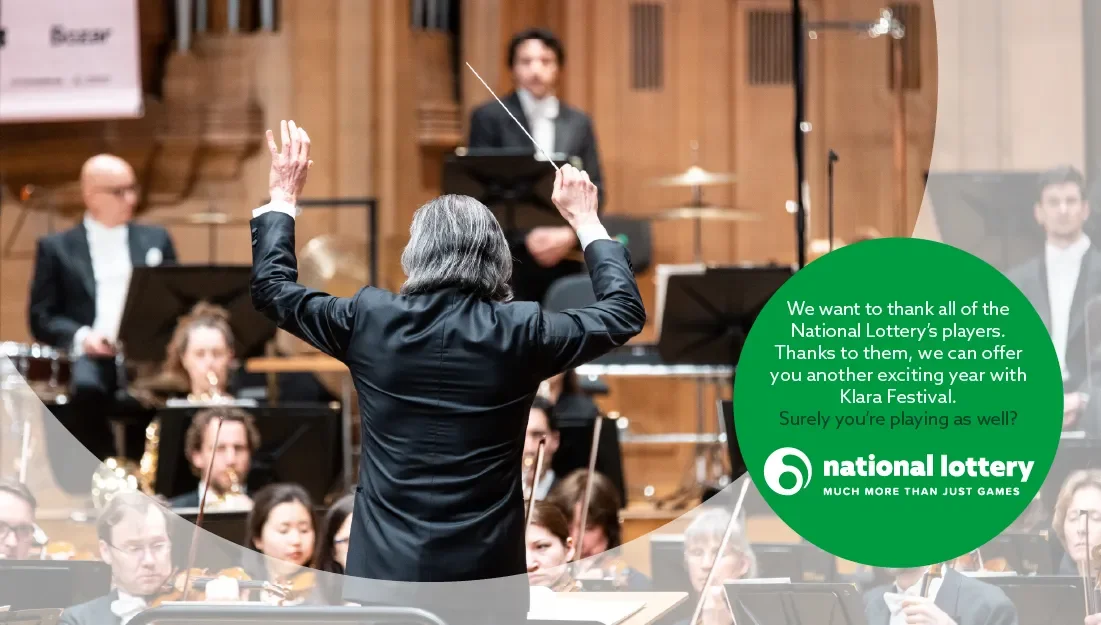
Nationale Bank, Nationale Loterij meer dan spelen, Stad Brussel, Visit Brussels, Vlaamse Gemeenschap
Media partners
BRUZZ, De Standaard, Knack, La Première, La Trois, Le Soir, Musiq3, Radio 1, Ring TV, Le Vif, VRT Eén, VRT Canvas, VRT Max
Festival suppliers
Daniel Ost, Drukkerij VD, Fruit at Work, Tarteletto, Victor Bozar Cafe
Patrons
Wim Bossens, Alex Brabers, Tania Seynhaeve & Jan Raes, Sophie Rutten