Supernova: Satellite
Laureates’ concert II
Welcome to the 20th Klarafestival!
Under the title We Are Now, this special anniversary edition pays tribute to the here and now. No one embraces the magic of the moment more fearlessly than festival artist Patricia Kopatchinskaja. Wherever and whatever she plays, this Moldovan violinist and composer sets the stage alight. For her, every concert is a new beginning, a full moment in which anything can happen. Klarafestival 2025 paints a multifaceted portrait of Patricia Kopatchinskaja as a violinist, composer and inspiring presence.
In honour of our 20th anniversary, we are launching a new tradition: for one day, Mont des Arts will be transformed into the Muziekberg /Mont des Musiques. Alongside concerts and performances at various venues, a new ensemble will also see the light. Sound of Brussels Orchestra goes in search of the exceptional sound of our capital.
We live in challenging times, and some of the festival projects reflect on this. At the same time, they demonstrate how much hope can lurk between the notes of a Stabat Mater or a Dies Irae. How music can move and inspire us. For Patricia Kopatchinskaja, music is no abstract matter: ‘Music is there for us to do something with it. Even when it has no concrete message or function, it appeals to us. It wants to be heard. I don't believe in absolute music. Not really.'
Let the celebration begin!
Joost Fonteyne, intendant
Jan Raes, chairman
Chantal Pattyn, network manager
Satellite
Lia Manchón Martínez – violin
Coline Meulemans – viola
Marc Martín Nogueroles – cello
–
Emmy Frensel Wegener (1901-1973)
Suite for Violin, Viola and Cello
I. Inleiding: Moderato chiara
III. Scherzo: Leggiero et presto
IV. Andante: Dolce
V. Finale: Vivace. Rigoroso possibile
Sofia Gubaidulina (1931)
Trio for violin, viola and cello
- Part I
- Part II
- Part III
Gideon Klein (1919-1945)
String Trio
- Allegro
- Lento
- Molto Vivace
How to speak when silence is imposed? What words remain when your story is erased? For their programme, Speak: Art and Freedom, the musicians of Satellite have selected 20th-century string trios written by composers who lived under oppression. ‘At various times, men were forbidden from speaking out, and art was the only outlet’, explain Lia Manchón Martínez, Coline Meulemans and Marc Martín Nogueroles. ‘Music is a way to express oneself and, without words, to allow one’s voice to be heard.’
By spotlighting composers who have had to fight for their places – both in the world and in the collective memory – Satellite is broadening its musical horizons. Composers such as Emmy Frensel Wegener, Sofia Gubaidulina and Gideon Klein are not yet well-known to everyone, but reveal something that the ensemble believes is an essential part of music: politics. ‘The choice of programme is never neutral but always political by nature’, Satellite believes. Because one is always guided by what is available, that choice is a political one. In other words: what is available – which works are worth preserving, what music should be considered a masterpiece – is often based on long-standing prejudices.
At the same time, the music of Frensel Wegener, Gubaidulina and Klein is fundamentally marked by the repressive political context in which they lived. Not that their creations are necessarily steeped in melancholy, finds Satellite, who see hope and light also. Thus Emmy Frensel Wegener’s Suite for violin, viola and cello is both romantic and expressive. This balance makes her work innovative, despite its being seldom performed today. ‘Too often, women who were once known, disappear between the pages of history’, say Satellite. ‘In this way, the memory of half of humankind is obliterated.’
Nobel prize winner Boris Pasternak also had to fight to be heard. Because of his criticism of the Soviet regime, the Russian author of notably Doctor Zhivago was hounded by the Communist Party. His fellow citizen Sofia Gubaidulina wrote her Trio for violin, viola and cello as a tribute to his courage in speaking out. In this trio, ‘you hear neither narrative nor protagonist, but simply lines and forms’, explain Satellite, and that was also Gubaidulina’s goal. She regarded each note as a symbol – for life, for death – and wished, through contrasting, dissonant sonorities, to transcend hard reality.
Despite the countless obstacles in their paths, composers such as Gubaidulina managed to express the complex landscape of our human emotions, according to Satellite. They also recognise that talent in Gideon Klein, a Jewish composer of Czechoslovakian origin, who composed his most important works in the Terezín concentration camp close to Prague. In his Trio for violin, viola and cello, he distances himself from the contemporary, atonal music developing in Germany and Austria, and opts for light, rhythmic and even danceable music. The second movement is based on a folksong about a bird that flies to a tower, looking for the freedom which Klein also yearned.
We have no idea of the circumstances in which he composed this trio, just days before his deportation to Auschwitz. Satellite therefore does not choose pity but rather distance and respect. ‘We do not wish to be disloyal by imagining what the composers in this programme were feeling. We know their future, but only they know their past.’
Hanne Schelstraete
Translation: Patrick Goddard
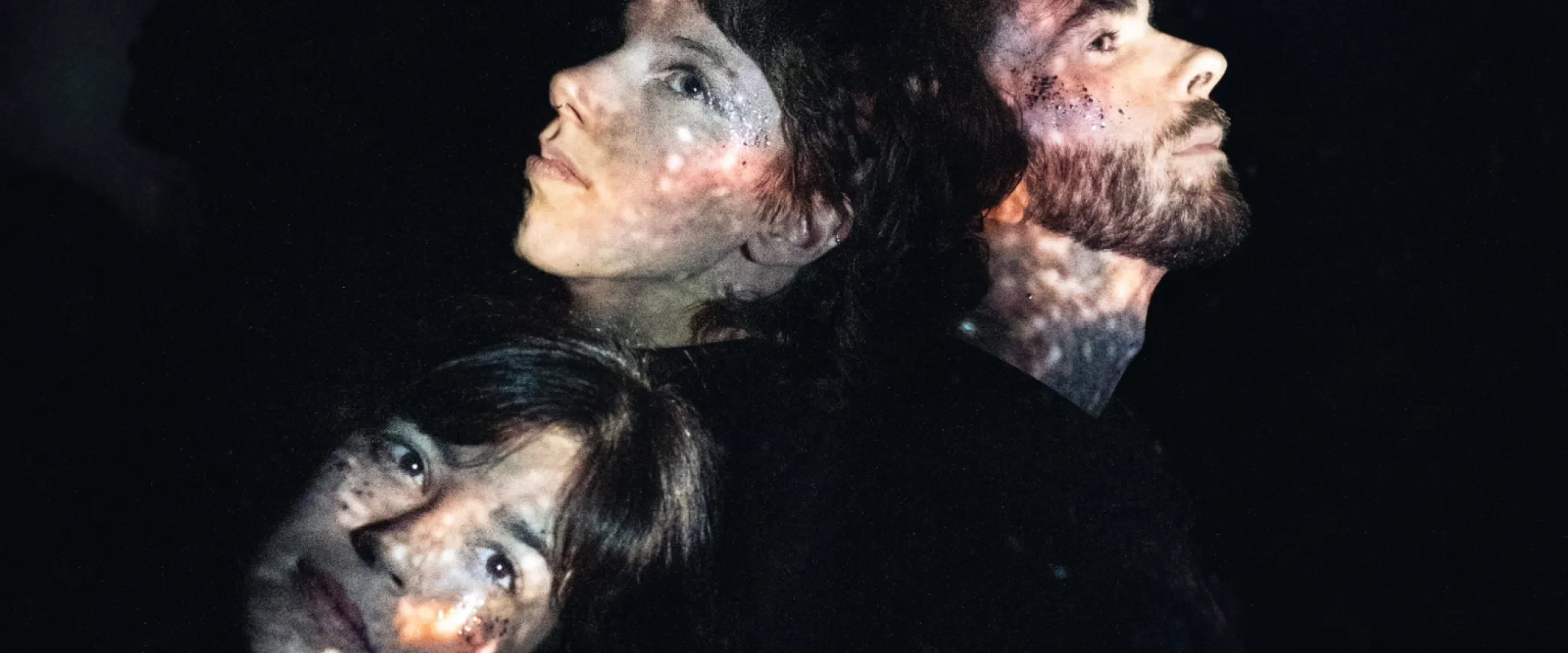
Satellite, an ensemble with a changing form, always starts from an intriguing central idea, and then connects it with music that brings the theme to life. In 2024, Lia Manchón Martínez, Coline Meulemans and Marc Martín Nogueroles will delve into rarely performed string trios by composers who have suffered under totalitarian and destructive systems. Rather than their difficult situation, Satellite is inspired by the unique way in which these composers create a universe full of light and energy. In the coming years, the ensemble will explore the work of Johannes Brahms, alongside several ongoing collaborations with various Belgian artists.
Structural partners
Klara, KPMG
Event partners
Belfius, Interparking, Proximus
Cultural partners
Ancienne Belgique, Belgian National Orchestra, Bozar, Brussels Philharmonic, Flagey, Kaaitheater, Muntpunt, Passa Porta
Public funding
Nationale Bank, Nationale Loterij meer dan spelen, Stad Brussel, Visit Brussels, Vlaamse Gemeenschap
Media partners
BRUZZ, De Standaard, Knack, La Première, La Trois, Le Soir, Musiq3, Radio 1, Ring TV, Le Vif, VRT Eén, VRT Canvas, VRT Max
Festival suppliers
Daniel Ost, Drukkerij VD, Fruit at Work, Tarteletto, Victor Bozar Cafe
Patrons
Wim Bossens, Alex Brabers, Tania Seynhaeve & Jan Raes, Sophie Rutten