B’Rock Orchestra, Robin Verheyen & Cristina Zavalloni
Il Quaderno di Nerina
Where Is Home?
Coming home in music
A man steps onto the stage, cello in hand. He looks out into the concert hall, spreads his arms and says, ‘Welcome. Tonight, you are not listeners, but participants. Our meeting is an exchange.’ Then he begins to sing and play, and everything becomes clear. He absorbs the audience’s energy like a human antenna and returns it tenfold. The concert hall shifts into an intimate living room. Everyone who witnessed it walks away transformed.
This is essentially how a concert by Abel Selaocoe unfolds. Together with this charismatic cellist, singer and composer, we warmly welcome you to the 21st Klarafestival. As a festival artist, Selaocoe will play three concerts spanning the full spectrum of his musical world. From traditional music from his native South Africa to baroque, jazz, contemporary classical and improvisation: he melds all these influences into a unique body of work, centred on identity and cultural exchange.
The theme of this year's festival is taken from the debut album of Selaocoe’s own Bantu Ensemble: Where Is Home? It is an open question with endless answers – especially in the super-diverse city of Brussels, home to 180 nationalities and 100 languages. Our capital is a crossroads, a refuge, a temporary or permanent home for countless individuals, each carrying their own story. Every day, we feel privileged that our festival can take root in such fertile soil.
Klarafestival 2026 is an ode to the city we call home. During Muziekberg/Mont des Musiques, Brussels musicians will take over the Kunstberg (Mont des Arts) for a day, from the Musical Instruments Museum to Bozar, from the Ravenstein Gallery to the Royal Museums of Fine Arts. And both Radio Lomax and the choir Les Invisibles (La Voix des Femmes Sans Papiers) will perform Brussels songs with diverse roots.
Our mission is to show as wide an audience as possible that classical music is alive and kicking. Even the most familiar works take on fresh life in the hands of the adventurous musicians we surround ourselves with. Prepare to be captivated by Bach's St John Passion as conducted by Maxim Emelyanychev. Marvel at Beethoven and Strauss with the Orchestre Philharmonique du Luxembourg. Rediscover Chopin and Scriabin in a performance by Alexandre Kantorow. Or encounter keyboard phenomenon Anthony Romaniuk: like Abel Selaocoe, he intertwines his own compositions with the established repertoire, from Bach to Björk.
This festival programme features many more musical kindred spirits. Annelies Van Parys completed the 8th symphony of her former teacher Luc Brewaeys. Pianists Kris Defoort and Stephane Ginsburgh pay tribute to their friend Philippe Boesmans, who would have turned 90 in 2026. Abel Selaocoe, in turn, improvises with like-minded souls, both old and new, and performs a brand-new cello concerto by American composer Jessie Montgomery.
None of this would be possible without the support of our partners in Brussels and beyond. Bozar, Flagey, De Munt, Ancienne Belgique, Brussels Philharmonic, Belgian National Orchestra, Passa Porta, BNA-BBOT and the Luc Brewaeys Foundation all contribute to Klarafestival’s unique DNA. Our indispensable private partners include KPMG Belgium, Proximus, Brugse Zot, Gimv/WorxInvest and Interparking. We are grateful for the support of the Flemish Community, the Flemish Community Commission, the Brussels-Capital Region and the National Lottery. Our collaboration with VRT and Klara, meanwhile, is the secret to our success as a broadcasting festival. Above all, we thank our enthusiastic audience who follow us both in the concert hall and at home on the radio and VRT MAX.
For Abel Selaocoe, ‘home’ is much more than a building or a place. 'It can be a spiritual space. It can be people. (...) It can be something you find along your travels.’ For seven years, Klarafestival has been ‘home’ for festival director Joost Fonteyne. His sense of adventure and social connection is more evident than ever in this festival programme. In April 2026, he will continue his journey and pass the torch to Jan Van den Borre. Many thanks, Joost, for the wonderful years!
The Klarafestival Team
Joost Fonteyne, intendant
Jan Raes, chairman
Chantal Pattyn, network manager Klara
B'Rock Orchestra – ensemble
Evgeny Sviridov – artistic direction, violin
Cristina Zavalloni – mezzo-soprano
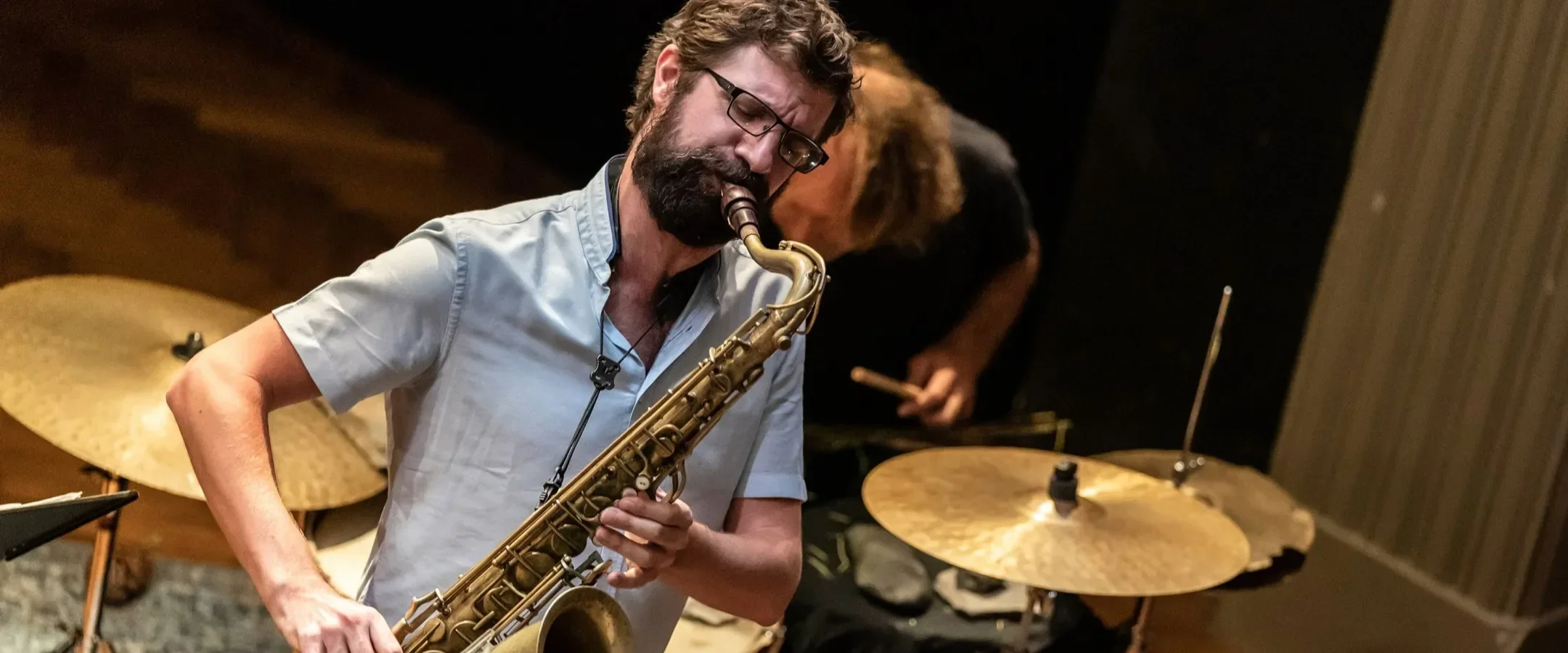
Robin Verheyen – composition, saxophone
Jhumpa Lahiri – text
Coproduction: Bozar, Klarafestival, B’Rock Orchestra
In collaboration with: De Munt/La Monnaie
This production is realized with the support of the Tax Shelter measure of the Belgian Federal Government through Flanders Tax Shelter.
Henry Purcell (1659-1695)
Fantasias
- in D minor, Z. 732
- in F major, Z. 733
- in C Minor, Z. 738
- in A Minor, Z. 740
- in G Major, Z. 742 D
- in G minor, Z. 734
Robin Verheyen (1983)
Il Quaderno di Nerina (world premiere)
Based on texts from Il Quaderno di Nerina, copyright © 2021 Jhumpa Lahiri
- Ouverture
- Poem For Ploughshares
- Davanzale
- Cupboard
- Obiettivo Part 1
- Obiettivo Part 2
- Interlude
- For Alberto De Lacerda
- Ad Alberto De Lacerda
Il Quaderno di Nerina: on traces, silence and connection
Interview with Robin Verheyen by Albert Edelman
Imagine opening the bottom drawer of an old desk and finding a notebook. The cover bears a handwritten name, Nerina. Inside are poems by an unknown woman – everyday, intimate, full of ruminations about a nomadic existence, about the traces people leave behind, and about how a place shapes you. The American-British writer Jhumpa Lahiri reworked these verses into a layered account in diary form. For saxophonist and composer Robin Verheyen, it became the key to his new Il Quaderno di Nerina, written especially for B'Rock Orchestra and Klarafestival.
What attracted you to Lahiri's poems, and how does that connect with your own life?
I don't know Jhumpa personally, but there is an indirect connection. Like me, she has lived all over the world, and that theme – the traces of previous inhabitants, the way a place influences you – resonates strongly with me. Sometimes we musicians live more in hotels than anywhere else, and I find that feeling of temporary homelessness, of energies lingering in a space, fascinating. Lahiri writes about it as if she were putting my own experiences into words. Her poems are not only about loneliness in nature, but also about isolation in the city, surrounded by people and stimuli. I sometimes feel that more powerfully in cities than in the countryside – that aloneness in the middle of the crowd, where everyone escapes into their phones to avoid the overload of information. That's a paradox of our time, and it's also in the music.
What was your starting point for this work?
I was looking for a musical translation of Lahiri's words. Just as she says that you become a better writer by translating, I learn by listening and improvising. In this piece, I ask myself: how does language – Italian or English – influence the rhythm, the expression, and even the physical sound of the music? Lahiri learned Italian from scratch in order to express herself in a new way, and she translates her own work back into English. That literal and figurative translation interests me, like when the violin and I play the same melody, but with a completely different character. That's what text does to music: it changes the expression, just as a translation lends a new layer to a poem.
Why did you choose Cristina Zavalloni, and what does she specifically bring to this project?
I know Cristina through the work of Fabrizio Cassol and the operas of Louis Andriessen. She is a truly complete musician, treading the line between jazz, improvised music and modern classical. Because of her range, I deliberately chose moments where she sings at the edge of her voice – I want not only beauty, but also an edge, something that is alive. We started playing with that in this work. Coincidentally, Cristina already had a connection with Lahiri; they know each other from Rome. We chose the lyrics together, which was a very enjoyable and enriching process. I let her voice weave through the lyrics and music, just like my saxophone.
The instrumentation is remarkably high in terms of registers. What was the reason for that?
I was looking for instruments in the same register precisely because of the texture. That's how I ended up with cornett, oboe, violins, soprano saxophone and mezzo-soprano voice. Double bass and low percussion fill the bass space without making it heavy. Transparency is important for improvisation, and I wanted a rich yet light sound.
Surprisingly, the evening begins with Purcell. What does that choice mean to you?
Purcell contrasts with my own counterpoint, but also acts as a mirror. Think of it as an overture: I improvise a bridge from Purcell's language to mine. But I don't want the audience to look too hard for references – it's about the atmosphere, the sound that is created. The saxophone and the voice emerge from that atmosphere and really set the work in motion.
Can you tell us something about how the different poems have been developed musically?
Each poem has been given its own character. In Poem for Ploughshares, the opening poem of the collection, I first introduce a theme with saxophone and voice, which is then developed by the orchestra. Then we get into a very lively section, on top of which you hear the poetry. There’s a lot of variation possible here; I wrote things down that don't necessarily have to be played in that way.
Davanzale (‘window sill’) begins very slowly, with long chords. And then – think Puccini meets Joni Mitchell – we move into jazz harmonies, a saxophone solo, minimalist structures, and rhythmic changes, to an almost Thelonious Monk-like adventure. The work plays with ternary and binary rhythms in the percussion and saxophone. In that sense, it’s about a rhythmic counterpoint: the European four-four feel versus the African twelve-eight feel, which are juxtaposed. You can hear this most clearly in the unison passages between the saxophone, oboe, and cornett. It’s as if a baroque orchestra suddenly starts speaking jazz – or vice versa.
Cupboard, in English, slows down the rhythm. There’s an underlying tension, the poetry is close to the skin, which is reflected in ostinatos and somewhat uncomfortable harmonies. For me, it’s a highly charged poem, about how you can be in a new place.
Then comes Obiettivo in two parts, two versions of the same poem: first rhythmic and almost hip-hop-like, spoken word, with violins responding to the text, then slower and more meditative, with arpeggios in the strings. It’s a dialogue between rhythm and silence.
After Interlude, the finale brings together all the influences you have already heard in different ways. I set the same poem to music twice: Ad Alberto de Lacerda, first spoken in English, then sung in Italian. No grand apotheosis, but a slow extinction, with a very fragile passage towards the end in the voice, where suddenly the blues comes to the fore. As if you are left alone with the echoes of the stories.
Albert Edelman
Translation: Catherine Grady
B’Rock Orchestra
Founded in Ghent in 2005, B'Rock Orchestra is driven by a passion for Baroque music and a groundbreaking approach to traditional performance practice. Working with the expressive potential of period instruments, the orchestra embraces a wide range of musical styles and periods. This innovative approach has earned B'Rock a reputation for daring programming and surprising performances. Recent highlights include a tour of Asia with Handel's Trionfo del Tempo with René Jacobs; Torment of Hearts by Femke Gyselinck (GRIP) and Chapters of Celebration by Benjamin Abel Meirhaeghe and Wouter Deltour, as well as collaborations with soloists such as Jeanine De Bique, Olga Pashchenko, and Elisabeth Hetherington.
Evgeny Sviridov
Evgeny Sviridov is one of the leading European baroque violinists of the moment. When he won first place at the Internationaler Bach-Wettbewerb Leipzig in 2010, he decided to devote himself entirely to historically informed performance practice. As a soloist and concertmaster, he has performed at venues including the Concertgebouw Amsterdam, the Wiener Musikverein, Konzerthaus Berlin and Bachfest Leipzig. Since 2016, he has been concertmaster of the Baroque ensemble Concerto Köln. He is also co-founder of the Baroque ensemble Ludus Instrumentalis. For his recording of sonatas and concertos by Giuseppe Tartini, Sviridov received the 2019 Preis der Deutschen Schallplattenkritik.
Cristina Zavalloni
Cristina Zavalloni is an Italian soprano and composer of jazz, experimental and avant-garde music. She studied singing and composition at the Conservatorio di Musica di Bologna and also trained in classical and contemporary dance. For contemporary repertoire, she forms a permanent duo with pianist Andrea Rebaudengo; as a jazz singer, she collaborates with her quartet Special Dish or with musicians such as Uri Caine or Paolo Fresu. Her core repertoire includes Schönberg's Pierrot lunaire, Poulenc's La Voix humaine and Berio's Folk Songs, but she is equally adept at singing opera roles by Monteverdi or Britten. She has also worked regularly with Louis Andriessen, who composed the double concerto for violin and soprano La Passione (2002) for her voice.
Robin Verheyen
Belgian jazz saxophonist and composer Robin Verheyen has been considered one of Europe's top musicians for many years. Since 2007, he has been based in New York, where he has performed alongside greats such as Ravi Coltrane, Ralph Alessi, Joey Baron and Branford Marsalis. The common thread in Verheyen's work is a genre-transcending approach to music. In 2014, for example, he travelled to Senegal to immerse himself in local music practices and incorporated these West African rhythms with modern harmonies inspired by Messiaen into his work. As a composer, he wrote Blues, Reds and Other Songs, commissioned by the KMSKA, and The Bach Riddles, a reworking for quartet of Bach's Musikalisches Opfer.
Jhumpa Lahiri
Jhumpa Lahiri is an American writer and translator. She made her debut in 1999 with the short story collection Interpreter of Maladies, for which she received the Pulitzer Prize. She has also written The Namesake (2003), Unaccustomed Earth (2008), The Lowland (2013) and Dove mi trovo (2018). Since 2015, Lahiri has been writing fiction, essays and poetry in Italian. She received the National Humanities Medal in the US in 2014 and was appointed Commander of the Order of Merit of the Italian Republic in 2019. Lahiri is a professor of English and director of Creative Writing at Barnard College of Columbia University.
Post-concert talk with Robin Verheyen & Cristina Zavalloni, moderated by Katherina Lindekens - Hall M
In Bozar’s Fumoir, you can visit a mini exhibition by Maria Farré, house artist of B’Rock Orchestra for the season 2025-2026.
Your ticket for this concert also gives you access that same evening to Bozar All over the P(a)lace. The exhibitions will stay open late, and you can enjoy a rich programme of performances, concerts, guided tours, film screenings, debates, and DJ sets throughout every corner of Bozar.
Read the song texts from Il Quaderno di Nerina, copyright © 2021 Jhumpa Lahiri
B'Rock Orchestra
Evgeny Sviridov – artistic direction, violin
Rebecca Huber, Shiho Ono – violin 1
Sara DeCorso, Ellie Nimeroski, Yukie Yamaguchi – violin 2
Raquel Massadas, Luc Gysbregts, Bernadette Verhaegen – alto
Rebecca Rosen, Julien Barre – cello
Tom Devaere – double bass
Marleen Leicher – cornett
Tatjana Zimre – oboe
Koen Plaetinck – percussion
Structural partners
Klara, KPMG
Event partners
Brouwerij Halve Maan, Gimv | Worxinvest, Interparking, Proximus
Cultural partners
Ancienne Belgique, Belgian National Orchestra, Bozar, Brussels Philharmonic, De Munt | La Monnaie, Flagey, Muntpunt, Museum of Musical Instruments, Passa Porta
Public funding
Nationale Bank, Nationale Loterij meer dan spelen, Stad Brussel, Visit Brussels, Vlaamse Gemeenschap
Media partners
BRUZZ, De Standaard, La Première, La Trois, Le Soir, Musiq3, Radio 1, Ring TV, VRT Eén, VRT Canvas, VRT Max
Festival suppliers
Daniel Ost, Drukkerij VD, Maison Dandoy