I Solisti & HIIIT
Talisker
Where Is Home?
Coming home in music
A man steps onto the stage, cello in hand. He looks out into the concert hall, spreads his arms and says, ‘Welcome. Tonight, you are not listeners, but participants. Our meeting is an exchange.’ Then he begins to sing and play, and everything becomes clear. He absorbs the audience’s energy like a human antenna and returns it tenfold. The concert hall shifts into an intimate living room. Everyone who witnessed it walks away transformed.
This is essentially how a concert by Abel Selaocoe unfolds. Together with this charismatic cellist, singer and composer, we warmly welcome you to the 21st Klarafestival. As a festival artist, Selaocoe will play three concerts spanning the full spectrum of his musical world. From traditional music from his native South Africa to baroque, jazz, contemporary classical and improvisation: he melds all these influences into a unique body of work, centred on identity and cultural exchange.
The theme of this year's festival is taken from the debut album of Selaocoe’s own Bantu Ensemble: Where Is Home? It is an open question with endless answers – especially in the super-diverse city of Brussels, home to 180 nationalities and 100 languages. Our capital is a crossroads, a refuge, a temporary or permanent home for countless individuals, each carrying their own story. Every day, we feel privileged that our festival can take root in such fertile soil.
Klarafestival 2026 is an ode to the city we call home. During Muziekberg/Mont des Musiques, Brussels musicians will take over the Kunstberg (Mont des Arts) for a day, from the Musical Instruments Museum to Bozar, from the Ravenstein Gallery to the Royal Museums of Fine Arts. And both Radio Lomax and the choir Les Invisibles (La Voix des Femmes Sans Papiers) will perform Brussels songs with diverse roots.
Our mission is to show as wide an audience as possible that classical music is alive and kicking. Even the most familiar works take on fresh life in the hands of the adventurous musicians we surround ourselves with. Prepare to be captivated by Bach's St John Passion as conducted by Maxim Emelyanychev. Marvel at Beethoven and Strauss with the Orchestre Philharmonique du Luxembourg. Rediscover Chopin and Scriabin in a performance by Alexandre Kantorow. Or encounter keyboard phenomenon Anthony Romaniuk: like Abel Selaocoe, he intertwines his own compositions with the established repertoire, from Bach to Björk.
This festival programme features many more musical kindred spirits. Annelies Van Parys completed the 8th symphony of her former teacher Luc Brewaeys. Pianists Kris Defoort and Stephane Ginsburgh pay tribute to their friend Philippe Boesmans, who would have turned 90 in 2026. Abel Selaocoe, in turn, improvises with like-minded souls, both old and new, and performs a brand-new cello concerto by American composer Jessie Montgomery.
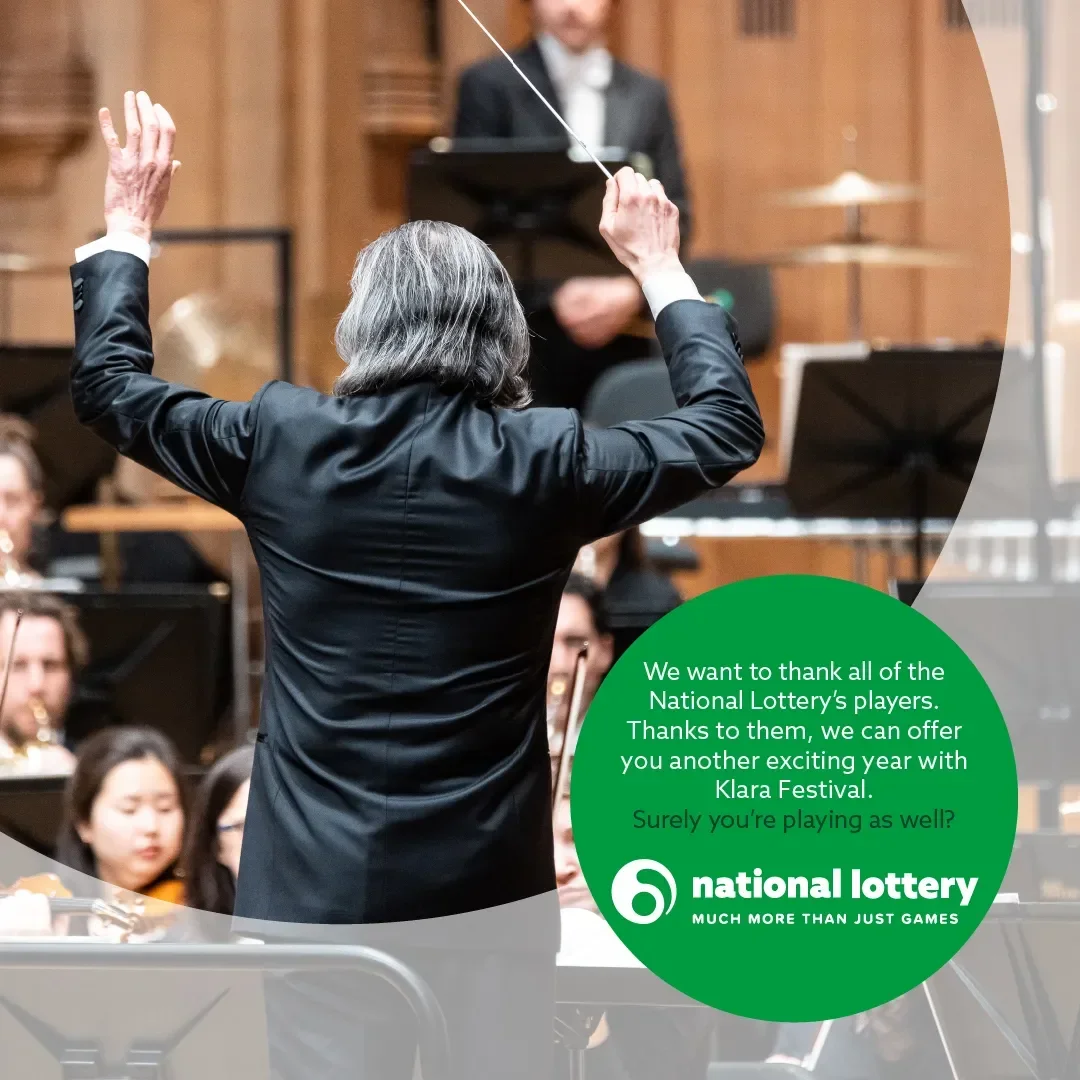
None of this would be possible without the support of our partners in Brussels and beyond. Bozar, Flagey, De Munt, Ancienne Belgique, Brussels Philharmonic, Belgian National Orchestra, Passa Porta, BNA-BBOT and the Luc Brewaeys Foundation all contribute to Klarafestival’s unique DNA. Our indispensable private partners include KPMG Belgium, Proximus, Brugse Zot, Gimv/WorxInvest and Interparking. We are grateful for the support of the Flemish Community, the Flemish Community Commission, the Brussels-Capital Region and the National Lottery. Our collaboration with VRT and Klara, meanwhile, is the secret to our success as a broadcasting festival. Above all, we thank our enthusiastic audience who follow us both in the concert hall and at home on the radio and VRT MAX.
For Abel Selaocoe, ‘home’ is much more than a building or a place. 'It can be a spiritual space. It can be people. (...) It can be something you find along your travels.’ For seven years, Klarafestival has been ‘home’ for festival director Joost Fonteyne. His sense of adventure and social connection is more evident than ever in this festival programme. In April 2026, he will continue his journey and pass the torch to Jan Van den Borre. Many thanks, Joost, for the wonderful years!
The Klarafestival Team
Joost Fonteyne, intendant
Jan Raes, chairman
Chantal Pattyn, network manager
I SOLISTI – ensemble
HIIIT – ensemble
Clarinet choir in collaboration with Koninklijk Conservatorium Antwerpen, Koninklijk Conservatorium Brussel, KASK & Conservatorium Gent
Filip Rathé – musical direction
Coproduction: Bozar, Klarafestival
In the context of Fasten Seat Belts! Celebrating Luc Brewaeys 2025-2026
Luc Brewaeys (1959-2015)
Talisker
To savour with curiosity
In late March 1993, the crowds of train travellers hardly knew what hit them as they walked into the imposing station hall at Antwerp Central. On their way to the platform, they were bombarded by an array of clarinets, horns and percussion. They were witnesses to the first-ever performance of Talisker. It was the spectacular opening to Antwerpen 93, a festival to celebrate the city’s year-long role as the European Capital of Culture.
Luc Brewaeys, a self-assured spectralist
Luc Brewaeys attracted attention at a young age with his disarming combination of swagger and intellect. In the various biographical texts that have appeared since his premature death in 2015, a clear image of the composer emerges as a generous, talented and unusually creative personality. That image is reinforced all the more by the many personal testimonies from people he worked with closely. What always comes to the fore are his enthusiasm, energetic drive, subject knowledge, his love of music and people, and his capacity to enjoy life. We also find all these aspects in his music. Whether they are short, occasional pieces or grand symphonies: every work is imbued with his unique personality.
Of course, personality alone isn’t enough to create a musical language. Luc Brewaeys found the key to composition in spectralism. In spectral music, composers seek structures and sounds by analysing the internal composition of sound itself. The harmonic relationships between the different overtones that collectively determine the timbre of a note are the starting point for a range of musical creations. Brewaeys usually starts with a specific fundamental frequency and uses the harmonic series to construct his musical vocabulary.
The result of this fascination with sound is more than just a thorough study of the components of sound (the analysis). It also fuels the search for new sounds – ones that are literally unheard of, in many cases. Most of them arise from an ingenious combination of classical instruments, so that a new overall sound is generated from the sum of many small parts of the sound. In some cases, Brewaeys also extends his array of sound producers to include unconventional instruments such as a bathtub, heating oil tank or a big, metal rubbish bin. At least, that was the plan for Talisker, but the fire safety rules got in the way.
Resonance
The specific space for which Talisker was written would scare off most composers. As in a large cathedral, the extremely long reverberation time of the big station hall in Antwerp is an acoustic fact that cannot be ignored. But if you can’t avoid something, you may as well make use of it. So Luc Brewaeys decided to embrace the reverberation time – which lasts more than eight seconds – and construct his work around that interesting acoustic phenomenon. It is telling that when the composer wrote his Symphony No. 5 later that same year, he used electronics to fill it with echoes and resonances. Incidentally, he named the fifth symphony ‘Laphroaig’: like Talisker, it is the name of a single malt whisky. It is not so much that Brewaeys intended to capture the character of the whisky in music; instead, like these complex drinks, his music demands to be savoured with deliberate curiosity and a great openness to unfamiliar flavours.
The extreme resonances in the station hall means that the sounds blend into each other far more than they do in a concert hall with a reverberation time of one to one and a half seconds. This enables Luc Brewaeys to create new combinations of sounds and even to let instruments resonate with themselves. One of the playing techniques he uses for this is an oscillating movement: rapid alternation between two different notes. The reverb produces the illusion that the notes are sounding simultaneously.
Another clever idea that the composer likes to play with is mixing different sound colours. By getting the horn to start playing softly while the echo of a loud note on the clarinet is still fading, he creates a seamless blend of the two instruments.
This painstaking orchestration is closely related to Talisker’s unique instrumentation. The score is written for a ‘clarinet choir’ of 22 musicians plus six percussionists, as well as soloists on the clarinet, contrabass clarinet, horn and percussion. The combination of every possible clarinet (from the little sopranino in E♭ to the impressively low contrabass) with the horn creates a fairly homogeneous sound. The percussion consists of membranophones (bongos and various types of drum), melodic percussion and all sorts of gongs. Likewise, here, the acoustics play a role in the choice of instruments: sounds with a clear attack remain rhythmically legible, despite the long reverb.
As we said above, Brewaeys dreamed of using a big metal container as a musical instrument. At a certain point, it would fall from a great height, resulting in a hellish din. When that idea was rejected for safety reasons, the composer found a suitable alternative by dropping cymbals onto the stage. The result is a sound shock, exactly what Brewaeys intended. (Although we’re sure he would have loved the astonished faces in the audience if a container really had fallen from the ceiling.) The crucial thing, though, is what comes after the shock. How do you introduce other sounds after startling the listener with a loud noise? How does that surprise influence the perception of what follows?
Another, far more subtle effect arises when some of the clarinettists play with the bell of their instrument against the skin of a kettledrum. The vibrations of the clarinet are transmitted to the drum, whose pitch can be regulated with the help of a pedal. In this way, Brewaeys creates a new timbre with existing means. Moreover, it is a timbre that benefits from the generous acoustics. These acoustics lend the music a sense of stateliness, although the score itself is fairly rhythmic.
Talisker in the Ravenstein Gallery
In an article written in 1993, Eric Antonis, the cultural manager of Antwerpen 93, described the performance of Talisker as ‘a small miracle’. It is doubtful whether anyone had predicted the great impact the event would have. More than thirty years later, Talisker has been performed many times, which is quite exceptional for a site-specific project. The Ravenstein Gallery in Brussels, another place that countless commuters pass through every day, is a promising venue for this composition. Some of the musicians are placed in the higher galleries and move through the space by going up and down the staircases. The result is an experience that puts you in Luc Brewaeys’ own favourite place: right in the middle of the sound.
Klaas Coulembier
Translation: Helen White
I SOLISTI
I SOLISTI began 30 years ago as a wind octet and, under the leadership of founder and artistic director Francis Pollet, grew into an international production company. The ensemble consists of a core group of 25 musicians, each with a solid reputation as a soloist, orchestral or chamber musician, which is expanded or reduced depending on the project. I SOLISTI combines conceptual and dramaturgical thinking with high-quality performances in original projects, ranging from intimate chamber music and monumental masterpieces to new creations and opera and music theatre. In addition, the ensemble offers opportunities to young musicians and composers through the I SOLISTI ACADEMY.
HIIIT
Percussion ensemble HIIIT (formerly Slagwerk Den Haag) is an idiosyncratic group of musicians who explore the boundaries of new music out of a curiosity for rhythm and sound in the broadest sense. The ensemble actively seeks to reimagine percussion music and has expanded the repertoire through collaborations with composers such as Mauricio Kagel, John Cage, Karlheinz Stockhausen, Steve Reich and Michel van der Aa. In addition, HIIIT conducts artistic research into sound, structure and playing techniques, using traditional percussion instruments, self-built instruments and electronic means, while also bringing the same open spirit to interdisciplinary projects with creators from art forms such as dance, theatre and visual arts.
Filip Rathé
Conductor and composer Filip Rathé studied piano and conducting at the Royal Conservatory of Ghent. He then perfected his conducting skills with László Heltay and Pierre Cao, and studied composition with Lucien Goethals and musicology with Herman Sabbe. Since 1993, Rathé has been artistic director and conductor of the SPECTRA ensemble for contemporary music, with which he has created more than 200 new works in Europe and South America. He has also worked as a guest conductor with the Flanders Symphony Orchestra, Brussels Philharmonic, HYOID, HERMESensemble and Musiques Nouvelles, among others. His work as a composer has been performed by ensembles such as the Flemish Radio Choir, ASKO, Kremerata Baltica and the Neue Vocalsolisten Stuttgart.
Structural partners
Klara, KPMG
Event partners
Brouwerij Halve Maan, Gimv | Worxinvest, Interparking, Proximus
Cultural partners
Ancienne Belgique, Belgian National Orchestra, Bozar, Brussels Philharmonic, De Munt | La Monnaie, Flagey, Muntpunt, Museum of Musical Instruments, Passa Porta
Public funding
Nationale Bank, Nationale Loterij meer dan spelen, Stad Brussel, Visit Brussels, Vlaamse Gemeenschap
Media partners
BRUZZ, De Standaard, La Première, La Trois, Le Soir, Musiq3, Radio 1, Ring TV, VRT Eén, VRT Canvas, VRT Max
Festival suppliers
Daniel Ost, Drukkerij VD, Maison Dandoy