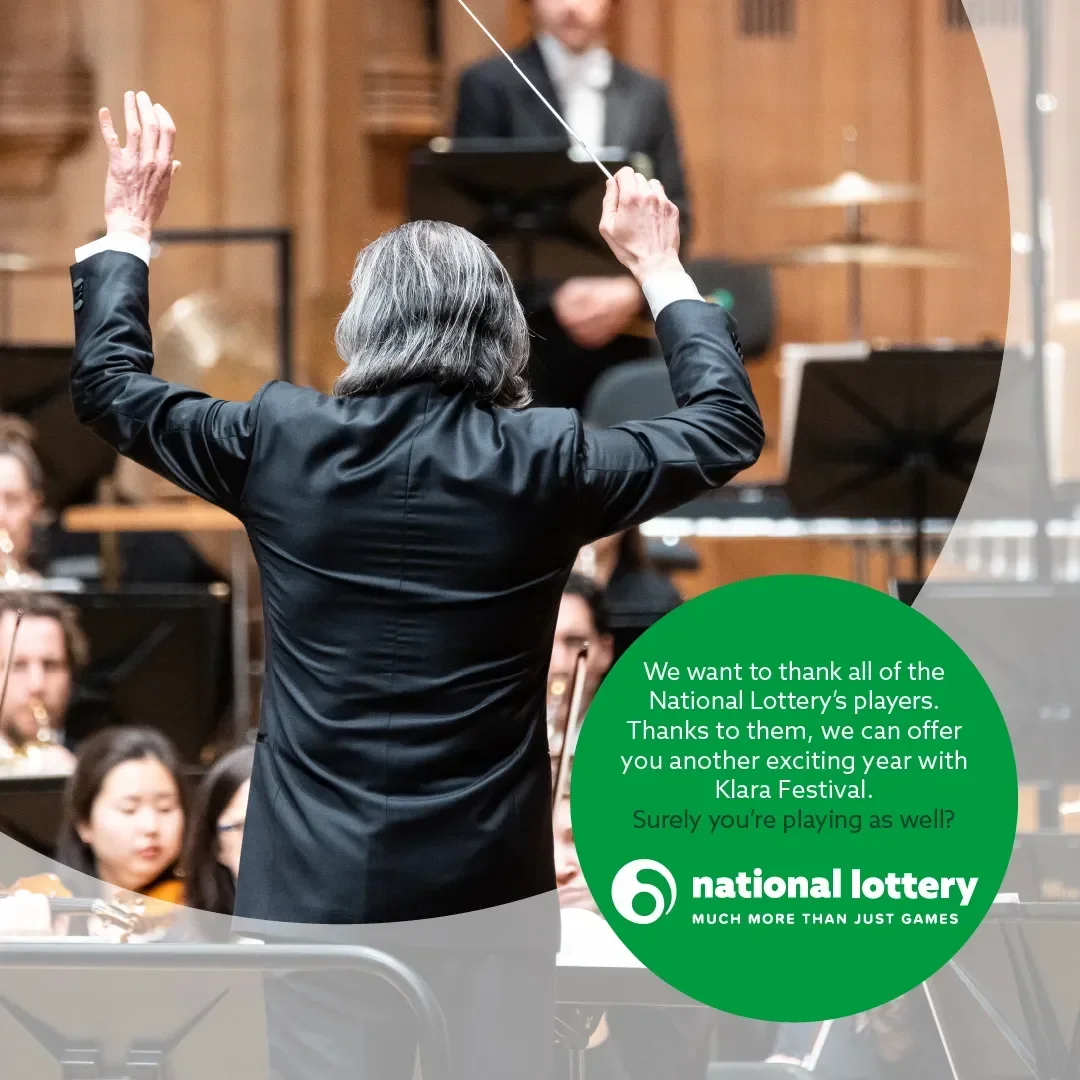
Belgian National Orchestra, Geoffrey Paterson & Ekaterina Levental
Exiles
Where Is Home?
Coming home in music
A man steps onto the stage, cello in hand. He looks out into the concert hall, spreads his arms and says, ‘Welcome. Tonight, you are not listeners, but participants. Our meeting is an exchange.’ Then he begins to sing and play, and everything becomes clear. He absorbs the audience’s energy like a human antenna and returns it tenfold. The concert hall shifts into an intimate living room. Everyone who witnessed it walks away transformed.
This is essentially how a concert by Abel Selaocoe unfolds. Together with this charismatic cellist, singer and composer, we warmly welcome you to the 21st Klarafestival. As a festival artist, Selaocoe will play three concerts spanning the full spectrum of his musical world. From traditional music from his native South Africa to baroque, jazz, contemporary classical and improvisation: he melds all these influences into a unique body of work, centred on identity and cultural exchange.
The theme of this year's festival is taken from the debut album of Selaocoe’s own Bantu Ensemble: Where Is Home? It is an open question with endless answers – especially in the super-diverse city of Brussels, home to 180 nationalities and 100 languages. Our capital is a crossroads, a refuge, a temporary or permanent home for countless individuals, each carrying their own story. Every day, we feel privileged that our festival can take root in such fertile soil.
Klarafestival 2026 is an ode to the city we call home. During Muziekberg/Mont des Musiques, Brussels musicians will take over the Kunstberg (Mont des Arts) for a day, from the Musical Instruments Museum to Bozar, from the Ravenstein Gallery to the Royal Museums of Fine Arts. And both Radio Lomax and the choir Les Invisibles (La Voix des Femmes Sans Papiers) will perform Brussels songs with diverse roots.
Our mission is to show as wide an audience as possible that classical music is alive and kicking. Even the most familiar works take on fresh life in the hands of the adventurous musicians we surround ourselves with. Prepare to be captivated by Bach's St John Passion as conducted by Maxim Emelyanychev. Marvel at Beethoven and Strauss with the Orchestre Philharmonique du Luxembourg. Rediscover Chopin and Scriabin in a performance by Alexandre Kantorow. Or encounter keyboard phenomenon Anthony Romaniuk: like Abel Selaocoe, he intertwines his own compositions with the established repertoire, from Bach to Björk.
This festival programme features many more musical kindred spirits. Annelies Van Parys completed the 8th symphony of her former teacher Luc Brewaeys. Pianists Kris Defoort and Stephane Ginsburgh pay tribute to their friend Philippe Boesmans, who would have turned 90 in 2026. Abel Selaocoe, in turn, improvises with like-minded souls, both old and new, and performs a brand-new cello concerto by American composer Jessie Montgomery.
None of this would be possible without the support of our partners in Brussels and beyond. Bozar, Flagey, De Munt, Ancienne Belgique, Brussels Philharmonic, Belgian National Orchestra, Passa Porta, BNA-BBOT and the Luc Brewaeys Foundation all contribute to Klarafestival’s unique DNA. Our indispensable private partners include KPMG Belgium, Proximus, Brugse Zot, Gimv/WorxInvest and Interparking. We are grateful for the support of the Flemish Community, the Flemish Community Commission, the Brussels-Capital Region and the National Lottery. Our collaboration with VRT and Klara, meanwhile, is the secret to our success as a broadcasting festival. Above all, we thank our enthusiastic audience who follow us both in the concert hall and at home on the radio and VRT MAX.
For Abel Selaocoe, ‘home’ is much more than a building or a place. 'It can be a spiritual space. It can be people. (...) It can be something you find along your travels.’ For seven years, Klarafestival has been ‘home’ for festival director Joost Fonteyne. His sense of adventure and social connection is more evident than ever in this festival programme. In April 2026, he will continue his journey and pass the torch to Jan Van den Borre. Many thanks, Joost, for the wonderful years!
The Klarafestivalteam
Joost Fonteyne, intendant
Jan Raes, chairman
Chantal Pattyn, network manager Klara
Belgian National Orchestra
Geoffrey Paterson – musical direction
Ekaterina Levental – harp, mezzo-soprano
Introduction (a capella)
Caroline Shaw (1982)
And So
Isang Yun (1917-1995)
Piri for solo oboe
-
II.
Intermezzo
Max Richter (1966)
Exiles
Luciano Berio (1925-2003)
Sequenza III
Jóhann Jóhannsson (1969-2018)
The Miners’ Hymns
-
The Cause of Labour Is the Hope of the World
Intermezzo (Ritual)
Manuel de Falla (1876-1946)
Siete canciones populares españolas
-
Nana
Oliver Knussen (1952-2018)
Gong
Henryk Górecki (1933-2010)
Symphony No. 3, Op. 36
- II. Lento e largo – Tranquillissimo
No strangers to estrangement
Beyond the borders. Border on the impossible. Border controls. For some, ‘border’ is an abstract word with no physical meaning. For others, its significance is overwhelming. It is a destination drenched in emotional connotations. A synonym for a better life. Armed conflicts, climate change or the risk of persecution force millions of people to leave the familiar setting of their home countries. When too many boundaries have been violated, there is no other solution than to cross the border yourself.
Entirely in line with the festival theme, Where Is Home, this adventurous concert follows musical stories of being uprooted and searching for connection. The singer and harpist Ekaterina Levental, who fled to the Netherlands herself from Soviet-occupied Uzbekistan, explains that ‘to me, being at home means feeling at home in the place where I am welcome.’ She takes you on an odyssey that traces the inner journey of migration in four phases.
1. No Longer Ours
What does it mean to lose everything? At what point do you decide to leave everything you have behind? When do you give in to the urgency of the situation? The first part of this concert echoes the feeling of no longer being welcome. And So, the work by the Pulitzer Prize-winning Caroline Shaw (°1982), makes the voice heard for the first time this evening. It is hesitant and reflective. Shaw, who was a portrait composer at Bozar only last season, combines her own texts with words by Gertrude Stein, Robert Burns and Billy Joel. The playfully repetitive texts refer to loss and futility: ‘Or will we fade to stanzas of the dust? That, I suppose is all we were and all we’ll be?’ Sometimes your own language is all that remains.
The South Korean composer Isang Yun (1917-1995) knew the feeling of no longer being welcome all too well. During the Second World War, Yun was arrested for being a member of the Korean independence movement: until 1945, Korea was a Japanese colony. He spent months in a small cell. In the 1950s, he continued his education in Paris and Germany, where history brutally repeated itself. He was kidnapped in West Berlin in 1967 by the South Korean secret service on suspicion of espionage. After days without hope, he ended up in prison in Seoul. The country he had once fought for had turned its back on him. Yun was tortured and tried to take his own life, but after a large-scale petition, he was freed and moved to Germany for good. Piri, for oboe solo, is a cry for help dating from 1971 that seeks connection. Luise Rinser, a writer and good friend of Yun, interprets the mysterious composition as follows: ‘Here the oboe is the voice of the captive in the dungeon. It expresses suffering but also the great attempt to overcome outward lack of freedom and to attain spiritual freedom.’
2. The Long Walk
The struggle for survival goes on. We find ourselves in Sequenza III by Luciano Berio (1925-2003). In the introduction to the score of this work for voice solo from 1965, the Italian composer writes that ‘the voice always holds an abundance of connotations, whatever it does.’ The text only has three lines, which means that its meaning is also found in the articulation, timbre and intonation. ‘Give me a few words for a woman / To sing a truth allowing us / To build a house without worrying before night comes.’ Berio shreds the text into barely recognisable fragments and gets the soloist to sing, stutter and babble, as if the protagonist had briefly lost her identity. He wrote the piece for his wife, the headstrong American singer and composer Cathy Berberian.
3. Foreign Ground
The unending voyage comes to a standstill but does not reach a destination or find reassurance. The central work in this evening’s concert, Exiles, was written by the post-minimalist Max Richter (°1966) in 2015. The unprecedented migration crisis from the Middle East had a profound effect on the British composer: ‘It is a kind of psychological disorientation and psychological trauma’, he says of the journey migrants are forced to make. The gradually unfolding music sways to a repetitive piano melody that encourages reflection. Bit by bit, the orchestra becomes richer, without losing its vulnerability. The landscape seems endless and scars are exposed. Here, silence speaks louder than words. The horizon is in sight.
4. Still, We Sing
When the destination is reached, hope wrestles with uncertainty. In the end, everyone in a strange place seeks something recognisable. A family member, a familiar language, a community. The Cause of Labour Is the Hope of the World by Jóhann Jóhannson (1969-2018) is a tribute to British miners. A powerful brass section sparks high expectations for the future and celebrates the miners’ community spirit. Through the dreamy lullaby Nana by Manuel de Falla (1876–1946), Leventhal leads us to two a cappella songs for soprano by the British composer Oliver Knussen (1952–2018). Following the epigram Rose, which the Prague poet Rainer Maria Rilke had inscribed on his gravestone, comes Gong, Rilke’s poem from the 1920s. The music outgrows us, the beautifully translated text tells us; the notes reach further than we do.
The second movement from Górecki’s Symphony no. 3 is a glance back at where we came from. We mourn what we have left behind. In this ‘symphony of laments’ by Henryk Mikolaj Górecki (1933-2010), a soprano gives voice to human suffering. Her words are taken from writing on the wall of a cell in a Gestapo prison in Zakopane, written by a young girl. Lacking the sharp sound of oboes or trumpets, the orchestra accompanies her with slow, gentle simplicity. A mere handful of chords are repeated over and over, as if it were a litany. Just as history continues to repeat itself. Finally, Ekaterina Levental returns and slowly dims the lights, although our thoughts continue to flicker in the darkness.
Guillaume De Grieve
Belgian National Orchestra
The Belgian National Orchestra has long been based at the Centre for Fine Arts (Bozar). Through its ongoing partnerships with the Festival of Flanders and the Festival de Wallonie, it also performs regularly in provincial capitals across the country. Internationally, BNO maintains a strong reputation through overseas tours and by providing accompaniment for the Queen Elisabeth Competition. Alongside the symphonic repertoire, the BNO presents film music, collaborations with pop artists such as Ozark Henry and Stromae, and contemporary works by composers including Annelies Van Parys, Michael Daugherty and Andrew Norman. Since 2022, the BNO has been led by Dutch chief conductor Antony Hermus, in addition to frequently hosting international guest conductors.
Geoffrey Paterson
British conductor Geoffrey Paterson performs regularly in both the opera house and the concert hall. As a young conductor, he trained at the Royal Opera House, where he worked with Antonio Pappano, Daniele Gatti, Andris Nelsons and Mark Elder. Since then, he has conducted orchestras such as the Orchestra of the Age of Enlightenment, BBC Philharmonic, London Sinfonietta and Philharmonia Orchestra. His background as a composition student under Alexander Goehr and masterclasses with Pierre Boulez and Peter Eötvös make Paterson a passionate interpreter of contemporary music. He has premiered works by Harrison Birtwistle, Peter Maxwell Davies and James Dillon and led numerous acclaimed performances of 20th-century masterpieces.
Ekaterina Levental
Singer and harpist Ekaterina Levental moves effortlessly between opera, chamber music and music theatre, with a repertoire ranging from baroque to contemporary. She is also known for her music theatre performances in which she uses her voice, harp and body as instruments to tell stories about displacement and the search for identity and self-worth. Her autobiographical trilogy De Weg – De Grens – Schoppenvrouw (translation: The Road – The Border – Queen of Spades), based on her experiences as a refugee from Uzbekistan to the Netherlands, has been performed hundreds of times in Europe, Asia and South Africa. As a singer, she also made the first complete recording of Nikolai Medtner's songs, spread over five internationally acclaimed CDs, together with pianist Frank Peters.
Upon presentation of your ticket for this concert, you can enjoy a free Sportzot or Brugse Zot at the beer truck on Hortaplein from 19:00, courtesy of Brewery De Halve Maan.
Konzertmeister
Kristie Su
First violins
Lev Adamov
Isabelle Chardon
Sarah Guiguet
Maria-Elena Boila
Annija Endija Kolerta
Anastasia Filippochkina
Françoise Gilliquet
Luis Greiner
Philip Handschoewerker
Akika Hayakawa
Keika Kawashima
Timur Kolesnikov
Ariane Plumerel
Isabelle Rowland
Serge Stons
Second violins
Filip Suys
Nathalie Lefin
Marie Danielle Turner
Michael Bonnay
Sophie Demoulin
Isabelle Deschamps
Pierre Hanquin
Andre Hosszu
Anouk Lapaire
Oscar Lerma Barrero
Louis Noël
Sarah Orero
Ekaterina Philippovich
Ana Spanu
Violas
Charlie Galante
Mihoko Kusama
Dmitri Ryanbinin
José Azevedo
Silvia Tentori Montalto
Katelijne Onsia
Sophie Destivelle
Daniel Poncela Montalban
Abraham Constantino
Frederik Camacho
Jorge Ramos
Cellos
Dmitry Silvian
Harm Van Rheeden
Taras Zanchak
Lesya Demkovych
Uros Nastic
Duarte Matos
Shiho Nishimura
Lucia Otero
Frederika Mareels
Irene Cancer Navarro
Double basses
Svetoslav Dimitriev
Miguel Meulders
Isa Opstaele
Robertino Mihai
Serghei Gorlenko
Grecia Crehuet Ramos
Lennert Janssen
Fred Dothee
Oboe
Dimitri Baeteman (solo in Piri)
Clarinets
Julien Bénéteau
Lena La Mela
Vladimir Pavtchinksy
Himawari Arai
Horns
Anthony Devriendt
Bernard Wasnaire
Bart Cypers
Bernard Wasnaire
Trumpets
Leo Wouters
Ward Opsteyn
Rudy Moercant
Steven Devolder
Pierre-Louis Marques
Jacob Janssen
Trombones
Guido Liveyns
Bruno De Busschere
Geert Devos
Wim Matheeuwese
Tuba
Jan De Maeseneer
Timpani
Nico Schoeters
Percussion
Katia Godart
Koen Maes
Harp
Annie Lavoisier
Roberta Brambilla
Piano
Eve Beroux
Celesta
Ilze De Maeyer
Structural partners
Klara, KPMG
Event partners
Brouwerij Halve Maan, Gimv | Worxinvest, Interparking, Proximus
Cultural partners
Ancienne Belgique, Belgian National Orchestra, Bozar, Brussels Philharmonic, De Munt | La Monnaie, Flagey, Muntpunt, Museum of Musical Instruments, Passa Porta
Public funding
Nationale Bank, Nationale Loterij meer dan spelen, Stad Brussel, Visit Brussels, Vlaamse Gemeenschap
Media partners
BRUZZ, De Standaard, La Première, La Trois, Le Soir, Musiq3, Radio 1, Ring TV, VRT Eén, VRT Canvas, VRT Max
Festival suppliers
Daniel Ost, Drukkerij VD, Maison Dandoy