Effel Quartet
Supernova Laureate Concert I
Where Is Home?
Coming home in music
A man steps onto the stage, cello in hand. He looks out into the concert hall, spreads his arms and says, ‘Welcome. Tonight, you are not listeners, but participants. Our meeting is an exchange.’ Then he begins to sing and play, and everything becomes clear. He absorbs the audience’s energy like a human antenna and returns it tenfold. The concert hall shifts into an intimate living room. Everyone who witnessed it walks away transformed.
This is essentially how a concert by Abel Selaocoe unfolds. Together with this charismatic cellist, singer and composer, we warmly welcome you to the 21st Klarafestival. As a festival artist, Selaocoe will play three concerts spanning the full spectrum of his musical world. From traditional music from his native South Africa to baroque, jazz, contemporary classical and improvisation: he melds all these influences into a unique body of work, centred on identity and cultural exchange.
The theme of this year's festival is taken from the debut album of Selaocoe’s own Bantu Ensemble: Where Is Home? It is an open question with endless answers – especially in the super-diverse city of Brussels, home to 180 nationalities and 100 languages. Our capital is a crossroads, a refuge, a temporary or permanent home for countless individuals, each carrying their own story. Every day, we feel privileged that our festival can take root in such fertile soil.
Klarafestival 2026 is an ode to the city we call home. During Muziekberg/Mont des Musiques, Brussels musicians will take over the Kunstberg (Mont des Arts) for a day, from the Musical Instruments Museum to Bozar, from the Ravenstein Gallery to the Royal Museums of Fine Arts. And both Radio Lomax and the choir Les Invisibles (La Voix des Femmes Sans Papiers) will perform Brussels songs with diverse roots.
Our mission is to show as wide an audience as possible that classical music is alive and kicking. Even the most familiar works take on fresh life in the hands of the adventurous musicians we surround ourselves with. Prepare to be captivated by Bach's St John Passion as conducted by Maxim Emelyanychev. Marvel at Beethoven and Strauss with the Orchestre Philharmonique du Luxembourg. Rediscover Chopin and Scriabin in a performance by Alexandre Kantorow. Or encounter keyboard phenomenon Anthony Romaniuk: like Abel Selaocoe, he intertwines his own compositions with the established repertoire, from Bach to Björk.
This festival programme features many more musical kindred spirits. Annelies Van Parys completed the 8th symphony of her former teacher Luc Brewaeys. Pianists Kris Defoort and Stephane Ginsburgh pay tribute to their friend Philippe Boesmans, who would have turned 90 in 2026. Abel Selaocoe, in turn, improvises with like-minded souls, both old and new, and performs a brand-new cello concerto by American composer Jessie Montgomery.
None of this would be possible without the support of our partners in Brussels and beyond. Bozar, Flagey, De Munt, Ancienne Belgique, Brussels Philharmonic, Belgian National Orchestra, Passa Porta, BNA-BBOT and the Luc Brewaeys Foundation all contribute to Klarafestival’s unique DNA. Our indispensable private partners include KPMG Belgium, Proximus, Brugse Zot, Gimv/WorxInvest and Interparking. We are grateful for the support of the Flemish Community, the Flemish Community Commission, the Brussels-Capital Region and the National Lottery. Our collaboration with VRT and Klara, meanwhile, is the secret to our success as a broadcasting festival. Above all, we thank our enthusiastic audience who follow us both in the concert hall and at home on the radio and VRT MAX.
For Abel Selaocoe, ‘home’ is much more than a building or a place. 'It can be a spiritual space. It can be people. (...) It can be something you find along your travels.’ For seven years, Klarafestival has been ‘home’ for festival director Joost Fonteyne. His sense of adventure and social connection is more evident than ever in this festival programme. In April 2026, he will continue his journey and pass the torch to Jan Van den Borre. Many thanks, Joost, for the wonderful years!
The Klarafestival Team
Joost Fonteyne, intendant
Jan Raes, chairman
Chantal Pattyn, network manager
Kristof Havasi - soprano saxophone
David Patyra - alto saxophone
Jorge Esteban - tenor saxophone
Kacper Puczko - baritone saxophone
Claude Debussy (1862–1918), arr. Effel Quartet
Suite bergamasque
- Prélude
- Menuet
- Clair de lune
- Passepied
Guillermo Lago (1960)
Ciudades
- Córdoba
Vincent David (1974)
Images
- I. Maurice
- III. Béla
Commissioned by Chamber Music for Europe, dedicated to Effel Quartet
World premiere of the entire suite: Andorra Sax Fest, 2026
Effel Quartet
In the autumn of his life, Claude Debussy wrote letters to Raoul Bardac, a promising pianist who would become his stepson a few years later. ‘Collect impressions, and don't rush to write them down,’ he urged the young man, because music only comes to life when it is detached from the page. The musicians of the Effel Quartet agree, and they have chosen a repertoire full of movement for their Supernova Laureates Concert. With Debussy, Guillermo Lago and Vincent David on the programme, they will perform chamber music that is not rigidly defined, but offers you ‘the freedom to move within it’.
As a saxophone quartet, they want to show what their instrument is capable of, the young musicians explain during an interview between rehearsals. The warm, vibrant sound of the saxophone is so closely associated with jazz, big band or concert band music that ‘few people realise how else a saxophone can sound’. Their arrangement of Debussy's Suite bergamasque (1905), originally written for piano, sounds both familiar and innovative. Inspired by a line from a poem by Paul Verlaine – ‘your soul is a chosen landscape’ – Debussy paints a musical landscape full of expression. One moment light and lively, the next full of tension and emotion. The transitions between them are like shades of colour in the moonlight.
‘Like the two hands of one person’, the Effel Quartet strives to translate those shades. From one finger to another, from the left to the right hand. ‘We each have our own ideas and perspectives,’ say the musicians, who all travelled from their home countries (Poland, Hungary, Spain and Germany) to study in Brussels with saxophone pioneer Vincent David, ‘but together we are like one instrument’. The Dutch composer Guillermo Lago, whose ‘Córdoba’ from Ciudades they will play, also travelled the world in search of new sounds, flavours and colours.
Each of the six parts of Ciudades (2011-2015) is a sketch of a different city that marked a turning point in Lago’s musical development. ‘Córdoba’, the first movement, is ‘full of energy and fire’, according to the musicians, and thus reflects not only the boisterous enthusiasm with which Lago and his friends on Erasmus exchange stumbled from one Mediterranean adventure to the next in the Spanish city. It also reflects the local flamenco culture that they got to know from the front row. In ‘Tokyo’ you can hear the noise of the busy streets, ‘Montevideo’ sounds like a tango, and in ‘Köln’ the Rhine flows between the notes. For the Effel Quartet, music is ‘a tapestry full of threads and colours, full of lively ideas’.
They share this conviction with David, who wrote Images (2026) especially for them: a suite in three parts inspired by three great masters of classical music: Maurice Ravel, Béla Bartók and György Ligeti. David is also a great master, according to the musicians of the Effel Quartet, who still can hardly believe that ‘the mastermind who single-handedly revolutionised saxophone music’ wrote this work for them and that they will perform its world premiere in March 2026.
In their view, the ingenuity of Images lies in the balance between inspiration and originality. In ‘Maurice’, you can hear the light and lively character of Ravel's string quartets, full of tremolos and graceful movements. In ‘Bela’, you hear chords that Bartók was the first to introduce, and the strong rhythm is reminiscent of his rousing dances and string quartets. Their influence can be traced between the staves, but the final tapestry is woven by David. It will be up to the Effel Quartet to tie up the loose ends.
Hanne Schelstraete
Translation: Catherine Grady
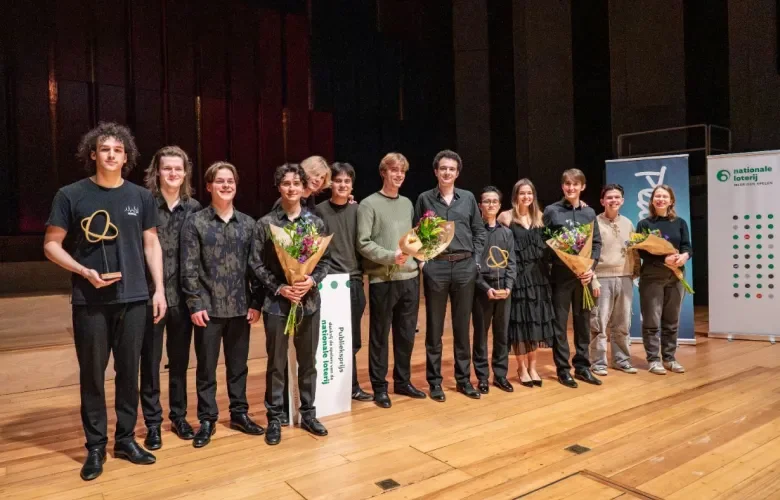
Effel Quartet is a four-piece saxophone ensemble with a tremendous sense of experimentation and adventure. In addition to arrangements by the likes of Claude Debussy and Maurice Ravel, saxophonists Kristof Havasi, David Patyra, Jorge Esteban and Kacper Puczko also present rarely performed works, new creations and visual projects. In this way, they aim to challenge the traditional expectations of a saxophone quartet and build bridges with other artistic disciplines. In recent years, Effel Quartet has performed at the Brussels festival Midis Minimes, the Nuit de la Poésie of Musiq3, the Palais des Beaux Arts de Charleroi and Łazienki Królewskie in Warsaw. In the autumn of 2025, they also toured Brussels care institutions for ‘Klarafestival takes care of you'. In 2026, they will perform the world premiere of Vincent David’s Images.
Structural partners
Klara, KPMG
Event partners
Brouwerij Halve Maan, Gimv | Worxinvest, Interparking, Proximus
Cultural partners
Ancienne Belgique, Belgian National Orchestra, Bozar, Brussels Philharmonic, De Munt | La Monnaie, Flagey, Muntpunt, Museum of Musical Instruments, Passa Porta
Public funding
Nationale Bank, Nationale Loterij meer dan spelen, Stad Brussel, Visit Brussels, Vlaamse Gemeenschap
Media partners
BRUZZ, De Standaard, La Première, La Trois, Le Soir, Musiq3, Radio 1, Ring TV, VRT Eén, VRT Canvas, VRT Max
Festival suppliers
Daniel Ost, Drukkerij VD, Maison Dandoy