Naka Quartet
Supernova Laureate Concert II
Where Is Home?
Coming home in music
A man steps onto the stage, cello in hand. He looks out into the concert hall, spreads his arms and says, ‘Welcome. Tonight, you are not listeners, but participants. Our meeting is an exchange.’ Then he begins to sing and play, and everything becomes clear. He absorbs the audience’s energy like a human antenna and returns it tenfold. The concert hall shifts into an intimate living room. Everyone who witnessed it walks away transformed.
This is essentially how a concert by Abel Selaocoe unfolds. Together with this charismatic cellist, singer and composer, we warmly welcome you to the 21st Klarafestival. As a festival artist, Selaocoe will play three concerts spanning the full spectrum of his musical world. From traditional music from his native South Africa to baroque, jazz, contemporary classical and improvisation: he melds all these influences into a unique body of work, centred on identity and cultural exchange.
The theme of this year's festival is taken from the debut album of Selaocoe’s own Bantu Ensemble: Where Is Home? It is an open question with endless answers – especially in the super-diverse city of Brussels, home to 180 nationalities and 100 languages. Our capital is a crossroads, a refuge, a temporary or permanent home for countless individuals, each carrying their own story. Every day, we feel privileged that our festival can take root in such fertile soil.
Klarafestival 2026 is an ode to the city we call home. During Muziekberg/Mont des Musiques, Brussels musicians will take over the Kunstberg (Mont des Arts) for a day, from the Musical Instruments Museum to Bozar, from the Ravenstein Gallery to the Royal Museums of Fine Arts. And both Radio Lomax and the choir Les Invisibles (La Voix des Femmes Sans Papiers) will perform Brussels songs with diverse roots.
Our mission is to show as wide an audience as possible that classical music is alive and kicking. Even the most familiar works take on fresh life in the hands of the adventurous musicians we surround ourselves with. Prepare to be captivated by Bach's St John Passion as conducted by Maxim Emelyanychev. Marvel at Beethoven and Strauss with the Orchestre Philharmonique du Luxembourg. Rediscover Chopin and Scriabin in a performance by Alexandre Kantorow. Or encounter keyboard phenomenon Anthony Romaniuk: like Abel Selaocoe, he intertwines his own compositions with the established repertoire, from Bach to Björk.
This festival programme features many more musical kindred spirits. Annelies Van Parys completed the 8th symphony of her former teacher Luc Brewaeys. Pianists Kris Defoort and Stephane Ginsburgh pay tribute to their friend Philippe Boesmans, who would have turned 90 in 2026. Abel Selaocoe, in turn, improvises with like-minded souls, both old and new, and performs a brand-new cello concerto by American composer Jessie Montgomery.
None of this would be possible without the support of our partners in Brussels and beyond. Bozar, Flagey, De Munt, Ancienne Belgique, Brussels Philharmonic, Belgian National Orchestra, Passa Porta, BNA-BBOT and the Luc Brewaeys Foundation all contribute to Klarafestival’s unique DNA. Our indispensable private partners include KPMG Belgium, Proximus, Brugse Zot, Gimv/WorxInvest and Interparking. We are grateful for the support of the Flemish Community, the Flemish Community Commission, the Brussels-Capital Region and the National Lottery. Our collaboration with VRT and Klara, meanwhile, is the secret to our success as a broadcasting festival. Above all, we thank our enthusiastic audience who follow us both in the concert hall and at home on the radio and VRT MAX.
For Abel Selaocoe, ‘home’ is much more than a building or a place. 'It can be a spiritual space. It can be people. (...) It can be something you find along your travels.’ For seven years, Klarafestival has been ‘home’ for festival director Joost Fonteyne. His sense of adventure and social connection is more evident than ever in this festival programme. In April 2026, he will continue his journey and pass the torch to Jan Van den Borre. Many thanks, Joost, for the wonderful years!
The Klarafestival Team
Joost Fonteyne, intendant
Jan Raes, chairman
Chantal Pattyn, network manager
Karen Nonomura - violin
Giovanna Sevi - violin
Camille Havel - viola
Boris Benazdia - cello
Felix Mendelssohn Bartholdy (1809-1847)
String Quartet in F Minor, Op. 80, No. 6
- Allegro vivace assai
- Allegro assai
- Adagio
- Finale Allegro molto
Wim Henderickx (1962-2022)
In Deep Silence III. Impression on a Theme from Haydn. String Quartet No. 2
Naka Quartet
‘We want the audience to forget we’re there.’ From their home base in Paris, the members of the Naka Quartet explain that they see themselves as the medium rather than the protagonists. They want to take their audience on a journey of discovery through the musical world of the composers they place in the spotlight. During their Supernova Laureate Concert, with Claude Debussy and Wim Henderickx on the programme, that journey promises to be one of sorrow and hope, tranquillity and freedom. A programme full of contrasts that celebrates music as an art form that goes straight to the heart. Simply put, according to the young foursome, ‘the music has to speak to us.’
They immediately felt that emotional connection with Felix Mendelssohn Bartholdy, the 19th-century German composer who, like no other, translated heartache – often his own – into music. When his sister Fanny Mendelssohn – also a gifted composer – died suddenly in May 1847 and circumstances prevented him from attending her funeral, Mendelssohn withdrew from public life. Seeking a place to mourn, he went to the Swiss mountains, where he wrote his last major work: his String Quartet in F minor, Op. 80, No. 6.
‘The work begins darkly and timidly,’ say the Naka Quartet musicians. Gradually, the intensity and energy increase and ‘moments of deep sorrow resound’. ‘In the third movement, the Adagio, we hear light and redemption, and there seems to be hope for a better future.’ The music unfurls, there is breathing space again. Although that serenity is only an illusion: in the Finale, full of dissonant sounds, fast notes and almost screaming melodies, fear seems to take over. ‘We are lost at sea,’ writes musicologist Kai Christiansen about this string quartet, ‘and doomed to drown in raging waters.’
With Wim Henderickx, we find no raging waters, but calm seas. The quartet perform his In Deep Silence III. Impression on a Theme from Haydn. String Quartet No. 2 (2019) as the third part in a series about peace and quiet. Whereas Mendelssohn's string quartet focuses on ‘turning outward all kinds of internal passions’, Henderickx encourages listeners to ‘turn inward and tap into your inner feelings’. The Belgian composer, who, together with peers such as Luc Brewaeys and Annelies Van Parys, put Belgian contemporary music on the map internationally, was fascinated by the universal human search for meaning and connection.
In Deep Silence III, Henderickx starts from the second movement of Joseph Haydn's Emperor Quartet (1796-1797), a virtuoso, triumphant quartet in C major. For each of the three movements, Henderickx takes one detail from the original as his starting point and transforms Haydn's most famous earworm into an almost unrecognisable soundscape in minor key. By writing a flexible, open score rather than a hermetic one, he also gives the performer a great deal of freedom. ‘We determine the duration of the notes ourselves and can stretch out the time,’ the Naka Quartet emphasise. ‘This makes every concert different, because the audience's attention span also determines how quickly we slow down.’
It's only natural for the young quartet to choose not only classical chamber music repertoire, but also recent Belgian music. After all, ‘contemporary work invites us to ask questions about the composer’s intention,’ they reflect. ‘The Belgian music scene is also very open and interested in innovation.’ The young musicians are only too happy to savour this freedom, always on the lookout for ‘new forms of expression and aesthetics’.
Hanne Schelstraete
Translation: Catherine Grady
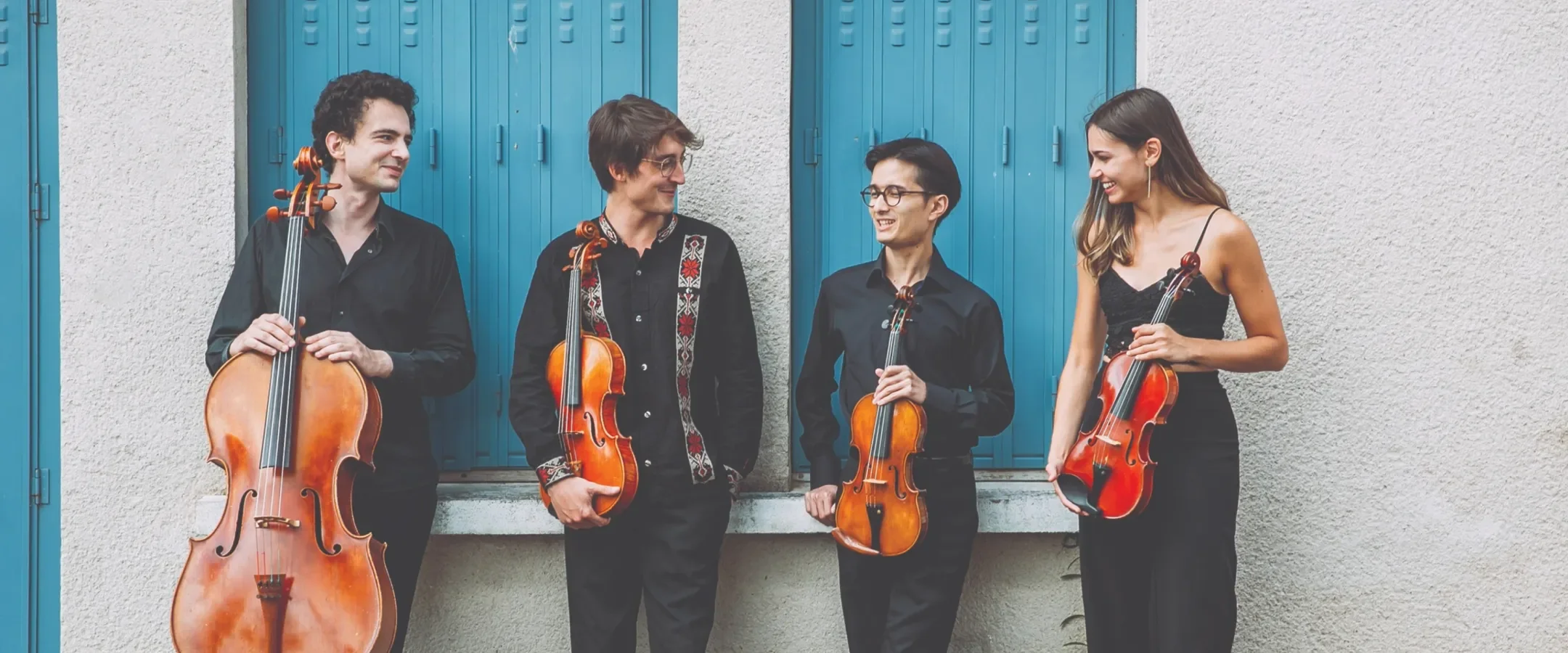
Named after the Japanese word for connection, Quatuor Naka plays music that builds bridges, raises questions and seeks balance. The string quartet, made up of Karen Nonomura and Giovanna Sevi on violin, Camille Havel on viola and Boris Benazdia on cello, was formed in 2024 out of a shared desire to make chamber music a lively place for dialogue and depth. Under the guidance of renowned musicians from the Diotima Kwartet, Silesian Quartet and Quatuor Danel, they developed a musical DNA full of curiosity, passion and a sense of experimentation. On stages in Belgium, France and Italy, they perform classical string quartets and contemporary creations, with a special focus on Belgian repertoire
Structural partners
Klara, KPMG
Event partners
Brouwerij Halve Maan, Gimv | Worxinvest, Interparking, Proximus
Cultural partners
Ancienne Belgique, Belgian National Orchestra, Bozar, Brussels Philharmonic, De Munt | La Monnaie, Flagey, Muntpunt, Museum of Musical Instruments, Passa Porta
Public funding
Nationale Bank, Nationale Loterij meer dan spelen, Stad Brussel, Visit Brussels, Vlaamse Gemeenschap
Media partners
BRUZZ, De Standaard, La Première, La Trois, Le Soir, Musiq3, Radio 1, Ring TV, VRT Eén, VRT Canvas, VRT Max
Festival suppliers
Daniel Ost, Drukkerij VD, Maison Dandoy