The magic of the moment
In conversation with Patricia Kopatchinskaja
For violinist and composer Patricia Kopatchinskaja, music is no dry matter – it is nothing short of existential. When she steps onto the stage, barefoot or otherwise, expect an electric performance that changes how you see the world. Whether she’s performing early, contemporary or her own music, she reimagines each note, guided by the singular energy of the moment. Convention and perfection take a back seat to imagination and adventure.
A portrait of Patricia Kopatchinskaja – ‘PatKop’, as she calls herself – can only be as dynamic as her multifaceted personality. Klarafestival 2025 showcases her vibrant spirit in its many forms. In the staged concert Dies Irae, she addresses the pressing issues of our time. A promising recital with pianist Fazil Say features works by Szymanowski, Beethoven, and new pieces by both performers. And together with Brussels Philharmonic and young conductor Patrick Hahn, Kopatchinskaja will dive into the musical spirit of the 1930s.
In the run-up to the festival, she spoke with intendant Joost Fonteyne and dramaturge Katherina Lindekens about her conception of music and the special ritual of a concert.
JF - In an interview, you once said that the rain was your first music teacher.
PK - Yes, I vividly remember my first impressions of rhythm and melody in nature. People always ask who your teacher was, but you can learn anywhere. Music is more than what’s written down in scores. In fact, Busoni said: ‘As soon as you write down music, you kill it.’ You literally capture it in a rigid form. So, in order to perform music, you have to take it off the paper and bring it back to life. A performance is a personal encounter. I interpret what happens between the work and myself – here and now, without the mediation of theories or traditions. I invite the audience to join me on that adventure. Sometimes things go wrong, and that's okay. I think it's important to embrace mistakes and imperfections. We’re human.
KL - You are both a violinist and a composer. How do those two identities relate to each other?
PK - I don't distinguish between creative processes. In fact, I don’t believe compositions are owned by anyone – not even the author. The material is all around us. As a creator, you are simply capturing something that is already there. It’s a privilege to be able to hear it, write it down and play it. The composer is not a god, with musicians as servants. No, we are all part of that creative process. The score is a stopover, where the material is preserved for a while. But then we have to bring it to our time and interpret it in a language that everyone understands. When I play early music, I am not in a distant past. Of course, I want it to sound as surprising and revolutionary as it did back then. But I am in the now. My listeners live in these times. They know what nuclear threat and climate change are; they know Spotify and A.I.
KL - So the audience is a crucial interlocutor?
PK - Absolutely. Without the audience, we don't exist. There is also no wall between player and spectator, although you might sometimes think there is. It seems as if the concert hall has taken the place of the church: the musicians are at a safe distance, and people are only allowed to applaud. I would like to desecrate that sacred setting. As far as I’m concerned, the stage can be a playground. Play with the music. Live it, over and over again. Move it! What is our duty as artists? First and foremost: not to bore our audience. Next, we have to be as authentic as possible. We stand onstage as our fragile, naked selves, but with a strong message.
JF - I also see artists as questioners, inviting us to reflect.
PK - Artists often see the world in a slightly different light. As a result, they also pull people out of their comfort zone. A concert hall is not a wellness centre. It’s a space for entertainment and beauty, sure, but also for fascination, confrontation, provocation. As an artist, you show a mirror of your soul. Only in this way can you uncover a fraction of the truth, which always has many layers. That's also why I don't think art can be apolitical. Politics is about us and art is about us. We’re not aliens. We’re here, we’re a community.
JF - Do we reduce art to beauty? After a concert, people often ask each other: ‘Did you like it? Did you enjoy it?'
PK - Yes, whereas the question should perhaps rather be what a concert did to you. That experience can be about beauty, but about so many other things as well. Beauty is an elastic and personal concept. Just think of Francis Bacon's agonised paintings, Munch' s The Scream or Hieronymus Bosch's hellscapes. Or take the faces of Frans Hals: if you look at them close up, they’re far from perfect. You need some distance to experience their power. A dissonance in Kurtág's music, that's beauty.
KL - Back to your call to embrace imperfection. Coming from such a phenomenal violinist, it sounds almost paradoxical.
PK - For me, it's mainly about integrating art into life and vice versa. I learnt a lot from the folk music I heard in my childhood, which was very functional. There was dance music, and music for funerals and other rituals. Invariably, it was structured in such a way that you couldn't help but dance or cry. That kind of directness is deeply rooted in me. Music is never really abstract. It’s there to do something with. Even when it has no concrete message or intention, it appeals to us. It wants to be heard. I don't believe in absolute music. Not really.
Text: Katherina Lindekens
3 x Patricia Kopatchinskaja
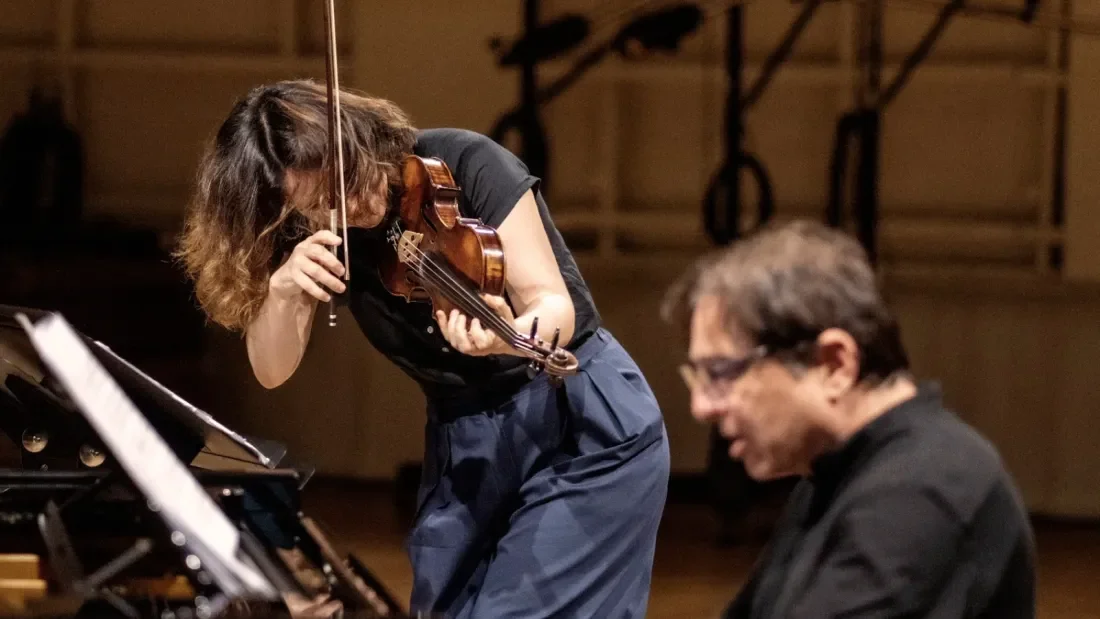
Patricia Koptachinskaja © Marco Borggreve