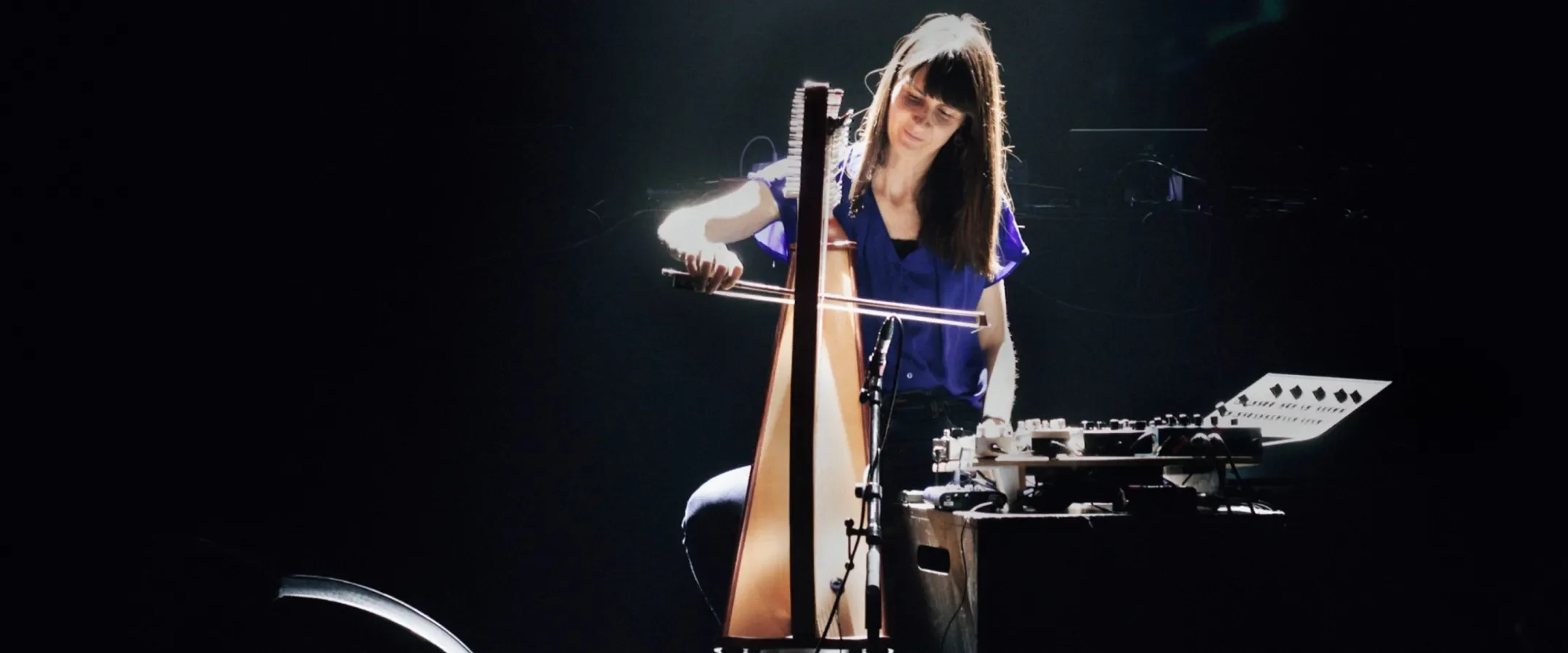
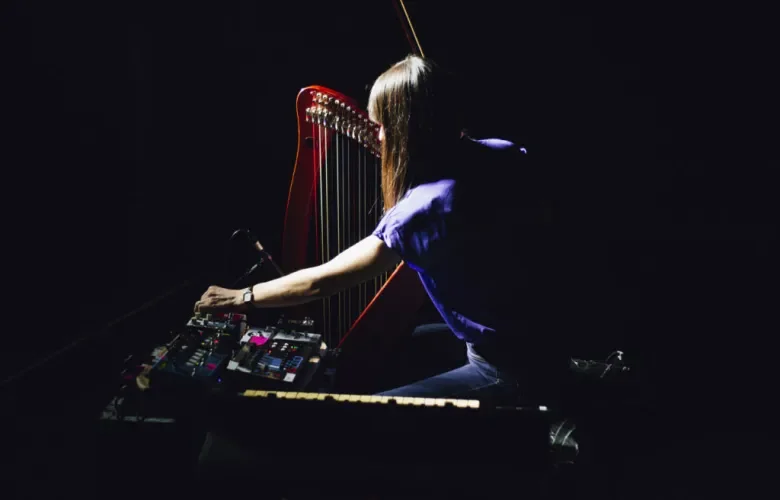
Composer and harpist Margaret Hermant is a co-founder of ensembles including Echo Collective, but she also creates mesmerising solo sets for harp and electronics. At Klarafestival 2026, she will present her first solo album Freedom in avant-première. A few weeks before the official release, we meet her at Bozar for a discussion about the importance of freedom in her musical practice. There is no better place than the vibrant heart of her hometown, Brussels, to ask her the festival’s central question: Where is Home?
Brussels is your home base. What is your relationship with this vibrant city?
I’ve lived here for twenty years and I still find it a fantastic city. As an artist, it’s particularly enriching to live among all those diverse cultures. Brussels is a vibrant artistic hub, a mix of different styles and genres – from dance, circus, film and music to visual arts – everything comes together here. At the same time, cities like Paris, London, Amsterdam and Berlin are within easy reach; that makes this city even more appealing.
What makes you feel at home here?
I grew up in a village in the countryside, where outdoor life played an important role. Our home in Brussels has a small garden, which allows me to relive that feeling to some extent: we tend the garden, care for the chickens, and spend a lot of time there in the summer. I greatly value these small daily rituals and seemingly simple things. They contribute to my sense of well-being.
What sounds do you associate with Brussels?
At home, I rarely listen to music; there’s mainly peace and quiet. Although Brussels is a large city, it can be surprisingly silent. I live on a peaceful street and really appreciate its calm atmosphere. There’s also a homely atmosphere in the city because of the many houses so close together.
As a musician, you’re often on the road. What do you do to carry that feeling of home with you?
For me, 'home' is more a feeling of safety, well-being and connection. I can feel at home anywhere, as long as I’m in good company. So far, I’ve been fortunate to work with people who are dear to me and feel like family. That is why I also feel so at home on stage. It is a magical place: everything happens live, in the moment and in direct contact with the audience. Sharing that moment together enhances the experience and gives me energy.
Did you inherit your love for music from home?
At home, the radio was on all day, from early morning until late at night. My parents would play records, either classical music or spoken word recordings. As a child, I would listen endlessly to the music from the cartoon Fantasia, alongside my brothers and sisters. Often, it wasn’t just listening; we’d dance around the whole room. My younger sister and I also frequently sang songs from The Sound of Music and acted out various scenes.
Did you start playing music at a young age as well?
I began playing the violin when I was four, following the Suzuki method. I’m still grateful that I encountered music in this way. It’s a very natural approach to music, entirely based on ear training. We were taught by an inspiring teacher who ignited a lasting passion for music in me and many other students.
Were there other people who inspired you during those formative years?
Throughout my musical journey, I’ve had the privilege of meeting remarkable individuals, each of whom has had a lasting impact on my artistic development in their own way. At the conservatoire, I was afforded the freedom and trust to discover my own musical voice. This is essential for a musician: it forms the foundation for autonomous growth. Alongside that, meeting Adam Wiltzie, Dustin O’Halloran, and Neil Leiter, fellow musicians at Echo Collective, was artistically enriching. They opened the door for me to a new musical landscape and field of experimentation. I also had the opportunity to tour with Jóhann Jóhannsson; a pivotal moment in my career.
Besides being a violinist, you are also a composer and harpist. Is there an instrument with which you feel most at home?
For me, an instrument is a means of sharing a particular emotion and energy through music. Each instrument has its own character, which contributes to the expression of what I feel and wish to articulate. I particularly love the melodic aspect of the violin. Currently, I feel most connected to the harp, as there’s still a whole world of sound for me to explore. Experimenting with it and searching for my own voice is incredibly liberating.
Is it that freedom you want to share in your new album Freedom, which you will present at Klarafestival?
Freedom did indeed arise from that personal need. I wanted to let the harp shine in all its versatility and delve deeper into the combination with electronics. I gave myself the freedom to explore that palette of sounds and colours down to the smallest detail. For the album, I collaborated with an orchestra, but during the concert, sound engineer Fabien Leseure will accompany me. He will add an extra dimension to the harp sounds live, without intending to replace the orchestra. For me, that combination with electronics offers immense freedom, and I want to share that feeling with the audience.
Interview by Fauve Charlier and Aurélie Walschaert