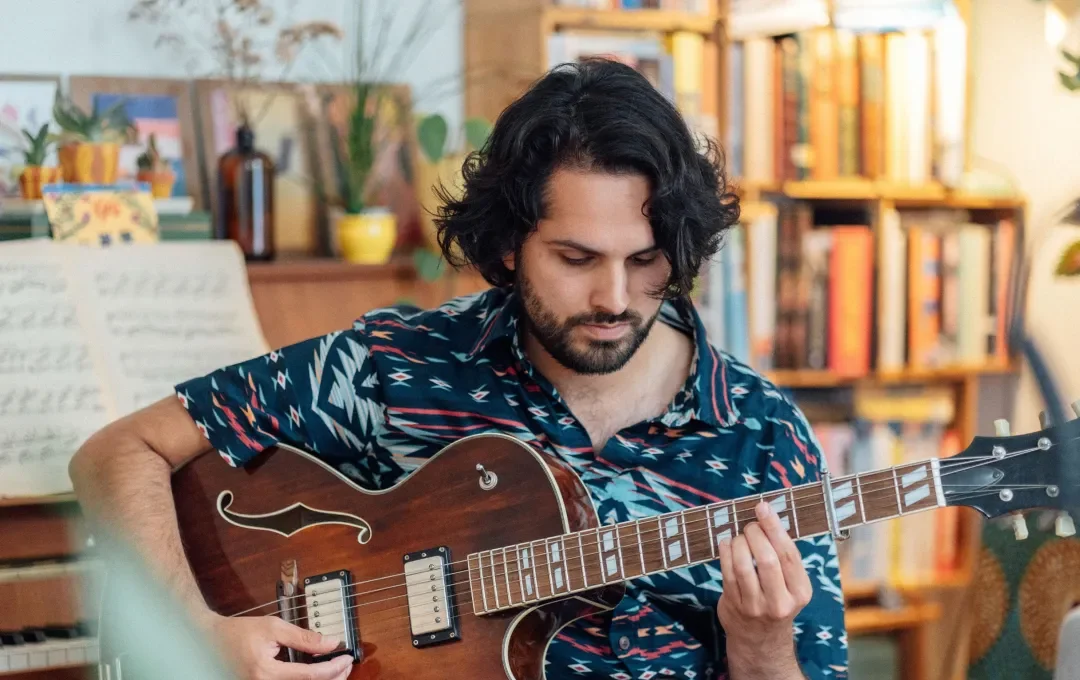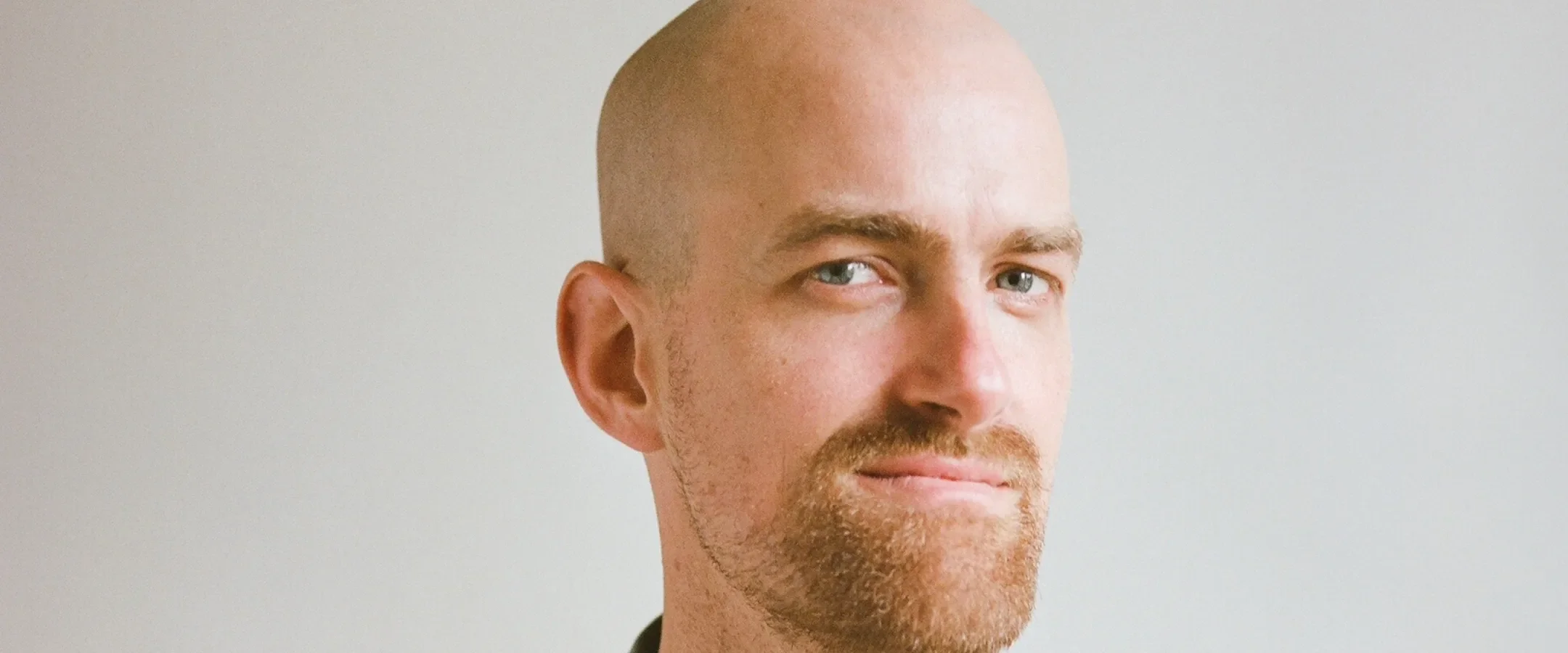
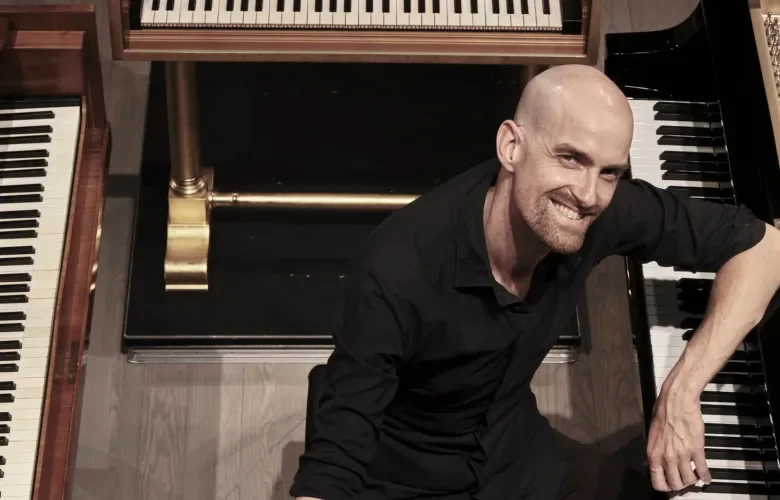
Keyboard prodigy Anthony Romaniuk travels effortlessly between classical, jazz, improvisation and ambient music. At Klarafestival 2026, he will present his solo album On Modes. On this brand-new record, he interweaves a rich array of his own music with compositions by Pärt, Adams and Ligeti. Along the way, he also arranges pieces by Radiohead, Björk and other artists. A few weeks before the release concert, we spoke to him about the album, his adventurous journey, and the festival’s central question: Where Is Home?
What role did music play at your home?
How much time do you have? (laughs) It was mainly through my father that music came into my life. My grandfather was a folk musician in Bukovina, a mountainous region that used to be in Romania, but is now part of Ukraine. Although my father did not become a musician himself, he did grow up with music. During the Second World War, like many others, he fled to the southern hemisphere, and if we fast forward, that’s how I came to be born in Australia. I think music had an emotionally stabilising effect on my father. He had a small record collection, which he played incessantly. That music was always there, as a soundtrack to our daily lives. I am the youngest of five children, and each of us also had music lessons. There was always someone playing.
What is your earliest musical memory?
Hmm... I don’t think I really have one. I could make something up, but as I’ve just come back from a ten-day silent retreat, I’d rather be honest. (laughs) What I do remember is the first time I felt the emotional impact of music. That must have been around the age of eleven, when I discovered jazz. Before that, music had always simply been there, without my having a strong personal connection to it. But when I heard the album Steamin' by Miles Davis, I didn't know what had hit me. For the first time, I felt that music could mean something, that it could absorb you totally. Music can make you a more complete person, and become part of who you are and what drives you.
What made Steamin' so special for you?
There’s an inherent coolness to that record, a self-assuredness that contains a certain optimism. What is coolness, when you think about it? Essentially, it’s the result of self-confidence. Knowing who you are, and being at peace with that. We all experience insecurity when we’re young, so Steamin' truly inspired me. I wanted to become that music.
Were there other people who inspired you during those formative years?
My first piano teacher was more of a guide than a teacher. I still remember the most important advice she gave me: pay attention to your posture and distribute your weight, 'from bum to thumb'. Plus, she really gave me the space to develop myself independently, which was wonderful. I mainly developed my technical skills in my twenties, when I was quite nerdy about Charles-Louis Hanon’s drills (from Le pianiste virtuose, ed.). I worked through those technical exercises every single day. Thriving on that kind of structure is a bit of a personality quirk of mine. (laughs)
You started out as a pianist. When did the harpsichord and the pianoforte come into the picture?
That was in my mid-twenties, when I was studying in New York and meeting other fascinating people. They introduced me to baroque music, which I adored but was unable to interpret on the piano. That's why I also started learning the harpsichord. Later still, in The Hague, I discovered the pianoforte and changed majors yet again. (laughs)
Which of those instruments do you feel most at home on?
No matter what keyboard I sit down at, I always find ways to make it work, by prioritising sound production. That adaptability is my greatest strength, I think. But I remain a pianist at heart. The mechanics of a hammer and a string are simply what I’m most familiar with. I grew up with that instrument, and that development has never stopped. How do you continue to grow as a musician after completing your studies? That, to me, is an intriguing question and a significant challenge. In my opinion, On Modes is my best work to date, and I'm quite pleasantly surprised by that.
On the album you also incorporate electronics. How do they relate to your acoustic instrumentation?
I listen to a lot of electronic music and enjoy experimenting with it, but I certainly wouldn't call myself a technically proficient electronic musician. Still, that world has influenced my thinking. For example, one of my recent works is a kind of analogue reimagining of a synthesiser improvisation – although I only realised that afterwards. For On Modes, I worked in a beautiful studio in Berlin, with a wealth of tape delays and other analogue equipment. I simply had to make use of it all. I am very grateful to have been supported by two brilliant producers, one of whom is a Belgian friend of mine, Jo Thielemans.
You spend a lot of time on tour and have lived on different continents. What is it like to have such a changeable home?
I was 18 when I left Australia, and I’ve moved several times since then. I lived in New York for six years, in The Hague for five years, in Brussels for six years, and in Antwerp for seven years. I’ve been living in Madrid for three years now, where I almost feel more 'at home' than my Spanish wife. (laughs) Look, of course there are advantages to saying, 'This is my place. These are my people. This is where I want to root myself.’ In that sense, I may have disadvantaged myself. But it’s also quite instructive to change your home from time to time. It gives you the opportunity to ask yourself: who am I in this environment? How do I position myself in this new context?
Have you discovered what 'home' means to you?
Again, it's all about adaptability. For me, home is change, movement. It is not a fixed place. Home is the passage of time, the passing of places. It’s more about letting go than holding on. There is a kind of peace in that – at the risk of sounding increasingly Buddhist. (laughs)
Is there a particular sound you associate with any of your home towns?
My standout example would be New York, where you hear an unbelievable cacophony of sirens, the subway, and millions of people around you. I adored living there. But music, too, is inherently connected to its environment. Listening to bluegrass, for example, is a completely different experience in North Carolina than in West Africa.
Do you have rituals that make you feel at home when you're on the road?
I meditate every day and am a big coffee snob. (laughs) I take my AeroPress and hand grinder with me everywhere and seek out the best coffee shops in every city. It’s a way of connecting with the place where I am.
Do you feel at home on stage?
In a sense, yes. Although now I’m reminded of a 16th-century treatise that says a performance is not an exchange between artist and audience, but a collective gathering. Ideally, everyone looks at the centre of a space together. It is in that shared experience that the possibility of magic lies. The Spanish word 'duende' sums this up beautifully: the moment we are taken over by something bigger than ourselves.
How would you describe your connection with Brussels?
To me, Brussels feels like a crossroads of cultures. It’s not a big city, but it is becoming increasingly cosmopolitan. This confluence of worlds brings with it a remarkable vibrancy. Brussels is big enough to be truly welcoming. It’s a place where you can be completely yourself. I enjoyed living there.
You'll be back soon, for the release concert of On Modes. How did the idea for this extraordinary album come about?
During lockdown, I started playing John Adams' Phrygian Gates. The work resonated with me so powerfully that I wanted to build a programme around it. As the title reveals, it is written in Phrygian mode (a specific scale, ed.), and I knew pretty quickly that I wanted to explore the expressive power of this and other modes.
What draws you to modes?
Even more than the major or minor keys, modes each tell their own story. They are scales that exude a myriad of colours and moods, and that can transport you to another world in the blink of an eye. The mixolydian mode, for example, sounds bold and defiant, while the Dorian feels more pensive and radiates a gentle optimism. Each mode puts you in a different emotional state, without your needing to know anything about it. And so we return to the listener who becomes the music. A sound emerges, and there is life in that sound, and that life can express an infinite number of things.
How did you engage with that modal language?
It was a long process of reflection and exploration. After all, modes are primarily found in early music and jazz. There is little modal repertoire for pianists, which basically meant I had to create repertoire. In addition to Adams' work, I selected a few 20th-century pieces by Pärt and Ligeti. But beyond that, the album consists entirely of my own compositions, improvisations and arrangements. It was an important step for me to develop my own voice. The album is being released on a classical label (Alpha Classics, ed.), but to be honest, I have no idea what genre I should describe it as. It's not jazz, not ambient, not electronic music, and not neoclassical.
Maybe it's simply your own genre? A blend of influences that have percolated through your unique filter?
That's exactly right. (laughs)
Fauve Charlier & Katherina Lindekens