sun, beach and climate change
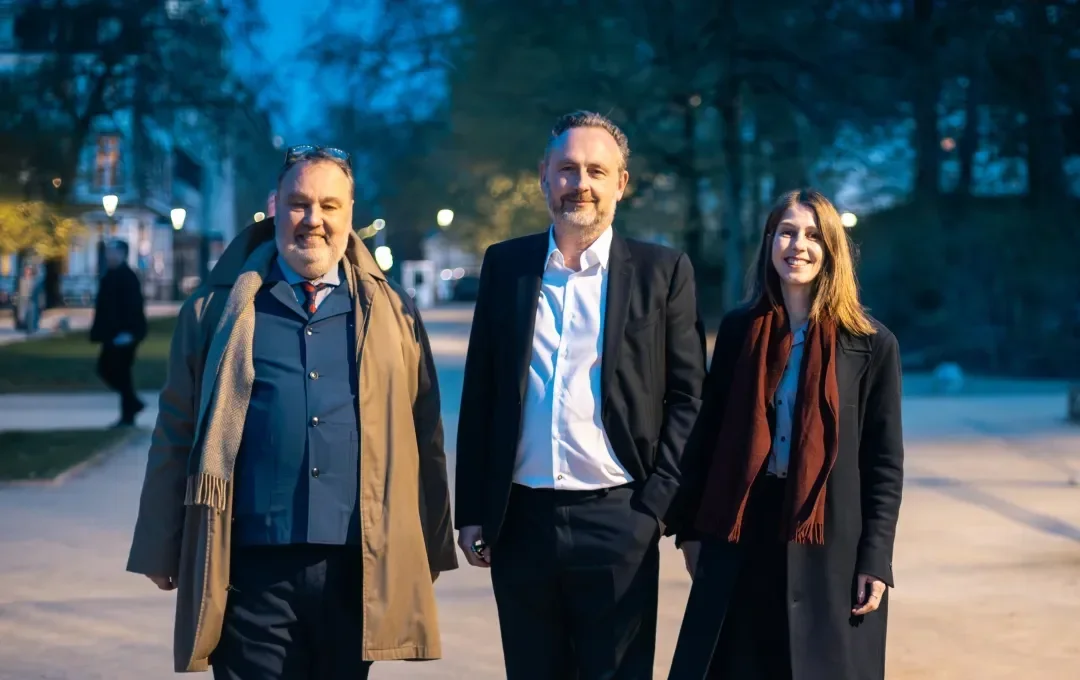
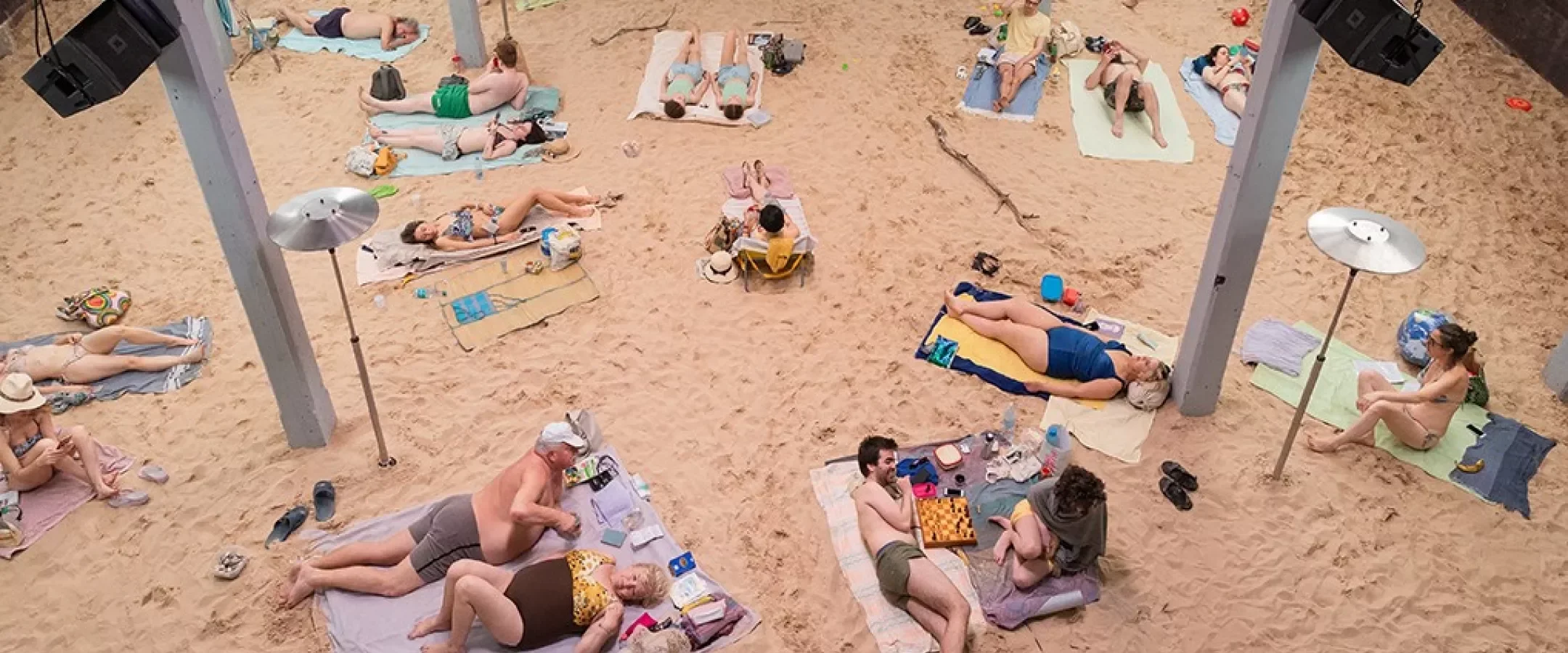
During Klarafestival, the internationally acclaimed opera performance Sun & Sea will have its Belgian premiere. We sat down with the three artists behind Sun & Sea: director Rugilė Barzdžiukaitė, writer Vaiva Grainytė and composer Lina Lapelytė.
Vaiva Grainytė, Lina Lapelytė and Rugilė Barzdžiukaitė: you all come from very different backgrounds. How did you three meet?
Vaiva: We’ve known each other since we were teenagers. We’re not only colleagues, but also good friends. We all grew up in Kaunas, the second biggest city of Lithuania, so we share a very similar collective memory. Lina and I used to hitchhike and hang around in underground concerts, while Rugile and I studied at the same school for photography. I am sure that our friendship and our shared memory are the core of our collaborative practice.
Lina: It’s also an intellectual friendship. We share some of the same worldviews and have similar feelings towards many things, towards living...
Rugilė: And yet another kind of friendship evolved while embarking upon our first project together, when we realised how closely our ideas resonate artistically.
Sun & Sea wasn't your first collaboration. In 2010 you already created Have a Good Day! together, which equally was a big success.
Lina: The opera Have a Good Day! for 10 cashiers, supermarket sounds and piano brought us together artistically. That particular work dealt with the circle of buying and selling, consumerism, capitalism... The cashier in the supermarket became a metaphorical figure reflecting each of us. While we were touring with Have a Good Day! and focusing on our own practices, we slowly started to develop Sun & Sea. We later discovered that our new opera was actually a continuation of the theme of consumerism and the collective voice, but this time taking the topic further: to the consumption of the planet and the joy of it.
And to address the topic of climate change, you chose to set your next opera amidst an artificial, crowded beach. Why?
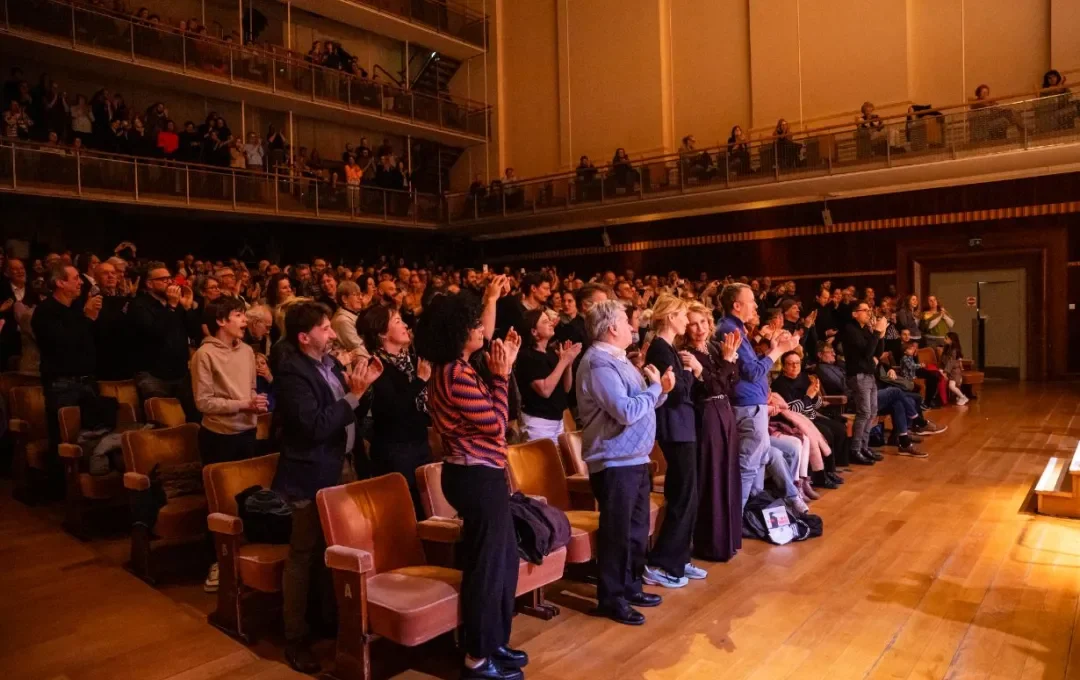
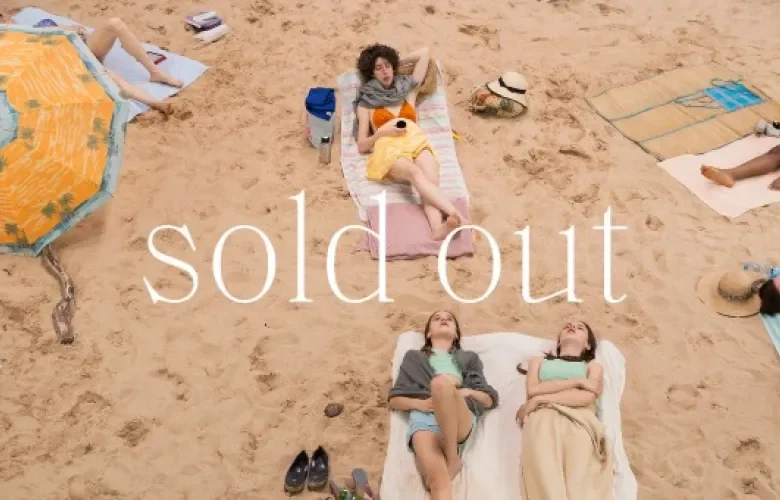
Rugilė: The initial intuition we felt when imagining a singing beach was the relation between our bodies, which are fragile and mortal, and the bigger, cosmic body of Earth, equally fragile. It is also very light and a bit funny, too. If you look at it from a distance, beach rituals make the human species look more peculiar than any other sea or sky creature. The fact that the beachgoers are also singing makes the experience even more surreal. At the same time, the irony of it all helps to transmit difficult topics in such a way. It makes them easier to grasp.
Sun & Sea must have been a challenging project to realise. What would you say was the biggest challenge?
Vaiva: After realising that our singing beach would somehow tackle the topic of ecology, we ended up being totally perplexed as ecology is quite a complex and alarming problem. How could something like that be put into lines? What should these lying bodies tell us or sing to us? Who are they? How not to be prophetic, but rather talk in both an effective and a subtle manner?
Lina: Besides wanting to make something good and staying true to our ideas, the biggest challenge in the midst of all the financial, conceptual and productional issues was to stay sane. To keep in tune with each other.
Was it hard to find a common language?
Vaiva: It’s like living in a dormitory and having a shared kitchen. All the ingredients of the piece are being cooked together during collective sessions. Although, when it comes to specific tasks and competences, we have our private rooms, our own territory. But because of the aforementioned dorm mode, this privacy is constantly interrupted and ‘inspected’. That is to say, it is an overwhelming process!
Lina: We do come from very different backgrounds. Vaiva is a writer and a poet, who studied theatre criticism, Rugile is a documentary filmmaker, who studied theatre directing, and I am a musician and performer with a degree in sculpture. When we work, we first develop the conceptual framework together. Later on, each of us become instrumental in fulfilling the specific tasks. Vaiva writes the text, which I put into a musical score, and Rugile takes care of everything visual. In Sun & Sea, the performers also played a very important part in how the piece was developed. We all participated in selecting the performers, absorbing, listening to them.
Vaiva Grainytė, your work has been described as "reflections on everyday life", "equipped with the gaze of an ironic anthropologist". Are these elements also present in the libretto you wrote for Sun & Sea?
Vaiva: Yes, indeed. The topic of climate change itself is utterly threatening, and fuelled with despair, let alone grief. It was quite a challenge to find the proper language for the piece: there was the danger of repeating the predominant doomsday rhetoric or suggesting a solution and so to end up being moralistic. Whereas humor and irony allow for melancholy to enter through the back door. The libretto of the piece is set as a mosaic of stories, inner monologues, and thoughts, sung in solos and as a chorus. This soup of stories might sound like a mundane and carefree buzz: some lady complaining about messy dogs, a vegan boy sharing his dream he just had about visiting a seafood restaurant,... But through this poppy and synthetic ocean of songs, one can feel the threat throbbing: jellyfish dancing with plastic bags, water as green as the forest, a vacationer wearing a swimsuit labelled “made in China”,.... All these micro-narratives somehow refer to consumeristic pleasures and inertness. They’re a joint outcome of research, own experiences and the personal encounters we had with the singers.
Rugilė Barzdžiukaitė, what has been your approach as a theatre director? Did your background in cinema affect how you staged this live performance?
Rugilė: Before starting to work on Sun & Sea, I was making a film called Acid Forest, where humans arrive at a tourist attraction and are observed by the birds from above. The interspecies hierarchy was reversed, so that humans were perceived as tiny creatures, ants of some sort. This experience helped to nurture the idea of looking onto a beach from above as a superficial and anthropologically rich situation, with hot ecological topics inside.
Lina Lapelytė, your compositions often approach singing as a collective event, shared by both professionals and amateurs. What about your composition for Sun & Sea?
Lina: For me music is sculptural. I rarely think about sound alone or for the sake of its own beauty. Working with different people and different musical abilities teaches us about tolerance, patience and slowness, and I like being reminded about this. For my latest, ongoing work Study of Slope I invited tone deaf people to go on a musical journey together. In Sun & Sea, the musical material came out of the close observation of the people we decided to work with. Most of the arias were composed with a specific singer in mind. The collective aspect of music making and resonance that can be achieved by a group of people is something that interests me a lot. The single voice that turns into a collective voice has a lot of power, a power that goes beyond the music itself.